Dandelions on the Lawn of Empire: A reflection on the goodness of weeds
Lanni Lantto
Texts: Matthew 13:31-32, Zechariah 1:8-10, Isaiah 55:13 and 41:19
“We are dandelions on the lawn of Empire.” When Wendy Janzen of Burning Bush Forest Church spoke those words at a Wild Church Retreat in Ontario, Canada, the entire audience began scribbling it down in their notepads.
Wendy was referring to how we were coming out of the religious narrative of what it means to be ‘church’ in the world. Many of us spent our upbringings inside the walls of church yet felt a longing for the wilderness. We sought the healing, holy connection, revelation, and wonderment that was once a part of our ancient Christian roots- but through centuries of disconnect, had now made us outcast misfit exiles.
As revivers of that Mystery, we were dandelions; persistent ‘weeds’ popping up on the nicely mowed lawn of the Parishes and Cathedrals. What drew us together was that we were done trying to find health within dysfunction. We had each experienced our own form of indoctrinated shame and judgment and we were coming to realize that our dandelion status could actually be a healing source for others still in anguish.
When we begin the process of coming out of denial of our adverse religious childhood experiences, we are able to spot how we were raised within other ‘walls of dysfunction’ as well. This includes our family narratives. Breaking century-long cycles of generational trauma is not easy (or fun) so it’s good to focus on the positive stories -especially the ones that involve dandelions.
My mother recalls that as a young girl, her grandmother would pick dandelions from the church lawn after mass to bring home and cook for her family. My great-grandmother, Nellie transitioned at the age of 110 years old. My mother and I, along with my grandfather Paul, would make trips to the Italian neighborhoods of Sault Ste. Marie, Michigan i.e. Bawating Mishigamaa in Ojibwe. In her long smock apron, she would take me out to her small garden that bordered an old alley. She showed me her tomatoes and beautiful colorful array of flowers but sadly, one thing we never did together was eat dandelions. I wish she would’ve passed on her knowledge to me because I spent the majority of my life being taught that they were, by their nature, delinquent beings.
My teachers were the cultural narratives with the loudest most dominant voices. They encompassed politics, religion, history and even the food pyramid. I navigated their narratives with a mix of blind trust and guarded skepticism. Within the empire, dysfunction shape-shifts so deceptively that one can assimilate into the muck without knowing they are even in it. It can be really hard to find healthy soil. So I, literally, left the trappings and walls of empire and moved into the wilderness.
To truly know what a dandelion was I had to spend time with them. I watched how its waterproof seed head dispersed seeds over considerable odds. It resiliently burst through the concrete of our retaining wall; it grew back after being mowed over, it offered a haven to the pollinating bees, and my daughter would poke the circular droplets of water that formed atop the yellow bouquet with her fingertip. She giggled as she saw her own reflection within the water and it was as if her soul was meeting healthy soil.
What I learned was that the dandelion was fulfilling its purpose within a wider ecosystem simply by being alive (and dying). Within the natural world, there exists a water purification system filtering out bacteria through layers of soil, sand, and rock. It becomes purified at its roots so it can become a source of health and healing. Its presence illuminates an alternative path within the world where a weed becomes a remedy.
What I love about Jesus is that he did that all the time. Those deemed weeds by empire, are deemed worthy by the great I AM, like the invasive mustard seed that becomes “the greatest of shrubs” Matthew 13:31-32. In times of great hardship, my grandmother turned to the dandelion. I wonder if this is how God felt about the myrtle tree. Reference: Zechariah 1:8-10 and Isaiah 55:13 and 41:19. This simple plant becomes a symbol of enduring peace, divine favor, beauty out of desolation, eternal promise of renewal and the knowledge that God is actively in control.
A part of reconstructing my faith life is embracing being a weed. And then surrendering any control of changing anyone or anything except for myself.
The dandelion doesn’t get to choose where it grows. It must take its inner knowledge with it wherever it lands. There is a deep ancient wisdom within each seed that transcends empire. It’s the kind of remedy that I want to partake of- the kind that I want to tell my children about. That to be a healing dandelion is to be able to grow in all types of landscapes and be therapeutic without barriers.
When I returned home to my chosen family and chosen wild church community, we continued to do what we did in Ontario where Wendy first spoke those words. We sat down in circle and shared how we each felt like a weed and through or listening and resonating, we began healing.
By this simple act of self-reflection, each one of us is committed to the daily hard task of purifying our roots. To look at what formed us and how we became who we are and then, from that understanding, move towards who we want to be. It’s the most counter cultural task of our lifetimes: to become the remedy and pass on the wisdom of the dandelion to our children.
Author Bio
Lanni Lantto is curator of the non-profits U.P. Wild Church (www.upwild.org) and Shepherds of the Wilderness’s the Healing Forest in Anishinaabe Akiing Upper Peninsula of Michigan.
Image Description
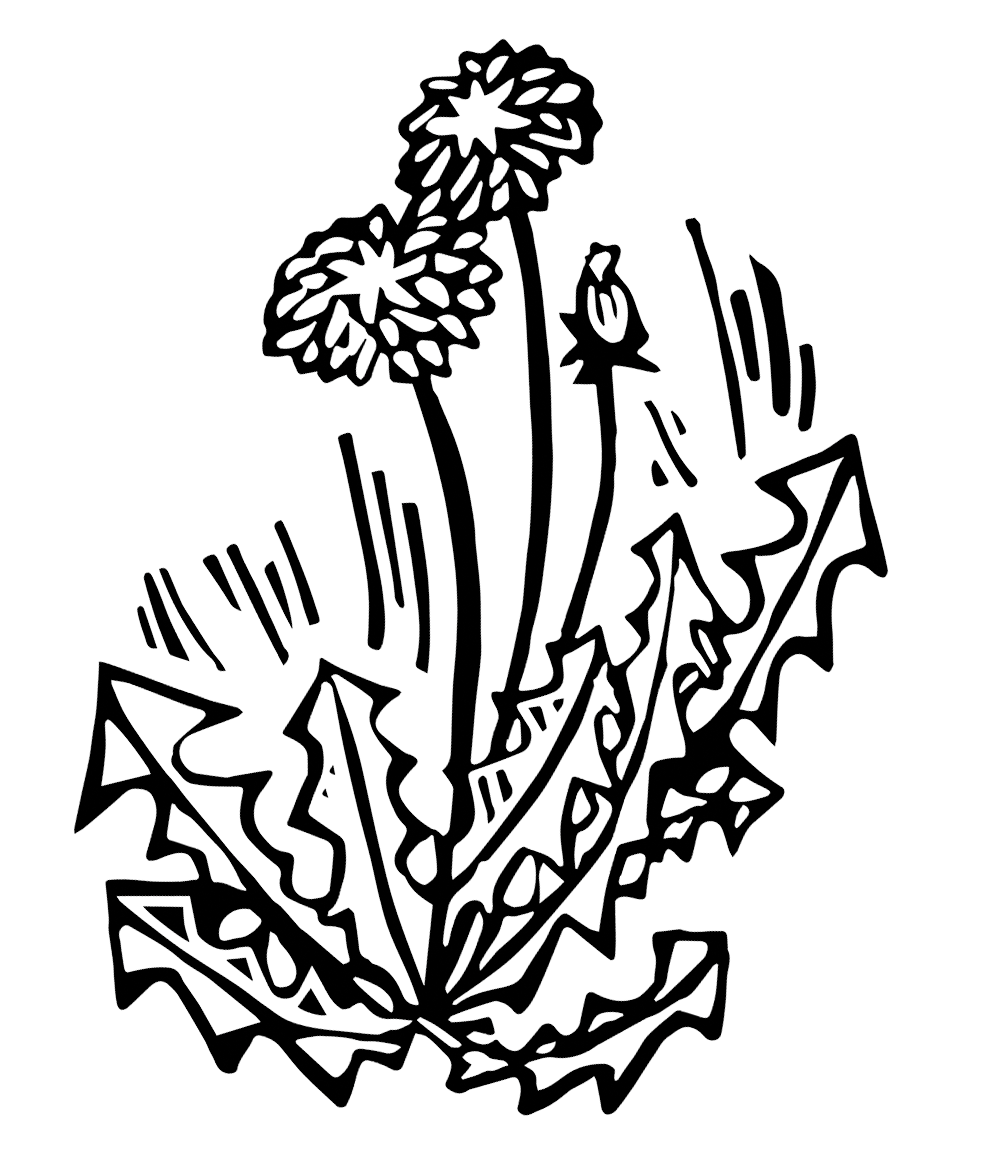
Dandelion fabric stamp by Sarah Fuller is black on white background. The top half of the image is three dandelion flowers, two are open one is in a bud. They spring up from a cluster of seven jagged leaves at the bottom of the image.