
Body in Creation: Eleventh Sunday After Pentecost, Yr A
Rev. Alecia Greenfield
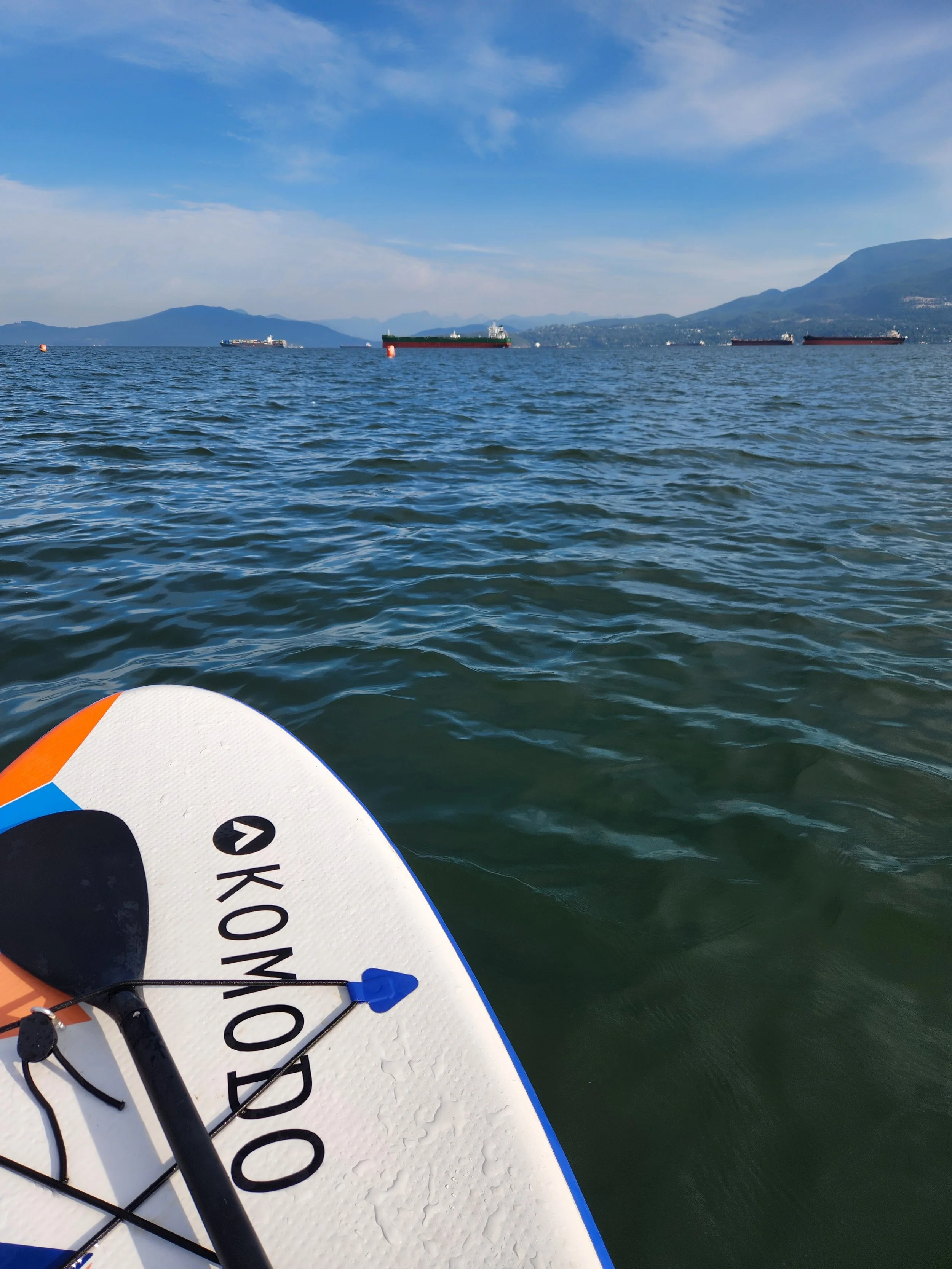
I study these passages while reading Deep Listening by Emily Kasriel and facilitating a series of workshops on Holy Listening. While none of these texts are explicitly about listening, I am paying particular attention to my own attentiveness this month. In both the Genesis story and the Gospel, we read a series of stories that are careful to name places, or identify wind, water and mountain top. How do we listen deeply to the land in these stories? How might we listen deeply to the land in the stories of our own place? This week with these readings I put my body into creation and listen to the water. (For example, on my paddleboard this summer)
*image, photo of Vancouver Harbour from my paddleboard.
Then when I listen to these stories, I hear lessons for change. In the face of climate change and ecological injustice, there are stories of people who can take the risks required to change.
Commentary
-
I notice the many places that are given names.
1- Jacob lived in the land (where his father had stayed), Canaan.
2- This is about Jacob’s family; Joseph is a tattle tale (or tells the truth about his brother’s activities)
3- and Jacob loves Joseph best, and gave him a special robe
4- Joseph’s brothers see that he is the favourite and cannot speak kindly to Joseph.
The stage is set: in the land lives a family with family tensions.
(Verses 5-11, Joseph dreams dreams and tells his brothers and father the truth of his dreams. In these dreams the father and older brothers will bow down to (the youngest) Joseph. The rest of the family is not pleased)
12- The brothers are grazing flocks near Shechem
13- Isreal/Jacob sends Joseph to his brothers in Shechem
14- Joseph is sent from the Valley of Hebron to Shechem (over a hundred kilometres) and instructed to bring word back news (truth) on how things are going with the brothers and the flocks
15- Anunidentified man finds Joseph wandering around fields and asks him what Joseph is looking for
16- Joseph says he is looking for his brothers who are grazing flocks
17- The man heard the brothers say they have moved to Dothan (23 kilometres away), so Joseph goes to Dothan, where he finds the brothers.
18- The brothers see Joseph in the distance and plot to kill him.
19- Brothers identify Joseph as the dreamer
20- Murder plot: kill him and throw him into a cistern (a place to hold a liquid, usually water), say that animals killed him. Brothers reference the dream: what will come of the dream if Joseph is dead?
21-Brother Reuben argues against killing
22- Ruben suggests trapping Joseph in the cistern but not killing him (the narrator tells us Ruben plans to return Joseph to their father.
23- When Joseph joins his brothers, they take the special robe.
24-and throw Joseph into an empty cistern
25- lunch break. While eating, the brothers see a caravan of merchant Ishmaelites (note: a side branch of the Abrahamic family) going to Egypt.
26- Brother Judah notices opportunity for gain
27 – Judah suggests selling Joseph, instead of killing a brother. The other brothers agree.
28- When Midianites (nomadic people from Arabia)/Ishmaelites come by the brothers sell Joseph for 20 pieces of silver, and Joseph is taken to Egypt.
Connecting to Ecological Themes in Genesis 37:1-4, 12-28
-Listen to the identification and repetition of place names—Canaan, Hebron, Shechem, Dothan, (merchant Ishmaelites are likely from Arabia), Egypt. The whole story is set in the specificity of a place, and we know when we are in a valley or field.
-This passage is the beginning of a series of stories about truth telling. Joseph is a consistent truth teller. Jospeh tells the truth of his brothers’ bad behaviours, tells the truth about his dreams, even when telling these truths make him unpopular. In this small part of the story, Joseph is sold into slavery, (with the brothers referencing his dreams as the reason). In the larger story Joseph continues to tell the truth even when it is dangerous. For example, telling a king about future famine. This capacity to see and say truth ultimately leads to the salvation of his family from starvation. Telling the truth of environmental and social injustice is often not popular. We might be living the part of the story that is dangerous truth telling. Still, our community’s salvation requires brave truth tellers.
- This passage is the beginning of a story that shows a significant character change. At one point in this story, all the brothers plot to kill Joseph. As our passage continues, the brother Judah sees an opportunity for practical gain and suggests selling Joseph (acknowledging the bonus of not killing a brother). Through the next chapters (that we do not read in church), Judah’s character undergoes significant change. Much later, when the brothers go to Egypt, Judah offers himself as a hostage to keep another of his father's favoured sons safe. Just because we behaved one way at one time does not mean we are trapped in the behaviour forever. We can learn and change like Judah. As communities respond to ecological injustice, can we hold space for ourselves to change? Can we hold space for others to change?
-
Salvation Is for All
Romans 10:1-5 is an affirmation that Paul’s heart desires that all the Israelites be saved.
I did write out what each verse means in my own words. I recommend the exercise. But really, either my summary is pages and pages (and wiser people than I have done that). Or, to get reasonably short, a summary stops making sense to anyone but the author.
Connecting to Ecological Themes in Romans 10:5-15
- My ecological curiosity is drawn to the word in Roman’s verse 10:7 ἄβυσσος. This is the same word used in Genesis 1:2, when the Earth was without form and void, and darkness was upon the deep. When we reflect on our ecological salvation, a mark of our Lord Jesus Christ is that God is present in the nothingness beyond creation, beyond death. As we look out on a world of ecological trauma and destruction, to trust that our salvation goes all the way to nothingness feels important.
- In verse 10:12 we read that there is no distinction between Jew and Greek. This is a reminder of the folly of human distinctions like Greek and Jew, that so often lead to the injustices of racism or sexism.
- We live in a world where the work of finding a clear path to ecological justice is complicated and hard. Working towards a just transition includes naming the priority of caring for creation and all peoples (all – at the same time). Reading in this passage that salvation can be as easy as confession has a hope-filled ease.
-
I notice how often the natural elements are named.
Prior: John the Baptist has been killed, Jesus withdrew to a deserted place, but the crowds followed him. Jesus had pity on the people and cured the sick and fed the (five thousand) hungry.
22- Immediately following the meal, Jesus sent the disciples in a boat to the other side; Jesus stayed to dismiss the crowds
23- Then Jesus goes up a mountain to pray in the evening (alone)
24- The boat with the disciples is far from land with battering waves
25- Early morning Jesus went to the disciples, walking on the sea
26- Disciples see him walking on the sea and think he’s a ghost and are afraid. They cry out in fear.
27-Immediately Jesus speaks to the disciples, telling them to take heart and not be afraid
28-Disciple Peter asks that if it is really Jesus, Jesus should command him to come out on the water
29- Jesus commands Peter to come. Peter gets out of the boat and walks on the water
30-Peter notices the wind and becomes scared and begins to sink. Peter calls to Jesus to save him.
31- Immediately Jesus reaches out a hand and catches Peter while Jesus asks Peter why he doubted
32- Peter and Jesus get to the boat, and the wind ceases
33- The disciples in the boat worship Jesus and acknowledge Jesus as the Son of God.
Connecting to Ecological Themes in Matthew 14:22-23
- Listening to the natural elements in this story, the mountain and sea, the waves and winds, I wonder what it would be to retell this very familiar story from the perspective of the water, wind or mountain.
- Jesus responds with urgency. What is it to respond to ecological disasters, such as sinking islands in the South Pacific, with urgency?
Teaching and Preaching Ideas
Change Management Lessons from Peter
Reflecting on change and what it will take for us to change our lives to respond to the climate crisis, I see a pattern in this passage worth considering:
Peter asks for proof (if it is really you, command me). Pausing to verify our understanding of a situation is a part of a faithful pattern.
Immediately (εὐθέως), or straightway, as soon as, is repeated in verses 22, 27 and 31. Yes, it is sensible to verify and check for proof – but then in this passage Peter and Jesus take action, do something different, immediately.
Expect to fail. we never think our plans for a change will fail. If we thought we would be unsuccessful, we probably wouldn’t do that thing. In this passage, we see the risk of a new behaviour and a disciple failing.
Trusting in God: this passage could be read as an invitation to take new risks, trusting in our forgiveness and salvation.
Suggestions: fail fast. Try something new, try smaller new responses so we can fail sooner, take the lessons and try another something new fast. What little things can a person or a community try in 15 minutes or less, immediately and learn to respond to all creation differently than we do now?
Listening to the Land (and the Water): How are we shaped by the places where we live and worship?
What might we learn if we were to imagine the places as characters (not background setting)? In the Genesis story and the Matthew reading, we read about the places either by name (Cannon, Shechem, or mountain, wave or wind). What story would we tell if we retold the story of Joseph or of Jesus’ walk on water from the perspective of place. Yes, this is a deeply imaginative exercise, but stretching our biblical imagination is a faithful activity.
For example (Genesis), imagine the experience of the field in relationship with the flocks, with the people of this story being a side note.
For example (Matthew), imagine the mountain and waves clamouring for Jesus’s attention, or offering comfort, support and strength.
Following this imaginative exercise, what would it be like for a community (or individual) to map the place they live or worship and, by giving creation a voice, wonder how the character of our place is talking to us.
OR
Following this imaginative exercise, identify one place in the next week to put our bodies into creation and re-tell the biblical story from the perspective of Creation; for example, I went out on the ocean on my paddleboard and imagined what the wind and waves might have said to Jesus as Peter sank.
References and Resources
GENESIS:
Journal for the Study of the Old Testament 49, no. 3 (2025): 265–86. https://doi.org/10.1177/03090892241304412.
Kasriel, Emily. Deep Listening, Transform Your Relationships with Family, Friends, and Foes. William Morrow, 2025.
Hamilton, Victor P. Commentary on Genesis: From the Baker Illustrated Bible Commentary. Baker Books, 2019.
West, G. O. “Facilitating Interpretive Resilience: The Joseph Story (Genesis 37-50) as a Site of Struggle.” Articles. Acta Theologica (Bloemfontein, South Africa) 38 (January 2018): 17–37. https://doi.org/10.18820/23099089/actat.sup26.1.
ROMANS:
Oliver, Willem. “Romans 10:5-13 Revisited.” Original Research. Hervormde Teologiese Studies (Pretoria, South Africa) 71, no. 3 (2015): 1–12.
Pidcock-Lester, Karen. “Romans 10:5-15.” Interpretation: A Journal of Bible and Theology (Richmond, United Kingdom) 50, no. 3 (1996): 288.
Brueggemann, Walter. Prophetic Imagination: Revised Edition. 1st ed. 1517 Media, 2001.
Kasriel, Emily. Deep Listening, Transform Your Relationships with Family, Friends, and Foes. William Morrow, 2025.
MATTHEW:
Lewrick, Michael, Link Patrick, Larry Leifer, and Nadia Langensand. The Design Thinking Playbook: Mindful Digital Transformation of Teams, Products, Services, Businesses and Ecosystems. Design Thinking Series. John Wiley & Sons, 2018.
Schulz, Kathryn. Being Wrong: Adventures in the Margin of Error. HarperCollins Publishers, 2011.
Contributor Bio
The Rev. Alecia Greenfield is rector of St. Anselm Anglican Parish in Vancouver BC. Her interests include Christian ministry and ecojustice advocacy. She is an artist and lover of all creation especially as expressed in the spiritual practice of pilgrimage.
Photo Credit
photo by Alecia Greenfield