
9th Sunday after Pentecost (A): Costly, Subversive Kingdom
Laurel Dykstra
The life-ways of plants, cultivated and wild, are used in the Gospel in a suite of parables conveying the subversive and costly qualities of the Kingdom, and in the Psalm to portray the flourishing of the faithful. As we consider our own relationships with the plants of our bioregion and the products of agribusiness, these texts and perhaps the photosynthesizers themselves, provoke unease.
Commentary
-
In the Genesis passage, daughters and maidservants are near-commodities, and women’s value is equated with beauty and reproductive capacity. If your tradition requires that you read these passages in worship, these issues of power should be addressed in a way that does not perpetuate anti-Judaism or Christian successionism, if only in a bulletin note or sermon side-quest. Aspects of these ancestor stories subvert the patriarchal and demonstrate women’s agency, and humanity, for example, Jacob’s famous God-wrestling (Genesis 32) is prefigured by Rachel’s wrestling with her sister (Genesis 30). But even if the matriarchs and the text ignore the humanity and dignity of the maid-wives Bilhah and Zilpah, we readers can refuse to do so.
-
The happiness of the faithful is described in vegetal metaphors. But it quickly becomes apparent that “all” or “everyone” who fears the Lord in verse one, in fact refers to a specific few “male heads of household.” And the image of their prospering begins with eating fruits and comparing family members to cultivated plants. The householder’s labour is conflated with that of the plants who actually produce the fruits, his wife is like a fruitful vine and his children like olive shoots -in both cases the plants that represent his family are producers of what the faithful householder consumes.
-
We most often hear the evocative words from Romans at funerals. But a key theme, which resonates with the kingdom parables, is that the Christian life is both marginal and costly. To preach from this text, we need to consider who in our communities and contexts now experiences “affliction or distress or persecution or famine or nakedness or peril or sword and even death,” and ask what are we doing to ensure that they are not separated from the love of God.
-
Lectionary divides up the parables of Chapter 13 over three weeks leaving two pairs and a singleton, in each of these the earth or the sea is a source of wealth or abundance.
Note there is no explicit interpretation of these tiny parables.
Note the Matthean use of Kingdom of Heaven where other gospels have Kingdom of God
Verse 32 small becomes large, trees in the Hebrew Bible frequently depict kings and nations,
Verse 33 the leaven is hidden, emphasizing the unclean, the measures are enormous
Parables of growth and parables of discovery bracket the explanation of the parable of the weeds which the lectionary considers in the previous week
Verse 44 -repeat of hiding
Pearl and the net represent different kinds of wealth from the sea
Verse 48-50 -while the evil people are thrown into the fire, desirable fish are consumed and unwanted are thrown away -which if they are thrown into the water could be good for them
Verse 52 the reference to treasure echoes the parables of discovery but the scribe who brings them out can be seen as the gospeller’s self-portrait, drawing heavily on quotes and allusions from the Hebrew Bible
Teaching and Preaching Ideas
What is the Kingdom of God Like?
Today we hear five Kingdom parables. Where the other gospellers have Jesus speak of the Kingdom of God, Matthew scrupulously follows the Jewish prohibition on speaking the name of God and describes the Kingdom of Heaven. What language does your community use where scriptures speak of the Kingdom of God: The divine economy, the beloved community, the kin-dom, the commonwealth of God? What works for you and why?
Parables are intended to provoke. Jesus was an itinerant prophet talking to debt-bound peasant farmers: men whose life expectancy was 40, women who bore twice as many infants as would live. For them, seeds were the stuff of survival. The parable of seed and soils that begins the chapter might better be called the parable of the wasteful or prodigal sower who strews seed equally on all kinds of ground. But the thing about this parable that city people are likely to miss, is that a 7-fold harvest is usual, a ten-fold harvest is a bumper crop, but a hundred-fold harvest would allow a peasant family to pay their taxes and debts and even buy land, effectively turning the social order on its head.
The mustard seed is paired with the one-verse parable of the yeast. It seems like a nice domestic image, a little gender parity, maybe an example of Jesus speaking specifically to women, except that women are a source of uncleanliness and shame in an honor-shame culture. Leaven, made by keeping a bit of bread in a damp dark place until it began to rot, is a symbol of moral corruption in both the Hebrew and Christian scriptures. In the Greek the woman does not mix the leaven or knead it into the flour, she hides it, confirming the subversive nature of the story. A modern paraphrase might be: The Kingdom of God is like a virus in a dirty needle that a junkie used and soon the whole body was infected.
In your context, whose living is described in language of invasion or contagion: drug users, migrants, undocumented persons, the unhoused? How are they bringers and signs of God’s kingdom? Or to quote from the Romans passage, who experiences “affliction or distress or persecution or famine or nakedness or peril or sword and even death,” and ask what are we doing to ensure that they are not separated from the love of God.
Out of this image of pollution and corruption comes a tremendous yield, a wild abundance. The amount of flour that the woman prepares is roughly equivalent to a bushel. Bread to feed more than 100 people.
Both of these parables describe food abundance, even extravagance, to an audience that experienced food scarcity -who experiences food insecurity where you live, how is your worshipping community engaging with those realities? Does how/does that impact our eucharistic practice?
The parable of the treasure is sneaky. The treasure does not belong to the person who buys the field to acquire it. And the Gospel of Thomas version is even worse. The man who finds the treasure then uses it to get rich by loaning money at interest. Again, not a wholly positive image. The pair to this parable is curious as well. A merchant's work is buying and selling pearls. When he finds a valuable pearl, like the person who finds the treasure, he “sells all that he has” to buy it, presumably to keep. So now he has a pearl that he cannot eat, cannot wear, cannot shelter beneath. John Dominic Crossan calls it both priceless and worthless.
The Kingdom parables are elusive but certain themes do emerge. One is that the kingdom is not compared to static objects but to people and their actions: Not a pearl but the merchant selling everything for it. Not yeast but a woman hiding it. Action is important. The kingdom of God is found in everyday tasks and everyday stuff, it is invasive and fertile. It rises up, is fast growing, wildly abundant, inspires extreme behaviour. Subversive, disruptive and yet desirable. You can't control the kingdom of God.
Learning from Plant Teachers
Both Jesus and the psalmist use the flourishing and growth of plants to talk about God. Taken together, the parable of the mustard seed and Psalm 128 can invite us to ask questions about our relationships with plants.
Jesus describes the Kingdom of Heaven as like a mustard seed that becomes the greatest of shrubs, a tree where birds nest. The psalmist describes the happiness of the faithful is described in vegetal metaphors. But it quickly becomes apparent that “all” or “everyone” who fears the Lord in verse one, in fact refers to a specific few “male heads of household.” And the image of their prospering begins with eating fruits and comparing family members to cultivated plants. The householder’s labour is conflated with that of the plants who actually produce the fruits, his wife is like a fruitful vine and his children like olive shoots -in both cases producers of what he consumes.
Of the psalm we do well to ask: Is this an example of biblical greenwashing where the story of the status quo is told in the language of nature? Does/how does the psalm contrast with the prophetic use of plant metaphors as Ezekiel’s subversion of the parable of the lofty cedar and Jesus’ continuation of the them in the parable of the mustard seed?
In the Gospels of Mark and Luke Jesus tells his disciples to learn the lesson of the fig tree, attention to the living world was part of their lives. What are the signs of changing season in your bioregion? Chickadees call? The first shoots of skunk cabbage emerging from the ground? Ripe blackberries? The leaves that reveal bright colours that are always there but concealed behind the green of chlorophyl? Flying geese? First snow fall?Has the timing of these signs changed with rising global temperatures?
When we use our plant neighbours, who Potawatomi botanist Robin Wall Kimmerer calls teachers and kin, whether as food, or indicator, or symbol, what debt or responsibility of care do we have to them? Do we know their names, where they grow, their properties? How can you deepen plant knowledge in your local watershed? What are the plants where you live that share qualities with mustard, cedar, olive and grape?
Are/how are plants agents or resistors of empire? How might we be conspirators with them, dandelions on the lawn of empire?
Worship Resources
Opening Prayer
Giver of our daily bread,
who waters the trees of the field,
provides grass for cattle, and prey for the lions,
grant us humility to learn from all our plant and creature kin
our place in your web of creation,
that we may join in the economy of abundance and gift
which is your Kingdom,
through Jesus and the Spirit of life, Amen.
(modified from Feast of the Creator trial use resources, Anglican Church of Canada, 2026)
Musical Suggestions
If God is for Us by John Foley
The Kingdom of God Is Justice and Joy by Byrn Rees, Tune: Paderborn
You Are Salt for the Earth by Marty Haugen
Love Is Come Again by John Macleod Campbell Crum, Tune: Noel Nouvelet
Dandelion Song by Linda Allen, Kristin and Jennifer Allen-Zito
Wonder Moment
Near the start of the service invite the children forward
Give each person a grain of yeast -perhaps prepared in a coin envelope or distributed with tweezers or teaspoon
Invite each person to place one grain of yeast in a solution of warm water and sugar,
Stir in on cup of flour -cover in a warm place in a clear bowl
Take the bowl out again at the end of the service? how has it changed? How does it look? How does is smell?
If possible, use this mixture to make bread for next week’s service.
This set of lections often falls close to Lammas or Loaf-mass, the Celtic cross quarter day between summer solstice and autumn equinox to mark the first grain harvest, if your community has roots in Northern Europe, this is a feast worth celebrating. Christopher Hill describes the summer lections of planting, feeding, bread and harvest as coming from the summer of Jesus’ ministry. This walking the Galilean hill is a small-scale working model of the Kingdom.
Sending Prayer
Listen:
Peasants are buying land, A woman has baked bread for one hundred,
The catch is so great fish break through the nets,
A rich man is selling all that he owns!
Listen, if you have ears.
The Kingdom of God is rising up and we find it in our daily bread.
Sources and Resources
All the Birds of the Air, Wonder Box Children’s Curriculum by Salal + Cedar https://www.salalandcedar.com/resources/wonderbox-birds
Vancouver Area Network of Drug Users https://vandu.org/
Ched Myers “Sowing Hope” Radical Discipleship https://radicaldiscipleship.net/2015/06/11/sowing-hope/
Robin Wall Kimmerer, Braiding Sweetgrass: Indigenous Wisdom, Scientific Knowledge, and the Teachings of Plants
James Perkinson “Wild Weeds and Imperial Trees” Radical Discipleship, https://radicaldiscipleship.net/2017/07/27/wild-lectionary-kingdom-like-a-seed/Christopher Hill, Holidays and Holy Nights: Celebrating Twelve Seasonal Festivals of the Christian YearDong Heyon Jeong Embracing the Nonhuman in the Gospel of Mark, Society for Biblical Literature, 2023
Contributor bio
Laurel Dykstra (they/them) is the founding priest of Salal + Cedar Watershed Discipleship Community, a church that worships outdoors and seeks to help Christians in the lower Fraser watershed grow their skills for Climate Justice. They also serve as vicar of St. George’s, Fort Langley. Laurel has written and edited a number of books, mostly at the intersection of faith and justice, their latest book Wildlife Congregations is on interspecies loneliness, and finding hope in an age of mass extinctions.
Image description
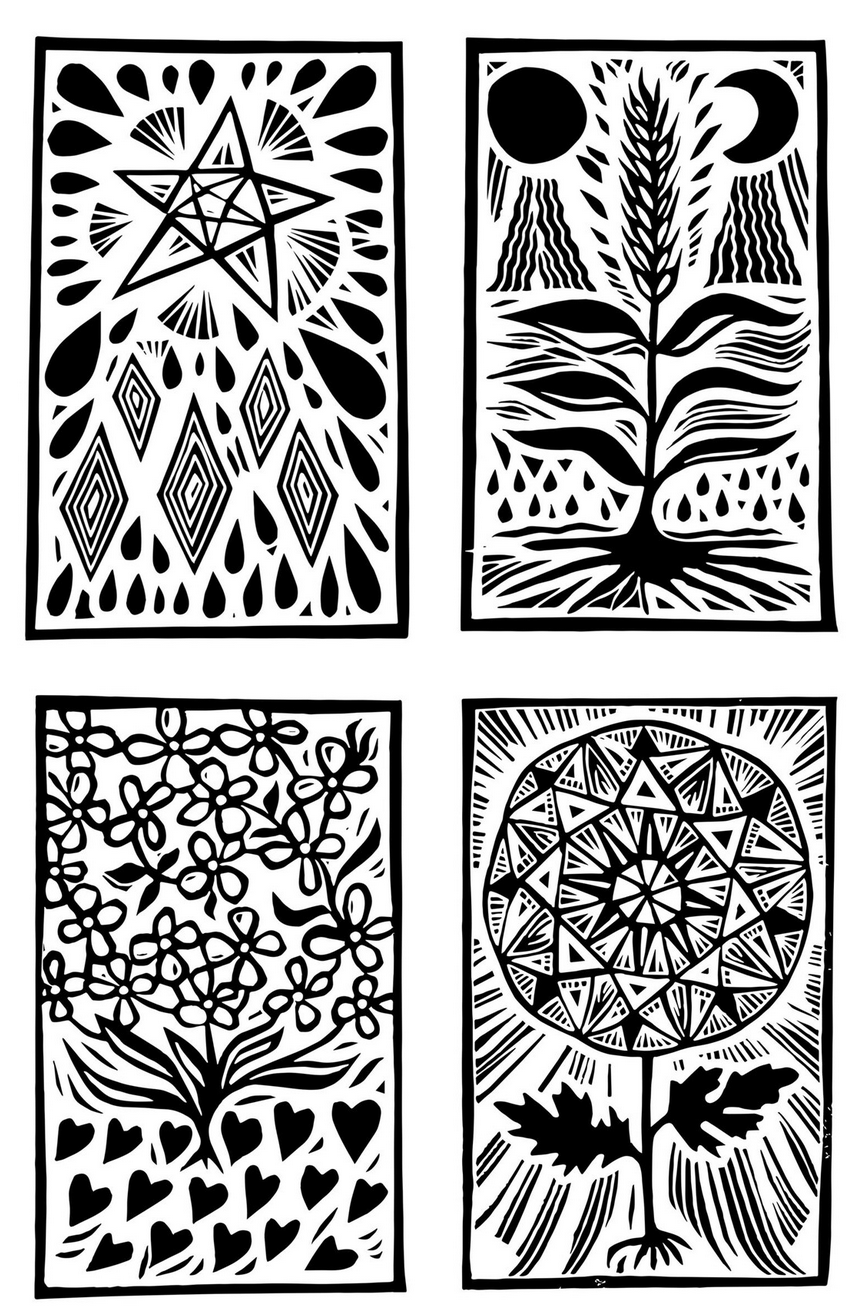
Kingdom of Heaven Parables in black and white by Sarah Fuller. Four panels: top left shows a stylized lamp on a stand depicted as a five pointed star surrounded by drop and diamond shapes; top right the growing plant shows a grain plant with roots below, six leaves and a seed-head, above the plant are the sun and moon, around it are drops of rain; the mustard plant shows a branched plant with many four petaled flowers growing from soil made up of hearts; the treasure in the field is a large round faceted gem growing from a plant stalk and surrounded by shining rays.