
From Brokenness to Wholeness: The Prophetic Journey from Hosea to Jesus’ Prayer - 7th Sunday After Pentecost
Maylanne Maybee
As I write this, in the summer of 2025, I observe a season when the hungry people of Gaza ask for food and instead receive not eggs, not even scorpions, but live bullets; when the breadbasket of Ukraine is laid waste by the deadly drones and bombs of a land-grabbing tyrant; and when wildfires and flashfloods on our own continent threaten property and communities, taking human and other than human lives.
Against this background, we read in the lectionary for this Sunday about the consequences of Israel’s unfaithfulness toward its covenant with YHWH (Hosea), we sing a song of restoration and forgiveness (Psalm 85), we are reminded of our baptismal call to faithfulness and growth (Colossians), and we are taught to pray, with directness and trust, for God’s kingdom to come (Luke). These readings speak of a God who covenants with humankind and creation to bring about a land that yields fruit and shape a world where everyone is fed.
Commentary
-
The prophet Hosea was a northern Israelite of the 8th Century BCE, at a time when the growing pressure of Assyria’s threat to Israel had de-stabilized the internal political situation of Israel and Judah to the point of chaos. Standing in the turbulent heart of Israel’s history, he dares to give voice to the anguish of a broken covenant among people who no longer know their God. His use of the imagery of prostitution and marital unfaithfulness to speak of the relationship between Israel and YHWH is vivid and unsettling.
Hosea’s own agonizing experience with his wife, Gomer, becomes a living parable, highlighted by the names given to their children: Jezreel (“God scatters”)—referring to Assyria’s policy of scattering and intermarrying conquered countries, Lo-ruhamah (“no pity” or “unloved”), and Lo-ammi (“not my people” or “not mine”). The prophet’s personal heartbreak echoes the spiritual betrayal he witnesses among his people: as Gomer turns away from her marriage covenant, so Israel turns away from YHWH. At the heart of Israel’s unfaithfulness lies its embrace of the Canaanite fertility cult of Baal to whom the people turn, believing they can conjure prosperity through ritual rather than trust in divine grace.
The people’s attempt to manipulate the earth’s bounty for their own ends is not only spiritual idolatry but an economic and social betrayal, forgetting their dependence on YHWH and the ethical economy of the covenant. Hosea’s prophecy is not only an unflinching critique but is also lament arising from his own pain and YHWH’s. Yet the impending catastrophe of Assyria’s invasion and Israel’s collapse that Hosea foresees is not the end. Out of judgment, he insists, hope will rise: “In the place where it was said to them, “You are not my people,” it shall be said to them, “Children of the living God.”
What often seems to be missing among commentators is Hosea’s explicit reference in his judgment to land and place. The devastation of Israel (and Judah to some extent) will not only be political and economic, but also ecological, violating the entire food system: land, animals, birds, and fish. Hosea’s prophetic message emphasizes the inter-connectedness of God, humanity, and the land, linking social and spiritual breakdown to ecological degradation, and calling for true restoration that requires caring for both creation and one another.
-
This theme of restoration finds poetic voice in Psalm 85. The psalmist sings of a time when “the Lord restored the fortunes of Jacob” and pleads for God’s steadfast love to bring the people back from captivity. The heart of the psalm is a vision of shalom—the deep, wholistic peace of God:
“Steadfast love and faithfulness will meet;
righteousness and peace will kiss each other.
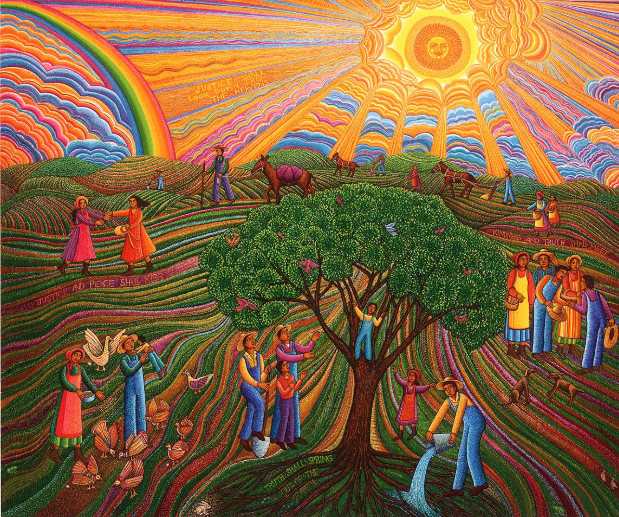
Faithfulness will spring up from the ground,
and righteousness will look down from the sky.” (Psalm 85:10-11)
Here, the healing of the land and the restoration of the people are inseparably linked. When God’s steadfast love joins with human faithfulness, a new world dawns—one in which there is food enough for all, and every person is fed. Righteousness and peace intertwine, and the abundance of the earth flows from restored relationships.
-
The letter to the Colossians is ostensibly written by Paul from prison to a community he hasn’t met but whose struggle is known to him through a visit from Epaphras, their leader. It appears they are facing certain cultural pressures both from wider society and from within Judaism regarding the practice of circumcision and certain dietary and other religious practices. In the second century CE when this letter was written, a worldview was emerging that challenged the Judeo-Christian belief in the inherent goodness of creation. (Walter Wink, The Powers that Be, p. 16). It was a philosophy that emphasized a dualistic worldview, a conflict between spirit and matter, from which one could be saved through the acquisition of secret knowledge (gnosis).
Paul warns the Colossians against being led astray by such beliefs and philosophies (“the elemental spirits of the universe”), calling them instead to embrace Christ as the embodiment of God’s fullness (verses 8 & 9). Indeed, the risen Christ disarmed spiritual rulers and authorities through the cross, offering believers freedom from their tyranny (v. 15). “If with Christ you died to the elemental spirits of the universe, why do you live as if you still belonged to the world?” (v. 20)
Likewise he enjoins them not to allow the laws of circumcision and matters of food and drink and calendar observances to distract them from the core event of their baptism, when they were buried with Christ and raised with him from the dead. (v.12). Their baptism was an ongoing event that separated them from “the trespasses and uncircumcision of the flesh”, making them alive instead through forgiveness and release from legal demands, holding them fast to the One “from whom the whole body… grows with a growth that is from God.” (v. 19).
These themes resonate with the other readings for this day: the apostasy of Baal worship in Israel condemned by Hosea, and the promise of God’s forgivenes in Jesus’ teaching about prayer.
-
In the gospel reading for today, the disciples observe Jesus’ intimate communion with God as he sets his face to Jerusalem and prepares to walk a dangerous and uncertain path. Just as Mary had sat attentively at the feet of Jesus, so now Jesus himself sits attentively in prayer at the feet of his Father/Abba.
“Lord, teach us to pray,” asks one of his disciples, as John the Baptist had taught his disciples to pray. And so Jesus teaches them a prayer—a good rabbinic prayer that draws from familiar passages of scripture and selected quotations from the Psalms, knit together in an integrated picture of God’s responsibility toward us and ours toward God.
God is as near to us as a father or mother to their child; God’s name is sacred; God’s kingdom is at hand; God gives us enough bread for each day. We in turn ask for that bread; we ask for forgiveness of our debts, for the will to be generous to those indebted to us; we ask to be spared from being tested beyond our capacity.
“Save us from the time of trial,” says the Teacher. Yet when Jesus reaches Gethsemane and asks for the cup of suffering to be removed, what he asks for is not granted. There is indeed cost and paradox to prayer. Which may be why Jesus promises not that our prayers will be answered, but that we will be given the gift of the Holy Spirit.
The prayer itself is followed by the example of “the Friend at Midnight” or “the Pushy Pal” as Amy-Jill Levine puts it. It’s a story rather than a parable about asking and receiving, taken from village life in Palestine, that involves three characters: the “you” whom Jesus addresses directly, the fellow villager or next door neighbour, and the friend from away who suddenly shows up as a guest. The story draws its “edge” from the certainty that no-one in that culture of hospitality would turn down a request for three loaves, even in the middle of the night. It would likewise be inconceivable for a parent to give their child a snake when asked for a fish, or a scorpion when asked for an egg. Even someone who is “evil” (as compared to the goodness of God) knows how to give what is good to their children. How much more will our good and gracious God give good things.
The story suggests that the essence of the prayer that Jesus taught is to ask for what we need and want both of God and of our neighbour, to be ready to receive what is given, and to be ready to give when something is asked of us.
+++
Hosea’s disturbing imagery, born from personal and communal pain, becomes the soil in which hope is sown. The restoration sung of in Psalm 85, the liberating promise of baptism, and the prayer of Jesus for daily bread and sacred economy, invite us into a vision of beloved community: a world where steadfast love and faithfulness meet, where everyone is fed, and the land itself is healed.
Sermon themes
Praying for God’s kingdom to come.
If I were preaching on the gospel reading for today, I would choose to dwell on the verses that follow Luke’s version of “The Lord’s Prayer”, and what they say about being in a trusting relationship with God.
For in the chapters of Luke’s gospel that follow, we learn the depth and cost and paradox of Jesus’ teaching about prayer. We learn that God’s kingdom comes like a mustard seed or a lump of yeast; that the door will be closed to many who seek entry; that seeking it is like going after a lost sheep or looking high and low for a lost coin. We learn that fellow heirs to the kingdom might not be found among friends or family, but “in the streets and the lanes where you will find the poor, the crippled, the blind, and the lame.”
I might try to link these reflections on prayer with the lessons from Hosea or Colossians, by studying what each has to say about who God is and what God asks of us.
Hosea’s prophetic message is about the limits of what God can offer to a people who refuse to be loyal. When we pray for the coming of God’s kingdom, we do so “not only with our lips, but in our lives”, offering our prayer not only as an act of worship, but by how we live our lives day to day, by how and whether we affirm the worth of another, by how and whether we affirm the worth of the land and creation itself.
In the epistle to the Colossians, we read how baptism immerses us into the life and death of Christ, in whom God makes us fully alive through the strong gift of forgiveness, a nonviolent response to evil, and the disarmament of the oppressive rulers and authorities of this world.
Taken together, these lessons give a glimpse of God’s kingdom, doing our part to bring it about, trusting in God that it will come, albeit at a time and at a cost that we may not know.
Praying for places as well as people
Jesse Zink, in his book Faithful, Creative, Hopeful: Fifteen Theses for Christians in a Crisis-Shaped World, devotes a chapter to the significance of place and land in the Hebrew scriptures, the gospels, and in our eucharistic liturgy. Hebrew Scriptures are full of stories of people’s relationship with place—from Jacob’s dream at the rock of Bethel to the emphasis on Jerusalem as the dwelling place of God, to the lament of a people in exile, “How can we sing the Lord’s song in a foreign land?
The Hebrew scholar, Ellen F. Davis, calls Hosea as an agrarian prophet who emphatically reminds his people that their covenant is a three-way covenant binding together YHWH with humanity and creation, including and especially the land. “The voices we hear in the Old Testament.” She writes, “bespeak throughout an agrarian mindfulness that land—this particular land, my land, our land—is inseparable from self ‘before God.’” (p. 40).
In the prayer that Jesus teaches, he addresses God as both Father and, implicitly, King – one who relates to us personally and who also relates to our place in the world. The prayer for God’s kingdom to come contains within it a vision of land and place, that like the wilderness between Egypt and the promised land, yields enough to feed everyone.
As a deacon, I prepare intercessions Sunday by Sunday, inviting God’s people to ask for these very things: for the necessities of life, for relations to be made right with those we have wronged and who have wronged us, for a restoration of what has been borrowed or taken, for healing and safety. A preacher might ask how these prayers might give voice to land and to creation itself when naming the victims of hunger, war, and climate catatastrophe.
Praying for our daily bread
Ellen Davis also writes of the radical re-orienting the Hebrew people must undergo as they leave the “fleshpots of Egypt” and learn to rely instead on the daily gift of manna. They must learn that the bread they receive as a gift from YHWH is also a test of Israel’s separation from the culture of Egypt and Pharaoh’s policy of hoarding and amassing grain to the detriment of the poor and the benefit of the rich and powerful. The test in the wilderness desert teaches God’s people the principles and restrictions related to the moral economy of food.
Hosea’s judgement of Israel is that under its kings it has begun to replicate Pharaoh’s system of a centralized, hoarding agriculture, a system that ignores the lessons of the wilderness. One of these lessons points to the consequence of storing up food beyond what is needed for the day, which in the wilderness resulted in manna that was rotten and wormeaten. When we commodify food for personal or imperial gain, we impoverish future generations by using up the elements that give growth – soil, water, compost – and incur a debt that we cannot repay. The only way out is for such debt to be forgiven so we can begin again.
And so, the preacher might look at Jesus’ prayer as an agrarian prayer, in which we ask
That the name of YHWH will be kept sacred—honoured above all rival loyalties, false gods, and self-serving ideologies;
That the economy of manna, learned in the wilderness, will be maintained—an economy in which each one receives “daily bread,” just enough and no more, so that none hoard and none go hungry;
That forgiveness will flow, not only for individual wrongs but for the collective debt owed to future generations—a prayer to be released from cycles of exploitation and greed;
That we will be saved “from the time of trial,” from being tested in the wilderness, acknowledging human frailty and the ever-present temptation to turn from trust in God’s abundance to anxious self-sufficiency.
Selected Resources
Walter Brueggemann, The Land: Place as Gift, Promise, and Challenge in Biblical Faith, Fortress Press, 1977.
------------------, The Prophetic Imagination, Fortress Press, 2001.
Ellen F. Davis, Scripture, Culture and Agriculture: An Agrarian Reading of the Bible, Cambridge University Press, 2009.
Amy-Jill Levine, Ben Witherington III, The Gospel of Luke, Cambridge University Press, 2018.
G. Ernest Wright and Reginald Fuller, The Book of the Acts of God, Penguin Books, 1957.
Jesse A. Zink, Faithful, Creative, Hopeful: Fifteen Theses for Christians in a Crisis-shaped World, Church Publishing, 2024.
Maylanne Maybee is an Anglican deacon, retired from ministry as a community developer, social justice advocate, and theological educator. Maylanne lives in Montreal, Quebec where she continues to be active in projects related to the diaconate, liturgy, creation care, and community ministry.