Overflowing Hospitality: 6th Sunday After Pentecost Year C
Wes Howard-Brook and Sue Ferguson Johnson
Our theme this week is abundant hospitality…and common obstacles to providing it for others in need. Our readings juxtapose the Creator’s overflowing generosity that we experience in earth’s bounty, with hardened human hearts that withhold from the poor or hearts distracted by anxiety-provoking cultural expectations. In these times where simple kindness can feel radical and concern for the poor shut down, our readings remind us clearly of our call as disciples to pour out freely to others what has been poured out so freely to us. And Amos, Colossians and Luke all agree on how we gain the power to engage in such overflowing hospitality: by “feeding” on the Creator’s Word itself.
Commentary
-
Our first reading finds old, childless Abraham and Sarah resting from the midday hot sun under a terebinth tree. Suddenly, Abraham sees three “men,” who turn out to be a pair of angels and YHWH. Where could they have come from out here in the heat?
But rather than ask such questions, Abraham turns on his hospitality engine and revs it up to full speed. After offering polite, deferential greetings to the visitors, he “hurries” (18.6, 7) and “runs” (18.7), calling Sarah into shared action: “Make ready quickly three measures (each perhaps two gallons) of choice flour, knead it and make cakes!” He then turns to the cattle, and, astoundingly, calls for a “tender and good” calf to be made into steaks at once! Not yet satisfied, he adds yogurt and fresh milk to the menu, sets it before his guests and stands by them awaiting further needs.
But as readers and hearers surely know, the greatest provision of hospitality will be in the other direction: the promise of fresh “fruit” from Sarah’s old womb. For whatever reason, the lectionary stops before one of the most fun scenes in the Bible: Sarah asking the messengers not about the possibility of pregnancy, but of her dried up body becoming moist with life-giving power once again (18.12)! It is her yearning for lost “pleasure” (Hebrew, `ednah, cognate with “Eden”), not children, that animates her attention.
The old couple’s response is the biblical paradigm of faithful redistribution of the Creator’s bounty. The image of these extremely senior citizens racing around in the sun, baking and butchering and pouring and plating for strangers borders on the cartoonish in its contravention of “normal” behavior. And yet, how memorable is this scene of Israel’s “first couple” eager to provide a royal feast for three nameless guests.
-
Of all the biblical prophets, Amos is the only one who expressly disclaims the title (7.14). Rather, he says to the priest of Bethel, “I am a herdsman, and a dresser (Hebrew, uboles, only here in the Bible) of sycamore trees, and YHWH took me from following the flock…” The term translated “dresser” was someone who punctured growing fruit to allow it become sweeter. So, it should not surprise us just four verses later (8.1) where the vision he sees from YHWH is a “basket of summer fruit” (Hebrew, keluv qayits). YHWH then speaks: “The end (Hebrew, haqqets) has come upon my people Israel…” (8.2). Note the wordplay: qayits…haqqets. The wordplay helps us hear that the end of the harvest season symbolizes the end of Israel’s own fertility. The reason is made all too clear in the following verses:
Hear this, you that trample on the needy (Hebrew, ‘ebyon), and bring to ruin the poor (Hebrew, `anawim) of the land, saying, "When will the new moon be over so that we may sell grain; and the sabbath, so that we may offer wheat for sale? We will make the ephah small and the shekel great, and practice deceit with false balances, buying the poor (Hebrew, dallim) for silver and the needy for a pair of sandals, and selling the sweepings of the wheat." (8.4-6)
Three different Hebrew words are used in three verses to encompass the range of oppressed people neglected by the wealthy landowners. They chafe to sell chaff at a profit! Not only that, they plan not only to exploit the poor’s desperation, they intend to cheat them as well with false scales. It is the precise opposite of Abraham’s and Sarah’s response. The wealthy not only refuse to share what has been given by God for free, they openly denigrate the glory of growth and the miracle of more by turning nature’s living gifts into mere commodities.
Amos tells us that YHWH’s response will be experienced in creation itself: “shall not the land tremble… and all of it rise like the Nile…I will make the sun go down at noon and darken the earth in broad daylight…” (8.8-9).
Whether in Amos’ time and place in 8th century BCE Israel or ours today, the impulse to transform God’s creation into commerce seems all too “normal.” But Amos’ prophecy concludes with the reason for this long-standing pattern: “a famine…of hearing the words of YHWH” (8.11). May those who do have ears to hear, hear the Creator’s Word and joyously provide as gift to others what has been provided as gift to us.
-
Whether from the pen of Paul or someone else, the letter to the discipleship community in Colossae contains, after initial greetings, a poetic paean to the cosmic Son of God (1.15-20). Its language is very different from what we hear in letters sure to be from Paul (e.g., 1-2 Corinthians, Philippians), echoing Wisdom literature themes from Sirach and the book of Wisdom. Using such traditional language, it makes a radically new claim: the creative force in God has not only been made flesh in the body of Jesus, it is now made flesh in the “body” of disciples. Further, bodily suffering at the hands of the powers—whether Jesus’ body of the collective body—is how people once “estranged and enemies (Greek, echthrous) in mind” can become part of a new all-inclusive Body, commissioned to “make the Word of God fully known” (1.25).
The poem can be divided into two strophes:
1.15-18a
He is the image of the invisible God,
the firstborn of all creation;
For in him all things in heaven and on earth were created,
things visible and invisible,
whether thrones or dominions or rulers or powers—
all things have been created through him and for him.
He himself is before all things,
and in him all things hold together.
He is the head of the body,
the church; he is the beginning,1.18b-20
the firstborn from the dead,
so that he might come to have first place in everything.
For in him all the fullness of God was pleased to dwell,
and through him God was pleased to reconcile to himself all things,
whether on earth or in heaven,
by making peace through the blood of his cross.As many scholars note, it is not that “Jesus” existed “in the beginning.” Rather, the Wisdom of God through which creation came to be (known in the Gospel of John as the Logos, John 1.1-5) was fully present in the historical Jesus as the “ikon of the invisible God” (1.15). One could thus say that the fullness of creation itself is present “in Christ.” It is as this eternal, embodied force that Jesus becomes superior to any rival power source in the empire: “whether thrones, dominions, rulers or powers” (1.16).
The center of the poem overflows with “first” language to make its point:
Head of the body, the ekklēsia
The beginning
The firstborn from the dead
First place in everything
Before all things
And if that wasn’t clear enough, “all” (Greek, panta) is found eight times in the six verses of the poem.
What is said to be the reason for this amassing of divine power in one Body? To make “peace through the blood of the cross” (1.20). Many hear this in terms of the much later theology of “penal substitutionary atonement.” But Colossians isn’t speaking here in legal terms, but in poetry. The writer is not making an argument, but pouring out praise in response to what has been experienced: the breaking of the cycle of imperial violence by taking it “in his fleshly body through death” (1.22). that is, the violence “dies” with the victim, only to rise by the Creator’s ongoing power.
What does all this have to do with the theme of hospitality? Well, what could be less “hospitable” than crucifixion? When faced with the messenger of Good News—as were Abraham and Sarah—supporters of Empire rejected both messenger and message utterly. And yet, the invitation to conversion and healing remains: those who were “enemies in mind” of the Gospel are now called to become among the “holy and blameless and irreproachable” (1.22). This is not another “holiness code” of “don’ts” but rather, a call to become empowered to share the Good News with all, so that the “riches of the glory of this mystery” might be made known (1.27).
Can we hear the echo of YHWH’s “diagnosis” in Amos 8, that there was a “famine” on hearing the Word of God? Now, our epistle writer proclaims, all are called to live according to that Word, which is true wisdom for those living into genuine “maturity” (Greek, teleion) in Christ (1.28). It is a wisdom that flows from the Creator through the creation, revealed now in human form.
-
“Martha, Martha, you are anxious (Greek, merimnas) and distracted (Greek, thorubasē) many things…” (10.41)If Amos conveys what are culturally typical “male” forms of resistance to providing joyous hospitality, Luke’s little story reveals the burden so often felt by women: the demands that everything be “just right” according to cultural expectations.
Whether having friends for dinner or serving the poor, it is so easy to allow the “getting the tasks done” overwhelm the heart of true hospitality: the generous sharing of gifts that breeds communion and love among participants.
We know nothing about the relationship between the sisters and “the Lord” before this scene, but it certainly is not their first gathering. Martha doesn’t hesitate to challenge Jesus on his apparent lack of “anxiety” (Greek, melei) over her doing it all herself. In other words, as is so often the case, she sees solidarity as Jesus becoming as anxious as she is!
Jesus will not give up his God-centered, genuine peace to join Martha where she is. Instead, he calls her to observe her sister, Mary, sitting at Jesus’ feet. Perhaps we can chuckle at the scene, as Jesus juxtaposes one sibling to another. Can we imagine their conversation later?
But his point is the same as that of Amos and the author of Colossians: it is only by hearing and sharing the gift of the Word that we can embody truly holy hospitality.
Finally, perhaps we can also hear that part of the pattern visible in this week’s readings is that it is patriarchy that most prevents our practice. As with any domination system, patriarchy” rewards” behavior that reinforces its mandates and punishes what diverges. What could be less “manly” than allowing people to pummel and pierce one’s body until death, naked and vulnerable for all to see? Perhaps this is part of what Paul meant in his ringing proclamation of freedom in Galatians 3.28:
There is no longer Jew or Greek, there is no longer slave or free, there is no longer male and female; for all of you are one in Christ Jesus.
Sermon ideas
Consider gendered patterns of providing hospitality in your community. Who organizes? Who does the work? Who is invited? What spirit is presented to guests? How do these readings call your community to new patterns?
Creation as gift: what messages have we been given about the fruits of creation and our own choices? Are they “natural resources” to be gathered and sold? Commodities available for those who can afford them? Sacred siblings to be shared with all in need?
How do we determine who is “worthy” to receive hospitality? Consider the recent US law requiring people to work in order to receive food support or health care? What might a prophetic response like that of Amos look like?
Resources
Brian J. Walsh and Sylvia C. Keesmaat, Colossians Remixed: Subverting the Empire (IVP 2004), https://www.ivpress.com/colossians-remixed. An excellent engagement by two Canadian teacher-activist-farmers.
Radical Bible series on Luke’s Gospel: Wes’ word-by-word video commentary. Here’s the link to the video on Luke 10.38-42.
Ched Myers, Healing Affluenza and Resisting Plutocracy (Fortress 2025). A deep engagement with the economics of Luke’s Gospel, by one of our living masters of biblical engagement.
Ed., Lydia Wylie-Kellerman, The Sandbox Revolution: Raising Kids for a Just World (Broadleaf Books, 2021). While not explicitly about “hospitality,” this collection of essays from leading parent-activists of faith provides much wisdom on forming generous, loving young people.
Contributor Bios
Wes Howard-Brook and Sue Ferguson Johnson share the ministry, Abide in Me (John 15), seeking to interweave the mystical and prophetic, the personal and the political, the human and the nonhuman in the name of Jesus https://www.abideinme.net/ . Wes and Sue have been teaching and writing on the Bible for nearly 40 years. Sue is a spiritual director for individuals and groups. Wes, after 20 years teaching at Seattle University, retired in 2021 to create the “Radical Bible” YouTube channel, a free, word-by-word, video commentary on the Bible (https://www.youtube.com/@radicalbible). They dwell in the Issaquah Creek Watershed, traditional and unceded land of the Issaquah Band of the Snoqualmie people. They are blessed to have three of their five adult children and three of their four grandchildren in the same watershed.
Image Descriptions
Image 1: A very large and solid tree is shown, from within the broad canopy. The trunk is large and the branches reach in all different directions, some down to the ground.
Image 2: A three-panel painting is shown, depicting a tree of life image. Water flows behind the tree and large leaves and fruit are shown in the foreground.
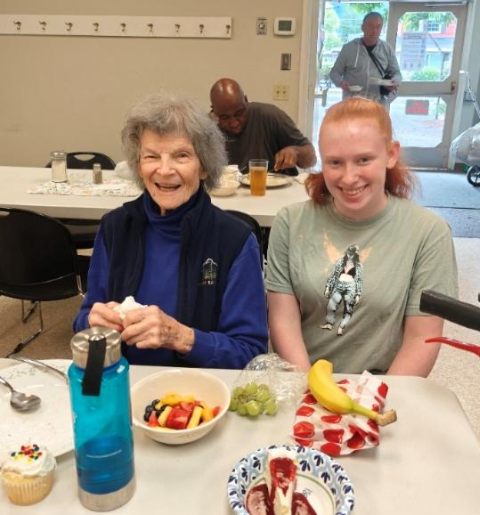
Image 3: Two people are shown sitting at a table with food in front of them. The person on the left is Bertie (103 y.o.), wearing blue long sleeves and black fleece vest. The person on the right is Edie (13 y.o.), wearing a light green t-shirt. They both smile at the camera.