
23rd Sunday after Pentecost Year C: Praise and Destruction for All Creation
Rev. Emily E. Ewing
From all creation praising God for God’s victory and compassion to destruction at the hands of humanity and food insecurity throughout the world, this week’s texts dig into “end times” and potential catastrophes. While these last weeks of the church year usually contain more of what is deemed “apocalyptic” literature, the struggles described, as with most of scripture, were intended to address crises and situations in first century Palestine. There is still, however, much for us to engage with today. No matter where your preaching leads, addressing the pop culture understandings of the end times is an essential part of supporting congregational biblical literacy, even if it is a simple disclaimer at the beginning of the sermon. Digging into food insecurity around the world and “natural” disasters that are increasingly the result of human action helps connect creation care and creation justice with larger movements for justice and care of humans as well.
Commentary
-
Isaiah recounts God’s promised vision of Jerusalem renewed and blessings abounding
Verse 17
New heavens and new earth point towards renewal and hope in creation.
Verse 18
God is Creator, creating Jerusalem for a joy.
Verse 19
God promises an end to weeping and distress.
Verse 20
God promises an end to infant mortality and long lifespans.
Verse 21
Communities settle in, building houses, and planting vineyards, only profitable after multiple years of living in a place.
Verse 22
People shall not be displaced, but rooted like trees in a place.
Verse 23
By evoking descendants, God promises a future.
Verse 25
The violence of predator/prey relationships in nature is calmed, apparently through veganism.
-
Isaiah tells of a future time when joy and gratitude for God abound.
Verse 3
Water and well imagery connects physical and spiritual sustenance.
Verse 5
God’s actions will be “known in all the earth”. Will animals and plants know?
Verse 6
God is present in the midst of God’s chosen people
Malachi 4:1-2a
Malachi’s vision is of trouble for evildoers and healing for those who revere God’s name.
Verse 1
The arrogant and evildoers’ consequences are depicted as a fire burning through a forest.
Verse 2a
Righteousness rises as a sun with healing in its wings.
-
A psalm of praise and joy for God’s victory.
Verse 3
The sociopolitical reality of God’s victory plays out to “all the ends of the earth”.
Verse 4
The whole earth is called to joyous song.
Verse 7
The sea and its multitudes roar as the world and all who live in it do.
Verse 8
Floods clap hands and hills sing.
Verse 9
The world and the people will be judged with righteousness and equity.
-
Purporting to be Paul, the author of 2 Thessalonians encourages the community to do what is “right” in terms of work.
Verse 8
This call to work in order to not be a burden challenges what is considered a human right (to food) and problematizes the very real need for government assistance.
Verse 10
The author states that “anyone unwilling to work should not eat.” Though a problematic statement in its application, it’s important to note that the author uses “unwilling” and not “unable”.
Verses 11-12
The author encourages those who are “mere busybodies” to work, contributing to the community.
Verse 13
Ultimately the exhortation is to not get tired of doing the right thing.
-
While some admire the fanciness of the temple, Jesus reminds them that the future is uncertain, but will certainly involve hardship.
Verse 5
Admiration for buildings, particularly the lavish part that conveys messages of wealth.
Verse 6
Jesus warns of future destruction, but whether it is of property or of his own body is uncertain.
Verse 9
Violence is coming, but it is not a sign for Jesus.
Verse 11
What has historically been considered natural disasters, but are increasingly considered human-made, like earthquakes, famines, and plagues will occur.
Verse 12
Jesus warns his followers of the state violence to come.
Verse 18
Even with hardship and persecution, Jesus promises that not even the smallest part of each follower will perish.
Teaching and Preaching Suggestions
Praise of Creation
From Isaiah 65’s new and renewing creation with a return to the community’s ancestral lands to Psalm 98’s praise of God’s work and invitation to all the earth–sea, floods, hills–to praise God, the readings for this Sunday emphasize the connection between humans and the rest of Creation. The connection is not all joy, however. Psalm 98’s exhortation to “Let the floods clap their hands” (v. 8) lands differently in Jamaica and parts of Cuba as they are in danger of flooding in the aftermath of Hurricane Melissa. Jesus adds in a challenge to those who were admiring buildings that humans made and would inevitably be destroyed at some point. Earthquakes, famines, and plagues are lived realities the world over: earthquakes near fracking sites, Israel’s imposed famine in Gaza as a tactic of genocide, and globalization and massive decreases in response to COVID-19’s ongoing infections. Humanity’s destruction of earth and each other limits the joy and praise possible of Isaiah 65 and Psalm 98.
Food Insecurity
While the author of 2 Thessalonians emphasizes the communal contributions and participation in the life of the community, verses 10-11 echo today in those who argue that government assistance, like the Supplemental Nutrition Assistance Program (SNAP, or food stamps) in the united states, or one of the many provincial programs that provide financial assistance in Canada, should come with work requirements. The author of 2 Thessalonians uses strongly worded phrasing, reflecting the value of work in both Jewish and Christian communities. However, the phrase translated as “unwilling” in v. 10 is an important distinction. It’s not about people who are unable to work, but those who are able and choosing not to. The Jewish Annotated New Testament notes that “Living in idleness” may refer to those who “believed the end had arrived, though the connection to 2.2 is not explicit.” (381, note on v. 6)
Connecting 2 Thessalonians with Isaiah 65 facilitates a conversation about community. Isaiah 65’s reassurance and comfort that God brings joy, health, and life provides a more helpful framing. Addressing those who had been uprooted from their land and community, the work of growing and eating their food and being in relationship with the land in that way was a gift. Connecting to the earth and doing meaningful work that was not forced labor for someone else, but labor bearing fruits for self and community. Verse 25 even adds in an upending of the ecosystem in favor of greater symbiosis between predator and prey.
Destruction
Destruction abounds in our readings this week in implicit and explicit ways. Destruction, in the form of devastation, is itself destroyed in Isaiah 65 as God proclaims the end of weeping, cries of distress, infant mortality, early death, calamity, and even carnivorous animals. For Malachi destruction comes as a fire burning the stubble of evildoers until there is “neither root nor branch.” Psalm 98 proclaims God’s victory and vindication. Praise for God culminates with Creation’s cry, including floods clapping. The culmination of destruction comes in the Gospel in response to adoration of the Temple’s adornments right after Jesus praises a widow in contrast to the wealthy for putting two small copper coins into the Temple treasury. Jesus’ prediction of the Temple’s destruction, a reminder of the fleeting nature of humanity, evokes sudden destruction as “all will be thrown down.” Jesus then refuses to answer their anxious questions about timing. Instead he tells of violence on a global level: wars and insurrections, none of which will be the sign, but all of which will cause destruction. Jesus also described what were natural disasters, many of which today can easily be traced back to human action and inaction. All of this also comes alongside possible destruction of Jesus’ followers’ own bodies as they are persecuted. And yet even in the midst of all of this destruction, Jesus promises immunity and everlasting life.
Sources and Resources
For another perspective on creation care in the apocalyptic literature and the current climate collapse and political devastation, check out this repost from 2013: https://lutheransrestoringcreation.org/sunday-november-13-19-year-c-schade13/
To dig into connections to the land and those for whom the land you are on is their ancestral land, check out Native Land to find which Indigenous communities have called the land you’re on home: https://native-land.ca/
To explore more about safety nets in the united states in connection to this week’s readings, check out this past Nerds at Church Podcast episode: https://podcasters.spotify.com/pod/show/nerdsatchurch/episodes/23rd-Sunday-after-Pentecost-Year-C-e1qbq84
There are many news articles written and available that dig into the complexities of government assistance as it is changing in the united states under the current administration and particularly during the current government shutdown.
In Canada, going to the website for your province will be the best way to find out about food and monetary assistance.
World Central Kitchen is providing direct relief in both Gaza and Jamaica: https://wck.org/
If focusing on food and food access, the United Nation’s Universal Declaration of Human Rights, Article 25 is a helpful reference: https://www.un.org/en/about-us/universal-declaration-of-human-rights
There are many maps and databases that illuminate flood risks and flooding throughout the world, including: https://www.fm.com/resources/nathaz-toolkit/flood-map
To explore flood risk specifically in connection to climate change, Climate Central has comprehensive and visual predictive maps: https://coastal.climatecentral.org/
A map of earthquake activity is available here: https://earthquake.usgs.gov/earthquakes/map
Contributor Bio
Rev. Emily E. Ewing (they/them) is a Lutheran (ELCA) pastor serving in Baltimore, Maryland working on their MFA in Community Arts from the Maryland Institute College of Arts (MICA). They combine creativity, spirituality, nerdiness, and the call to justice in many ways. Pastor Emily cohosts the Horror Nerds At Church podcast. They consult with communities of faith for anti-oppression trainings, Doodle Care spiritual practices, creative community projects, and whatever the Spirit calls them to.
Image Description
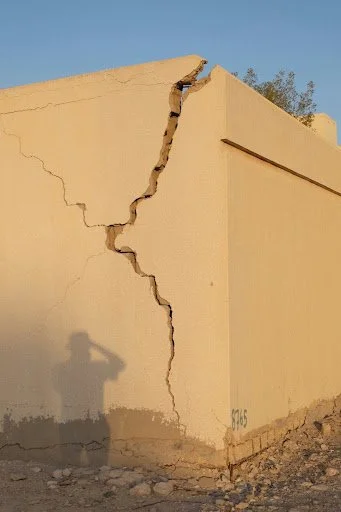
A Photo by Murewa Saibu on Unsplash shows the corner of a cream-colored wall with a large crack running down to the base of the wall. The sky behind the wall is blue and the shadow of the photographer is visible against the wall.