
The Great Flood of Advent: First Sunday of Advent, Year A
Jason Rajan
Whatever it is, the way you tell your story online can make all thThis Sunday we light the first candle of Advent, hope. It is during Advent where we slow down and reflect on the past year. It is also a time of waiting, waiting for the coming of Jesus. In the Gospel of Matthew, the writer points to the coming of the Son of Humanity and compares it to the flooding of the earth during the time of Noah (Matthew 36:37). The Great Flood and Advent are both “a coming.” (Julia Gatta. Life in Christ: Practising Christian Spirituality. Pg 109) The word advent is derived from the Latin word adventus, meaning “coming,” which is a translation of the Greek word parousia. (University of Portland. Did you know: Meaning of Advent.)
When I reflect on the story of The Great Flood, I think of all the flooding that occurs in the world, especially right here in British Columbia. The relationship between our current climate crisis and advent unfolds as we move through each of the readings. I want to draw your attention first to the Gospel, where the writer mentions The Great Flood. It is here where we focus on vigilance. In the story of The Great Flood the earth faces death and destruction when it is wiped clean of all wickedness. From death and destruction there is a renewal and a re-birth, which we see in Isaiah. The theme of re-birth is a call to a renewed life. It is a call to live in harmony with nature and with one another as God intended.
Commentary
-
In verse 32 we see how nature talks to us with the fig tree “…as soon as its branch becomes tender and puts forth its leaves, you know that summer is near.” Mother Nature is not idle nor is she passive. She is a living entity that embodies God’s creativity and their breath. In the end of this verse, “…when you see all these things, you know that he is near...” we see God in nature.
In verses 37-38 the description of people’s behaviour during Noah’s time is used to describe how it will be when Christ comes. “For as in those days before the flood they were eating and drinking, marrying and giving in marriage…” This is one reflection of human’s disregard to life around them, even to this day. The continuing of exploiting nature by the expansion of human interest and human infrastructure comes at the price of wildlife and its habitats.
In verse 39 we note the unexpected nature of the flood: “and they knew nothing until the flood came and swept them all away.” We see here that all those who were not in Noah’s ark went about their days completely oblivious to their coming destruction. Nature does give out signs of upcoming disasters. Clearly, they did not notice them, but do we? What are ways we can be alert?
In verses 42 to 44 we see the call for vigilance. We are not merely called to watch on the side lines.
Verse 42 we are called to be awake for Christ’s arrival is unknown.
Verse 43 “…if the owner of the house had known in what part of the night the thief was coming, he would have stayed awake and would not have let his house be broken into…” We see an example of how vigilant we must be.
Verse 44 “Therefore you also must be ready,…” again we are called to keep awake, to stay awake, and be ready. A call that contradicts the behaviour of the people destroyed in the flood.
-
There is a call for a new way to live.
Verse 3 People want to learn and walk in a new path. This is not just for a handful of people but “all the nations”
Verse 4 The people “shall beat their swords into ploughshares, and their spears into pruning-hooks; nation shall not lift up sword against nation, neither shall they learn war any more.” In addition to the mass production of goods under capitalism, we also have the mass production of weapons. Both productions contribute to global warming. In this verse, however, we see a shift from destructive exploitation to a way of cultivating and nurturing.
-
A renewed way of living.
Verse 11 A call to wake up.
Verse 13 A call to not just live our daily lives but to live honourably. In order to live up to that call and change we need to wake up and go beyond high moral expectations and to respect nature and live in and with it.
Teaching and Preaching Suggestions
The Great Flood and Noah’s vigilance.
Take a moment to get your listeners to engage in the following questions: 1. What is a flood? Why do they occur? Are there different types and which types are most common in your city, state or province? How does frequency in flooding affect the wildlife in your area? We can learn how to advocate for change when we understand the effects of climate change on our environment and the impact of increase flooding due to rising temperatures. To vigilantly seek a resolution, we need get others to trust in the science and hear the cries of Mother Nature. We cannot continue to be willfully ignorant to the impact global warming has around us.
What is vigilance? In my own version of the Bible NRSVUE, Matthew 24: 36-44 is under the title “Necessity for Watchfulness”. Reverend Julia Gatta uses the word, vigilance. “Vigilance, for instance is a crucial spiritual practice. It demands that we pay attention to what is going on inside us, and around us, discerning what is of God and what is not.” (Julia Gatta, Life in Christ: Practising Christian Spirituality Pg 111). How do we discern what God is calling us to do when we receive constant news of flooding, like the flooding that occurred in Taiwan because of Typhoon Fung-wung?
How does your city deal with disasters? Have you had a chance to look through city plans on dealing with flooding in your area or other areas? In what I see the focus is on the extent of damage to manmade infrastructure and the steps needed to take in its restoration. In the Canadian Climate Institute Fact Sheet of 2024, it states that the amount, length and intensity of rainfall can influence the severity of flooding. This report also reveals how the economy is affected. Do you see any statement in this report or others, that focus on prevention and or the restoration of nature?
In re-reading Matthew 24:32 we explore the different ways we see God in nature. How can we see nature speaking to us? And when she speaks, are we paying attention to what she is saying? Can we list the species that went extinct or have been expatriated?
Death and destruction
To go more in depth on extinction and expatriation or death and destruction, I found it best to re-read Noah’s story. There is so much in scripture that directs us closer to where God is calling us to be.
In my experience I found city officials stating their preparedness for any crisis especially flooding only to find that after the disaster that the extent of damage exceeds their estimations. Can we really predict Nature in such a precise way? After a flood, the are many reports on the destruction of homes, schools, entire towns, farmlands and deaths of farm animals. The rising death toll of wildlife, especially salmon on the other hand is minimally reported on. Do we take note that the cycle of the life, especially the food chain is altered because of climate change?
On November 25, 2021, an article written by Elizabeth McSheffrey on Global News’ website brings to light a report of the effects of flooding on natural habitats. In her article, “High fish mortality rates possible after record-breaking B.C. floods”, she makes note of the destruction flooding has on pink salmon. With the damage to the spawning locations, their eggs cannot incubate. The fish die and the eggs exposed to predators. This is just one report. Are we connecting the dots to the other reports? I find we as humans forget that we are part of nature and everything within our ecosystem is intertwined and connected. The action of one species affects all, even insects and plants.
Do we pay enough attention to the scientific research done that reveals the expiation of species around us, even the ones right in our backyard. What are a few species that have been expatriated in your area? In British Columbia, the government has an “Extent and Expiated Species” report on their website. Is there a list in your city, state, or province?
Re-birth and a New Life
Advent as we know, is the waiting for Christ’s birth. Do we however, take a moment to foresee his death as well? Christ’s life and death is very much the same as finding birth and a renewing of life in nature. In all that new life there is still destruction by human hands. My hope was for humans to stop fighting one another and fight climate change to save our world. We fail to see what a gift Earth is to us. It is our home. The change required to ensure the continuation of our home, goes beyond just stopping wars. People and nations need to be responsible and be held accountable for their actions. There needs to be an overall agreement by everyone to “walk in the light of the Lord!” (Isaiah 2:5).
There are more extensive sources that we have, to expand on how our need to live a new life that restores balance in nature. On page four of this report: “Pacific Institute for Climate Change: Integrated Flood Management Planning: A guide for communities in B.C.” is a list of defined terms. On of these terms is a focus on restoring habitats like the wetlands. The answer to our current climate crisis is nature herself. God calls us back to them. Just as in Isaiah we are to go up to the mountain of God and learn their ways and their paths.
For myself in seeing how we treat nature I go back to a children’s book. “God’s Dream” written by Archbishop Desmond Tutu and Douglas Carlton Abrams. In the middle of the book there is an image of children and a few animals being in harmony with one another. It reads: “Each of us carries a piece of God’s heart within us. And when we love one another the pieces of God’s heart are made whole.” This brings me back to the Garden of Eden, where we were one with God. Regardless of whether we believe in God or not, we are all made in their image. Are we not part of the whole earth? We as humans, animals, insects, and Mother Nature are all God’s creation and God called us all good.
Sources
To explore more of the meaning behind our faith and how we are called to live it, I suggest turning to Reverend Julia Gatta. Life in Christ: Practising Christian Spirituality. (Church Publishing, New York) 2018.
In reflecting on what the meaning of Advent is I found University of Portland’s site and their section: “Did you know: Meaning of Advent”
https://www.up.edu/garaventa/did-you-know/meaning-advent.html#:~:text=The%20word%20
There are resources and groups dedicated to understanding the impact of flooding. I found Climate Cosmos’ website and their article: “12 Warning signs of imminent flooding you should never ignore” https://climatecosmos.com/interviews-and-opinions/12-warning-signs-of-imminent-flooding-you-should-never-ignore/
For more on how plans are established to protect human infrastructure see “Best Practises in Western Canadian Flood Mapping” Prepared by National Resource Canada. https://climatesolutions.ca/wpcontent/uploads/2025/07/Best_Practices_Western_Flood_Mapping_Milne_Crawford_2025.pdf
Also see Pacific Institute for Climate Change: Integrated Flood Management Planning: A guide for communities in B.C. prepared in August of 2025. This report has both means of improvement to human infrastructure and restoring nature as well. There is also a PDF available which can be found in this link: < https://climatesolutions.ca/explainers/the-power-of-confluence-a-guide-for-integrated-flood-management-for-b-c-communities/>
I found children’s stories to be a great way to understand ourselves and our relationship with God and nature.
God’s Dream. Archbishop Desmond Tutu and Douglas Carlton Abrams illustrated by Leuyen Pham. (sMassachusetts: Candlewick Press) 2022.
Contributor bio
A child of a retired Baptist minister and now a devoted Anglican, who identifies as transgender. Jason is pursuing a Master of Divinity at the Vancouver School of Theology.
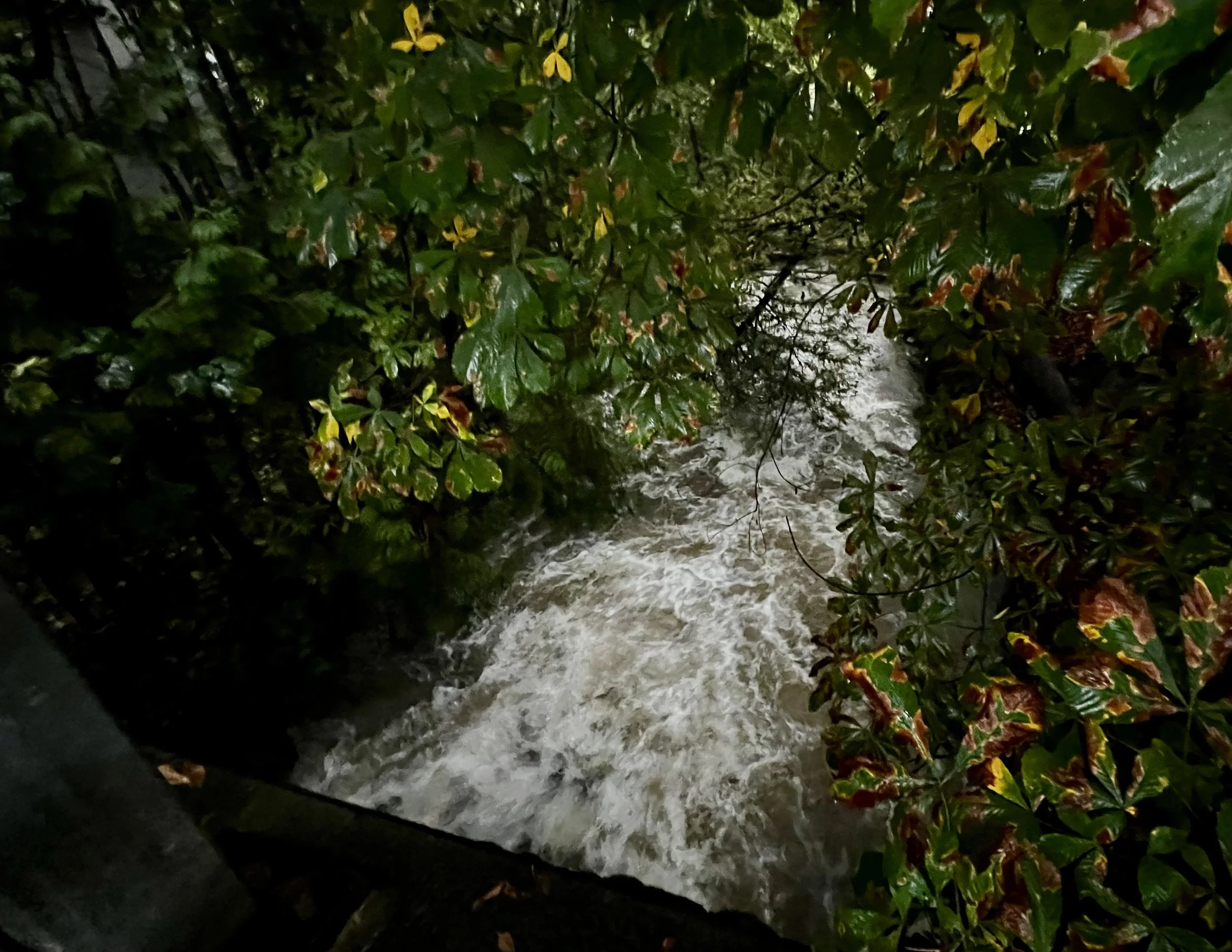
Image Description
I found Psalm 22 helpful in my recollection of Atmospheric River in October 2024. Here in this picture, I can feel the power of the water roaring through as it overtook the stream in my neighbourhood. In verse 12 the Psalmist mentions Bulls of Bashan. They were seen as “symbols of dominance and unyielding strength” (Bulls of Bashan by Davidson Our Bible Heritage). https://ourbibleheritage.com/bulls-of-bashan/