Peace, Imperfection, and Rest: 6th Sunday after Pentecost
Rev. Emily E. Ewing
From peace proclaimed with the procession of a donkey in Zechariah to praise of God’s compassion and mercy in Psalm 145, this week’s readings push back against war and violence. In Romans Paul confesses our human entrapment in evil while Jesus points to the lose-lose dynamic of criticism levied at both him and John. While many of us struggle to let go of the perfectionism drilled into us by white supremacist culture, the freedom of grace empowers us to keep trying and to keep working for climate justice, even when we cannot possibly do it perfectly. Jesus final invitation in the gospel ties us back into the gentleness of a king entering on a donkey with its invitation to rest, a key component of resisting capitalism and caring for Creation.
Commentary
-
A passage also referenced during Palm Sunday accounts, the king comes in humble peace, ending the violence of war.
Verse 9
Riding on a donkey even before it should be able to carry a load. This verses also uses repetition as a literary device to emphasize how very un-military this ride is.
Verse 10
Both chariot and war horse evoke the use of animals for violence and the violence and destruction of earth that comes with war. Instead, the king “commands peace” across all the land.
Verse 11
The waterless pit, death through dehydration, calls to mind Iran’s threatened salination plants during the trumped up war.
Verse 12
A reminder that retreating to safety, de-escalating or ending violence, is an action of hope.
-
Creation gives thanks to God, who rules over all the earth.
Verse 9
God’s compassion extends to all of Creation.
Verse 10
All of creation gives thanks to God.
Verse 11-14
God’s power and reign endure through time and space, supporting those who fall.
-
Paul points to the paradox of humanity: wanting to do the right thing but never fully being able to.
Verses 15
Even when we try to do what is right, caring for creation, we fall short of our hopes.
Verse 18
In this stage of capitalism, especially with green capitalism now making it nearly impossible to survive, let alone live sustainably with creation, no matter how much we desire to do good, the ability to prioritize creation justice is nearly nonexistent.
-
Jesus laments his critics and those who do not respond to his works while inviting the weary to rest in him.
Verse 16
Children, those who inherit the consequences of our present actions, become the comparison to those who seek only to criticize.
Verse 18
In John, asceticism, a way of caring for or being more in touch with creation, is called demonic.
Verse 19
Referring to himself as the Human One or Son of Humanity, Jesus points to his enjoyment of wine and food, gifts of creation, as evidence for some of his gluttony and poor company.
Verses 20-24 (excluded)
Of note, Jesus’s reproach of cities in which repentance did not follow deeds of power invokes Tyre, Sidon, and Sodom. While these verses are not included in the lectionary, skipping over them without knowing or acknowledging the references within could cause unnecessary trauma for those who would read them without the historical-critical context.
Verse 25
Jesus preaches his prayer to the one who rules over heaven and earth.
Verse 28
As the Nap Bishop, Tricia Hersey, reminds her readers, rest is a vital path to resistance, both journey and destination. Jesus calls us to rest, trading our individualistic burdens in for collective care, easing the work.
Teaching and Preaching Suggestions
Peace with Mercy
Zechariah calls out the news of a ruler who comes embodying a humble nature riding a donkey. And yet, this humble ruler is powerful enough to cut off the weapons of war and free the prisoners from death. Psalm 145 supports the call for peace in Zechariah, praising God’s grace, mercy, and compassion. Particularly with the ongoing military violence throughout the world, focusing in on these readings and God’s work to end warfare opens space to also name the environmental devastation wrought by militaries writ large and especially wars, as in Ukraine, Gaza, Iran, and Democratic Republic Congo. With all of the hypermilitarism wrapped into marking the 250th anniversary of the united states, these readings proclaim an alternative, speaking boldly to the climate crisis we are in and calling out one of the leading causes.
Action without Perfection
In Paul’s letter to the Romans, Paul laments his inability to do the good he wants to do in the ways he wants to do it, even naming the proximity of evil. Jesus takes up this paradox in Matthew pointing out the contradiction in claiming John’s asceticism as evidence of a demon and Jesus’s enjoyment of food and drink as evidence of gluttony and drunkenness. Together these readings point to the impossibility of perfect action. As Martin Luther said, “Sin boldly! But trust in Christ even more boldly still!” We are not called to perfect action, but we are called to take action. My favorite definition of grace states that you can’t make God love you any more than God already does and you can’t make God love you any less than God already does. This understanding of grace, existing at what could feel like a paradoxical crossroads, frees followers of Christ to do their best and take action for the good of the world without letting the possible failures prevent them from doing anything. When it comes to the climate, there is no perfect thing that we are capable of doing to immediately stop the collapse and reverse climate change. Globalized capitalism has tied everything together to keep good from being wholly good, but that does not relieve us of the responsibility and call to keep trying in our care for creation.
Respite for the Weary
The iconic words of Jesus inviting his followers to “come to me, all you who are weary and carrying heavy burdens,” are a breath of fresh air in the midst of the hustle and bustle of capitalism that captivates and even captures too many of us. Within capitalism, rest is viewed as laziness even as the gaps between the wealthy and poor in terms of finances and available time widen, those who are lower and even middle class are squeezed more and more. Jobs are consolidated with more responsibilities added to those who are already overworked and underpaid. The gig economy keeps people jumping from one underpaid contract position to the next and back again. The gospel and balm of these readings reveal themselves in rest and the space they can help create to breathe deeply. Rest as resistance to capitalism, a key point in Tricia Hersey’s Rest Is Resistance, pushes against the ways capitalism devalues creation and grinds humans down. Capitalism today relies heavily on the convenience economy by working humans so hard that we spend the extra money for the convenience of food delivery rather than pickup, next or same day arrivals for packages, and more. Demanding and taking space to rest pushes back against all of that, which also pushes against the environmental harm in rushed deliveries, excessive packaging, and the increase of individual vehicles on the road.
Sources and Resources
For more on the climate impact of war, genocide, and militarism, check out this article from 2023: https://climatedefenseproject.org/a-note-about-genocide-and-climate-injustice/
To dig into the ethical implications of Martin Luther’s call to “sin boldly”, check out this article in the Journal of Lutheran Ethics: https://learn.elca.org/jle/dirty-ethics-for-bold-sinning/
Tricia Hersey’s books Rest Is Resistance: a Manifesto and We Will Rest! The Art of Escape expound on the importance of rest and its role in resistance to capitalism.
To dig into these texts and others throughout the year more deeply from a particularly queer perspective, check out A Queer Lectionary: (Im)Proper Readings from the Margins Year A
Contributor Bio
Rev. Emily E. Ewing (they/them) is a Lutheran (ELCA) pastor serving in Baltimore, Maryland working on their MFA in Community Arts from the Maryland Institute College of Arts (MICA). They combine creativity, spirituality, nerdiness, and the call to justice in many ways. Pastor Emily consults with communities of faith for anti-oppression training, creative spiritual practices and community projects, and whatever the Spirit calls them to.
Image Description
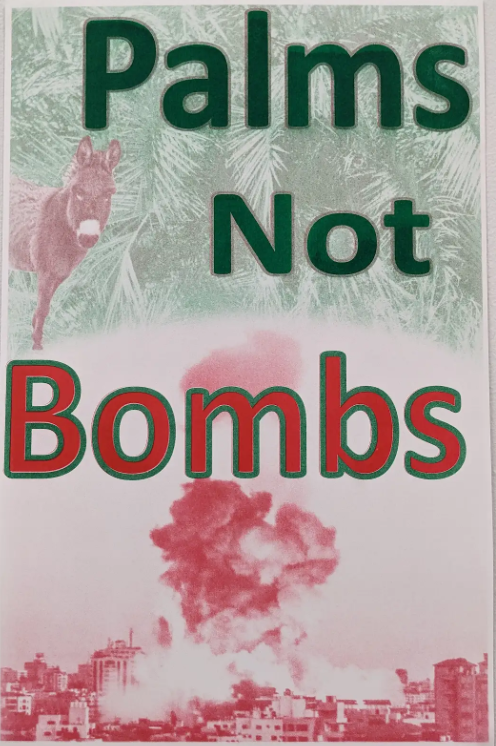
A green and red risoprint protest sign reads “Palms Not Bombs” with a background of green palms on the top and a red depiction of the bombing of Gaza on the bottom. A donkey peeks out from the right side of the poster.