
Rev. Carolina Glauster
This Sunday is the first Sunday of 7-week Advent, a practice a lot of liturgically oriented Christians have been taking up(1) or experimenting with in these last couple of decades.
I have now been practicing a 7-week Advent in my private prayer practice for so many years that I cannot remember exactly when I took it up. I do remember the feeling of discovering it and being drawn to it and what it offers: A chance to take part in the lonely yet spacious anticipatory practices of Advent before December, when the world seems to fill up with the noise and muchness of secular Christmas. The gift and challenge in those first years of strategizing about the creation of a 7-candle wreath and beeswax candles that would fit it. The pleasurably non-commercialized practice each November of going out to gather evergreen branches from actual bushes and trees in the various places I have lived because the stores aren't carrying them yet. And the embodied spiritual experience of an Advent more seasonally attuned, in both the meteorological and liturgical senses, to the apocalyptic threads that are always revealing themselves at this time of year and seeming always to draw my interest and attention.
Lectionarily, you don’t have to change a thing to celebrate 7-week Advent. It’s right around this time that our readings begin to surface more fully the duality of Advent themes: the sense of the longed-for coming of God (in the past, the present and the future) AND the apocalyptic flavours and possibilities of such a coming, which just feel like they belong in Advent along with the joy and anticipation. As the prophet Amos says, “Why do you long for the day of the lord? It is…gloom with no brightness in it.” And yet, we also do long for that day. It is a complex mix, and perhaps that is as it should be. But certainly my soul appreciates the matching of these apocalyptic themes with the ways fall is a death and endings time: how November was always when the most deaths happened in the parish when I worked as a pastor, how the bare trees and lessening light and increasingly dead rather than fiery leaves invite thoughts of the way loss and death and endings are, at least cyclically, inescapably part of life.
This week's readings, for the 24th Sunday of Pentecost (aka the 1st Sunday of Advent, for those who celebrate) invite us into those strange and unsettling but also honest feelings of this time of year--happening in the more-than-human world around us in a lot of the northern hemisphere and in our liturgical surroundings for a lot of Christianity. With the prophet Amos we ask, “Do we want the day of the Lord or don't we?” Listening to the psalmist’s cry, we may wonder, is God coming to help (as the psalmist hopes God will) or to shame and turn back (as the psalmist hopes God will do to their enemies)? In the words of Paul to the Thessalonians, are we grieving or hoping (or maybe both)? As we turn over the parable of the bridesmaids and their lamps, it may be hard to know, are we ready or aren't we? And what will happen if we aren’t?
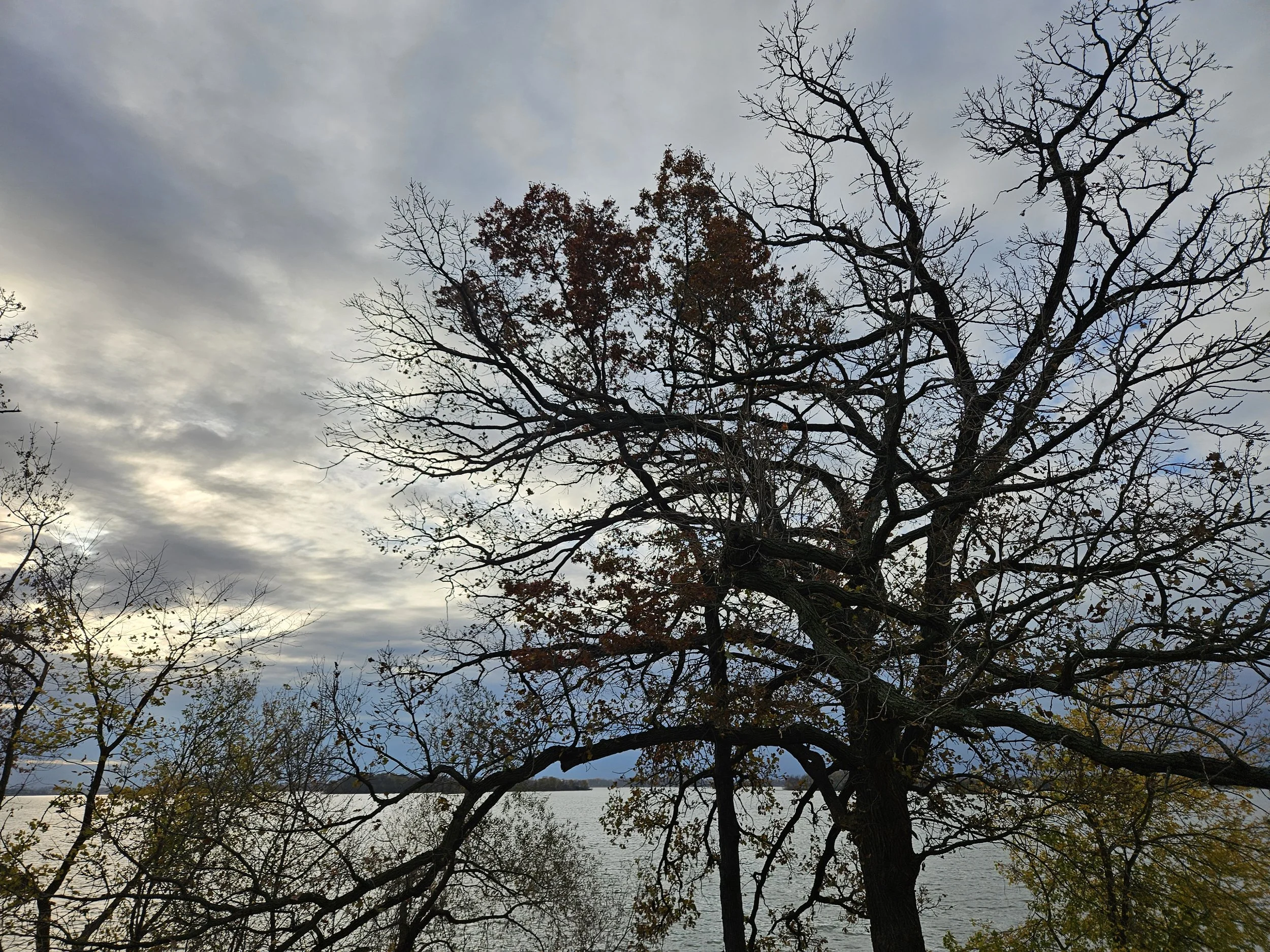
The word apocalypse is used, in English, to mean cataclysm, catastrophe, the end of the world. The Greek word from which it is derived actually means unveiling or revealing. Maybe it can hold both meanings for us as we encounter these November Advent texts. Like a tree whose leaves are all long blown off its now-bare branches, such that it feels more dead than it almost ever will and may make the humans who know it well feel sad or think of deaths and endings—and yet also such that its own form and those of the birds and other creatures inhabiting it are more apparent to our eyes—so also are these readings inviting our attention to the apocalyptic in both its senses: cataclysm and unveiling.
Commentary
-
Thanks to Dr. King's I Have A Dream speech, the final verse of this text is one of those handful of biblical passages that are still broadly familiar even as biblical literacy radically decreases...and one of those handful that lots of folks love without even knowing its biblical origins. And what a perfectly heart-brimming metaphor (and dream) for those of us who not only long for a just world but also love to be outdoors by a stream or a waterfall, whose unshod toes will always be in any stream moments after we've first laid eyes or ears on it.
And then backing up to a few verses before the mighty waters and ever flowing streams of God's justice and righteousness, this text offers those satisfying words of condemnation for those who practice outward piety but perpetrate violence and injustice. When you read verses 21 to 24 together, do you find a part of you instinctively knows who the hypocrites are in the world, at least as you see it? Those whose songs must be anathema to a God to whom piety that doesn’t translate to justice is no piety at all?
And then another step earlier in the reading reveals these encounters with the lion, the bear, and the scorpion. These vivid evocations of a moment I am sure is one of safety and rest and suddenly...not. The moment I thought was one of liberation or rejuvenation for me is suddenly recast as one of danger for me. But I hope, especially for those of us reading for ecological themes, we are wondering a little about the experience of the more-than-human characters in these snapshots. Is this same moment an assertion, maybe, of territorial integrity and perhaps liberation from my harassment for this bear or this scorpion?
When we begin, as the lectionary does, with the prophet's question "why do you want the day of the lord?" and read through to the famous streams of justice, the waters grow murkier. Not an unwelcome, necessarily, darkness and not light, but surely a less easily clarified one. Why do I want the day of the Lord? I mean, do I? Would it be so surprising if I turned out to be among those to whom some woe might come on such a day of reckoning? Haven't I in any case had plenty of reckonings, some quite painful, in the growth that has led me to today? -
What a great Psalm to pair with this Amos text. I don’t see a lot of explicitly ecological themes in this text—at least not in the form of nature images like the mighty waters and the streams, or the lion, the bear, and the scorpion. But this psalm does make me think about how God's help for the psalmist is explicitly cast as shame, confusion, turning back, and dishonor for those the psalmist identifies as enemies.
It reminds me of a conversation about accountability that happened recently in an intentional community to which I am connected: members were asked to talk together about the questions, “How do I want others to be held accountable?” and, “How do I want to be held accountable?” The arrival of someone who will “make haste to help” may feel fairly different depending on which one we assume we are.
-
At this time of year, I often end up going for a walk just before sunset because that is when my work day ends now that the days are shorter. I’ve seen some gorgeously lit cloudscapes these last few weeks, and that image of being caught up in the clouds with those we love who have died does make me think of the beauty of those skies, of dropping everything as soon as work ends and going for a walk in the waning light before it's gone, while the clouds are still limned with every colour...
But exegetically, I am most interested in that first verse, in which Paul asserts that he wants the Christians in Thessalonika to know about the resurrection of the dead “so that [they] may not grieve as others do who have no hope.” Of course the most straightforward reading of Paul’s desire is that he sees that those who have no hope grieve the deaths of those who die and his dream is that his siblings in Christ will not grieve at all. But the language admits of some curious wondering, especially for those of us living in a political and an ecological time in which much has been lost and there is much to grieve: What might it look like to grieve as those who have hope? What would that third way—to have hope, and yet also to grieve; to grieve, but not let go of hope—look like for us? -
This is one of Jesus’ parables with fewer more-than-human characters, though I hope we are feeling the oil and the light/fire as a bit of more than human accompaniment as we turn over this parable with all its resonances and challenges. Here are a few pieces I want to draw out:
I notice that although the bridesmaids are divided into the five wise and the five foolish, all ten of them fall asleep while they are waiting. This is interesting to notice next to the admonition the gospel writer appends to the parable, which is to “keep awake, therefore.” It’s also interesting in this Advent time with its “Awake, Awake!” hymnody and its “keep awake” themes. And of course, it may land as a bit of a comfort in this time of the astronomical year when (here in the northern hemisphere) the days become shorter and the nights colder and some of our bodies may be longing for more sleep than the hectic schedules of our work or social lives always welcome.
Another noticing here, which I will reflect on a little bit more below, is that in this Matthean sequence in which there is an almost reflexive turning to “the outer darkness, where there will be weeping and gnashing of teeth” at the end of each parable, it is notable that that is not the fate of our five foolish oil-forgetting friends—they miss the party, but perhaps life goes on in some way? I wonder what that is like for them, if indeed it doesn’t feel entirely like the outer darkness, with its weeping and gnashing of teeth.
A Few Sermon Starts:
The Many Faces of Apocalypse
The Greek word apocalupsis (ἀποκάλυψις) doesn’t appear in any of our readings for this week, but some version or versions of the theme appears and reappears in all of them. As mentioned above, it brings with us these two sensibilities at the same time: a kind of catastrophe/cataclysm/world ending in the English and an unveiling/revealing in the Greek from which it comes to us.
Because my work brings me close to details of the climate crisis on a daily basis, even the first sense of the word apocalypse can feel pretty welcome, strangely enough. It’s hard, when the eyes of your heart are trained closely on this or any of the many ecological catastrophes of our time, to live in a world often too distracted to think of them. A season of attention to apocalypse and ending can be downright validating. Sometimes I think, “This season gets me!” And when I let myself be seen and accompanied this way, I also sometimes get in touch with my deepest hopes that a kind of unveiling or revealing, of possibility or attention or understanding of this world’s interconnected systems of life, is present or on its way as well.
What do you know in your heart or mind or body about the apocalyptic sense of Advent or of November where you live? Either of the revealing/uncovering sense or in the ending/cataclysmic sense, or maybe of both living together somehow? Where does that sense of the apocalyptic belong in your preaching or teaching or living this week and through this season?
(Note: If you are interested in exploring more of others’ ideas about the productive tensions between these two senses of apocalypse, especially as they connect to the ecological apocalypticism of our time, Catherine Keller is one theologian whose work can be a way in to some of these imaginings, especially in her most recent couple of books. I’ve linked to a few ways to read or hear how she approaches these themes down in the resources section. Full disclosure (apocalypse?): I have studied with Dr. Keller as part of my own academic training.)
The Other Side of the Door
Some of my work is on some themes related to the climate crisis. One of the things I find I repeatedly want to bring forward in those many conversations has to do with the all or nothing, “we succeed or we fail” narrative which climate activists have often used to bring urgency and legibility to the problem. This same story can leave us, without noticing it, stuck in a false belief that there is just—in parable-bridesmaids terms—nothing on this side of the door. If we have failed to meet the climate targets someone told us would be a disaster to miss, it can start to feel like...welp, I guess it’s all over. But it’s not all or nothing that way. Whatever changed world our failures to transform ourselves and our emissions create, we still live in that world. It is still there for us to love, and to live in, to learn about, to be a part of.
I love that this parable doesn’t end with the weeping and the gnashing of teeth on which its nearest neighbours land. It would be so easy for it to go there. But the fact that it doesn’t helps me notice that, at least on the story’s own terms, what has happened to the foolish bridesmaids is of course not cataclysmic. They missed one wedding, one that they had dearly hoped to attend. But life is made up of many occasions for great celebration, countless mundane days in between, and many beloved family members and friends to celebrate and to celebrate with. When that door to the wedding banquet closed, it closed them not into the outer darkness, but simply into the whole rest of their lives, the whole wide world.
Parables are meant to mean in many ways, to be turned over in many hands, and to keep giving different possibilities. If the bridesmaids’ waiting/keeping awake task were, this time, to be imagined as a sort of metaphor for climate awareness and action, to a faithful attention to ecological devastation “while we still can”, where in the story do you think we are now? Have we fallen asleep? Have we woken up, all of a sudden? Are we the ones with enough oil(2) or with not enough? Which side of the door are we on, and what is it like here? And if we already are on the opposite side of the door from where we had hoped to be, and if it is closed and cannot be reopened, how then shall we live?
Grieving like Those Who Have Hope
In Paul’s letter to the community in Thessalonika, he tells them he wants to give them information about what we know about resurrection so that they will not grieve in the way people do who have no hope. Maybe he means that they won’t grieve at all, but I think this dream of his invites imaginative wondering about the third possibility of grieving, but in a different way than they would if they had no hope.
I live in a place where this time of the astronomical year means increasingly short days and long nights, and this time of the meteorological year means cold rains and winds blowing the remaining leaves off the trees. I know some folks for whom this time of year is incredibly sad and hard. They miss the leaves and the growing things. The reminders of death are everywhere, and the cold and the darkness feel emotionally exhausting. It can be honest to grieve in this (or any) season.
But the grief of this season is good practice for grieving like those who have hope, because we do know that all these deaths will be resurrections next spring. For me, Gordon Bok’s song Turning Toward the Morning captures this pairing of mournfulness and hope so perfectly as its lyrics imagine the heart’s posture as winter comes:
When the deer is bedded down
And the bear has gone to ground
And the northern goose has wandered off
To warmer bay and sound
It's so easy in the cold
To feel the darkness of the year
And the heart is growing lonely for the morning
Oh my Joanie don't you know
That the stars are swinging slow
And the seas are rolling easy
As they did so long ago
And if I had a thing to give you
I would tell you one more time
That the world is always turning toward the morning
What do you suppose would be the difference between grieving like those who have no hope vs like those who have hope? What difference might it make to be accompanied by our siblings of the more-than-human world in moving toward winter and at the same time turning toward the morning?
Footnotes:
(1): Many of those people might prefer to say rediscovering, since there is evidence that the more common 4-week Advent season arose from a 7th century truncation of the more original practice of a Lent-like 40-day (7-week) Advent, beginning right after All Saints Day.
(2) And an aside about sharing—what would it have been like for the wise bridesmaids to pack enough oil for two people? If they did, would they persuade themselves they need it all? When you prepare for emergencies and apocalypses, do you prepare for a sharing one or a to-each-their-own one? What does that look like?
Resources:
Seven-Week Advent:
I have looked at several options of folks who have written about this practice, but I don’t know that one is emerging as any better than another. I am inclined to encourage you to plug the phrase “seven-week advent” into a search engine of your choosing and see if there is a link to some writing from someone whose voice you trust, or who lives near you or shares some connection with your life and commitments. (But if you really want a link to click on, I think this one’s pretty readable and charming: https://barngeeseworship.com/2021/09/08/extended-advent-orientation/)
Catherine Keller on the Ecological Dimensions of Apocalypse as Unveiling:
If you like to read blog posts: https://politicaltheology.com/apocalypse-after-all/
If you prefer to listen to a podcast: https://omny.fm/shows/on-the-way/catherine-keller-the-apocalypse-and-why-it-s-not-t
If a whole book is more your jam: https://orbisbooks.com/products/facing-apocalypse
Gordon Bok’s song Turning Toward the Morning:
Author Bio:
Rev. Carolina Glauster (she/they) feels connected to at least three or four very different regions of Turtle Island that will probably always feel like home, but at this moment, their home is on the traditional homelands of the Council of the Three Fires (the Ojibwe, Odawa, and Potawatomi Nations), at the southern tip of Lake Michigan, in the city now known as Chicago. She spent much of her career working as a Lutheran pastor in Coast Salish territory, and is now in a season of second-careeer doctoral studenthood, studying theology and environmental issues through the Drew University Theological School. When they aren’t deep in the library stacks doing PhD things, Carolina can be found tending her window box vegetable garden, connecting with their housemates, and practicing her newly growing interest in birding. They have also just finished a year’s project of reading one picture book a day, and love to be asked for recommendations.
Image Description:
A landscape is shown with many trees in the foreground. They are in various states of autumn — bare of leaves, colourful leaves, some still full. The background shows a body of water and a cloudy sky.