
March of Biodiversity: All Saints 2026, Year A
Rev. Jonathan Crane
All Saints is a beloved feast day of the Church remembering those heros in faith who have gone before. It is held each year on November 1 or a Sunday nearby. November 2nd marks All Souls day which remembers those of our family and loved ones who have died. Some churches hold these both together, I prefer to mark All Souls in its own way with a simple common memorial and meal. It has always been well received. These days land in the ‘thin times’ of our year in the Northern Hemisphere when the vibrant life of summer meets the stillness of winter death. There is much spiritual moment that lives here like the ecological edges between biomes.
Commentary
-
V9-12
In this cosmic and heavenly vision these verses of Revelation brings us to view from a distance the whole of the human population. These are not only the Jewish community in which Jesus and his disciples existed, but humans in all their diversity. This is a Pentecost vision of humanity where all people meet God in their own language. They, all of them, are before the Lamb (the Christ), purified (in white) and at worship. The writer picks up on the palm waving tradition which welcomed Jesus into Jerusalem. Now it is not a small groups of followers, but full humanity waving palms.
In one voice, this throng ascribes healing through this one God surrounded by the heavenly host. They prostrate themselves and sing in worship.
These verses symbolize the victory of God who has brought all peoples into one congregation. There is no separateness, only unity, common voice, and harmony with the heavenly beings. All bow together, all sing and cry out together.
While not explicit, we might extend this vision to consider the wider ecological community present. So often in scripture these moments of victory are met with the voices of rocks crying out, hills singing and trees clapping their hands. (Luke 19:40; Isaiah 55:12; 1 Chronicles 16:33; Romans 8:19–22). It is not a far stretch to imagine that the beyond-human elements of our world are included before this throne in one voice.
V13-17
The heavenly vision becomes more poignant in these last verses of our reading as we discover that this multitude have been purified through suffering. It is no help to loose sleep over which ordeal is being referred to in this reading, but we hold only that some great ordeal has occurred which left the people decimated. However, the suffering has not turned them from God, but has brought them to prayer, purification, and devotion.
“Robes washed in the blood of the lamb”: this is deep sacrificial imagery suggesting that their suffering has become participation in the salvific Christ-suffering itself.
“They are before the throne of God.”: their suffering has brought them into the holiest of holies – beyond the curtain of the temple into the very presence of their Creator.
“The one who is seated on the throne will shelter them”: All ritualistic, sacrificial, and religious practices have ended and it is the Creator themselves who is their direct caretaker. We are to note how astonishing this vision truly is and how many boundaries have fallen away.
Verses 16, and 17 bring us to a very Psalm 23 pastoral image that touches the needs of their body, their protection, the hands-on approach of the Christ-Shepherd, their direction, and their comfort.
We are reminded of the primary way that God cares for them and us through the gifts of the earth in water, food, and shelter.
-
An alphabetic acrostic psalm (though missing the letter Waw as in Psalm 25.
There is a textual variant in verse 5 that makes the subject of that verse “They looked” unclear. The NRSV settles on, “Look to him, and be radiant” connecting with the previous verse.
v1-5
These verses are a call to worship to both the writer and audience. The author declares to themselves that God’s praise be always in their mouth. They also invite the audience to magnify the LORD as well. Why? Because (v4) the author sought the LORD and the LORD answered and delivered them from all their fears. The traditional inscriptions to this Psalm suggest that this is a psalm of David when he had fled from his enemy.
V6-7
Explores “how” the LORD saved the author from every trouble: the angel of the LORD was with him like a protecting presence. Like a military encampment close by.
V8-10,22
Return to the call to worship inviting the listener to move in closer to ‘taste and see’ that the LORD is good. The reference to young lions is likely a comparison similar to Jesus’ lilies of the field reference. We might paraphrase more clearly to say, ‘even the lions at the peak of their strength sometimes go hungry, but you, you who seek the LORD lack nothing.’
This point is reiterated in v22 that non of the redeemed will every be condemned.
(vv11-21 reiterate moral admonitions to keep to a righteous path and more blessings to the righteous)
Ecologically, does this Psalm signify that God has greater care for humans (righteous humans) than for lions and the natural world? In a way. This is a not so foreign in the scriptures (cf. Jesus with the sparrows and lilies). One way to hold this teaching is to understand humans as the weakest of creation who need the most help. A true statement is that humans need all the rest of creation to survive. We can do nothing on our own and are the most needy of all things. This corrects any triumphalism and ecological favoritism that we might get caught in.
-
Like 1 John as a whole, these verses are a meditation on the extravagant and inclusive love of God. In these verses the author is astonished at the adoptive quality of God’s love. The adoption as children of God is so complete to John that non-believers are as good as blind.
The love of God is also a process of revelation. God is yet to be fully revealed, and because of God’s adoptive love, God’s people are still being revealed as well. John believes that the surest thing is the believers unity with God so that, “when we see him as he is, we will be like him.” For John the unity between God and believe is complete.
This adoptive love is so radical that all who receive it in hope become purified.
-
With the many commentaries and reflections on the beatitudes extant I will not attempt to add my brand but highlight only the following ecological elements.
The first, of course, is the setting. Jesus goes up a mountain and sits down. He sits as a teacher. He ascends the mountain like Moses. Jesus becomes symbolically the Law descending the mountain and shattering the idols of the people. The Ten following announcements he makes present a very altered vision of the commandments of Sinai. Tom Wright’s translation of, “Good news to…” instead of, “Blessed are…” brings a helpful tone. Jesus announces good news to the poor in spirit, the mourning, the meek, the hungry, the thirsty, the merciful, the pure in heart, the peacemakers, and the persecuted. These are no lofty, heavenly characters, these are the manger-people, the low-people, the earth-people, the land-people.
If Jesus were speaking these words on Turtle Island, he would not be addressing the Colonialists or the power-hungry.
Good News to the earth-people is also good news for the earth.
Teaching and Preaching Ideas
All Saint’s day brings a rich ecological reflection. The wider biblical witness links almost entirely human and beyond-human flourishing: the land precedes humanity in creation; in the Hebrew Scriptures a blessed land is a sign of blessed people; the earth quakes at the crucifixion; at the end of all things, heaven and earth are united. While we have labored in Christendom with a human-centric theology, the ancients, and the call of the Spirit today is not so unimaginative. The Procession of the Saints into Glory is Toad and Trembling Aspen, Dene and Ukrainian, King Crab and Lichen. We are all caught up together in the heavenly vision of All Saints’ Day. Biodiversity.
We might camp out for a time on the far-reaching vision of Revelation 7:9. All people are included before the throne of God. There is no hint of division, the uniting factor is common suffering. All suffer. Suffering is a singularity. Suffering has been hastened by much of our dominant human ecological impact. In such a divided world this is not a bad message. The call of God, the call of All Saint’s is to overcome our differences and to return to the ground of our being, to our common humus-humanity. It is in the compost of suffering that we find we all break down into dust. There are no special ones who are otherwise preserved – all of us go down to the dust, but even at the grave we sing Alleluia.
Following from the Beatitudes exegesis from above – who are the earth-people, the low-people of our day? Who are they in our communities? Before we preach we might settle hard into what our relationship is with them. Is it us? Is it not us? How is our congregation or community related meaningfully with them? We come face to face with the fact that these low-ones are the beloved of Jesus and the ones to whom he came.
Sources and Resources
None listed
Contributor bio
Rev. Jonathan Crane is the son of a biologist who finds renewal in the trees and seeks to see Christian spirituality meaningfully connected and articulated through a deep ecological lens. He serves as Rector of Holy Trinity Anglican Church in Edmonton, AB, and as archdeacon for mission and discipleship.
Image description
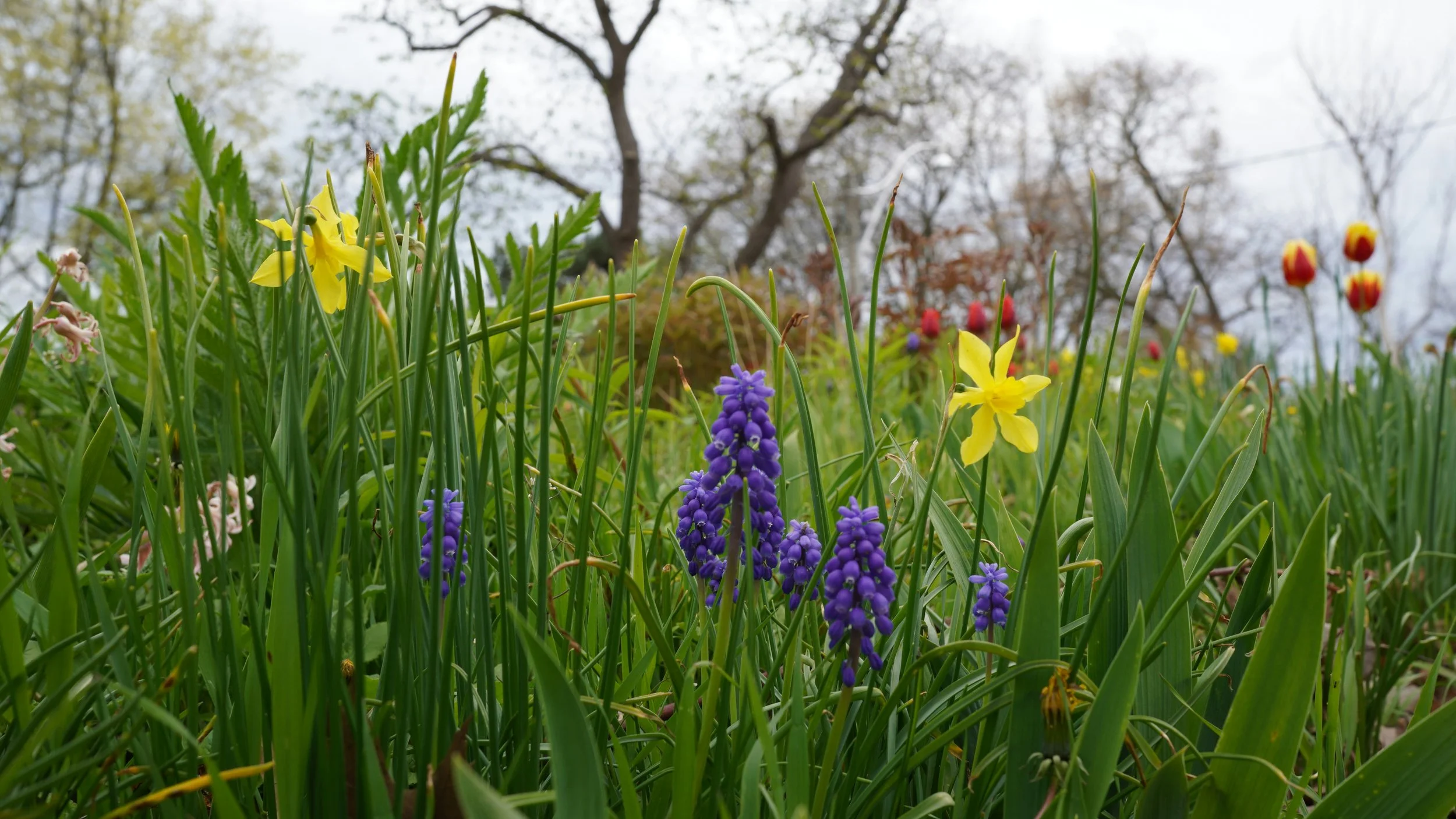
“the March of Biodiversity.” - Flowers in High Park Toronto.
Photo by Akshay Chauhan on Unsplash