
Sylvia C. Keesmaat
The first three of our passages this week are all concerned with the coming of the Creator God to right the wrongs of injustice, violence, and greed on the earth. While the Zephaniah passage and the Psalm describe this coming in terms of destruction for all of earth’s creatures, the Thessalonian passage, along with the gospel, highlights the way in which imperial realities are already engaged in the destruction of creation. The coming of the Creator God, therefore, will bring an end to the destruction that those with power have been wreaking on the earth.
The parable of the talents, on the other hand, describes how one enslaved man refuses to participate in the predatory land-destroying economics that have enriched his wealthy master. It is a sobering reality-check on the cost of non-compliance.
As a result, these passages work well in the context of an extended Advent, as well as in the lead up to the Reign of Christ.
Commentary
-
In some ways it is not hard to imagine this Zephaniah passage being written in the context of our own day, especially when we also include vv. 1-6 and 8-11, which the lectionary omits. Just as in the days of the flood, when the Creator’s heart was filled with grief over the violence and destruction that was being done by the heroes and warriors of old on the earth, Zephaniah 1 begins with God’s intention to sweep away humans and animals, birds and fish from the the face of the earth (1-2). The passage ends with the destruction of the entire earth, mirroring other passages that describe de-creation such as Jeremiah 4:23-29. In Jeremiah, however, God holds back, saying “The whole land will be a desolation, yet I will not make a full end.” (Jer 4:27). Here, in Zephaniah, it is as though time is up: there will be a full, a terrible end (Zeph 1:18).
Such an end is warranted, the text tells us, because judgement is needed against those who fill their master’s house with violence and fraud” (v. 9). In an agrarian society, what did such violence and fraud look like? Most often it was violence done against landowners in order to take their land (as in the murder of Naboth in order to seize his vineyard —1 Kings 21) and fraud consisted of moving boundary stones in order to gain more land (Job 24:2; Hosea 5:10), giving false testimony in order to gain land (1 Kings 21:8-14), and using false weights and measures to cheat sellers and buyers of barley and wheat (Amos 8:5–6; Micah 6:11; cf. Lev 19:36). In fact, Zephaniah says that there will be wailing because "all the traders have perished; all who weigh out silver are cut off” (v. 11). Just as those who relied on the imperial extractive economy in Revelation 18 are weeping and mourning, especially the merchants who can no longer sell their lucrative cargo (including animals and human lives; Rev 18:11-13), so in Zephaniah those who were at the top of an oppressive monetary system find themselves not only weeping, but gone. Those who thought there would be no consequences for their actions (Those who say in their hearts, “The Lord will not do good, nor will [God] do harm; v. 12) have found that they cannot continue to act with violence towards the land and the poor without reaping the reward: not only will their housing become uninhabitable and their vineyards destroyed, the implications of their actions for the earth will overtake them.
The language of God’s wrath in this passage is paralleled in other passages that try to describe the suffering of the people at the hands of invading armies, and at the hands of their own oppressive elites. For those trying to understand the destruction around them, language of God’s wrath seemed appropriate: “we can see the destruction that our leaders have created on the land. We can see the violence and oppression. Surely there will be judgement for this!” But as Terence Fretheim points out in The Suffering of God, in the Hebrew Bible the Godward side of judgement is always grief. Indeed, the thread of God’s grief that runs through the story, and the tension between anger and compassion that such grief creates (as in Hosea 11: 8,9) should not be ignored in this passage as well. The suffering and sorrow that violence and fraud has created on the earth is more than the Creator is able to stand. Only a new start, a complete purge can allow life to flourish once again. Later in Zephaniah, after the devouring officials, the unjust judges, and the reckless prophets and priests who have done violence to the law have been judged (3:3-8), a humble and lowly people shall renew the earth, those who do not lie and do no wrong (3:12-13). The Creator God is always looking for a way to begin anew.
-
Psalm 90 parallels the Zephaniah passage in its wrestling with why suffering has come upon the people, and it’s answer that the violence and oppression of the people have resulted in judgment. Also striking is the deep grounding in creation to understand not only who the Creator is, but also who we are. The faithfulness of the Creator began long before the mountains, earth and world were formed. Just as grass is renewed, flourishes, fades and withers, so the life of each human being has its brief role to play before it too becomes part of that ever renewing cycle of life and death, when we turn back to the earth once more (v. 3).
-
Every empire has its slogans intended to create unthinking trust in the rulers and warlords that are intent on maintaining power and control. In the Roman empire, one of those slogans was “peace and security.” What did the pax Romana offer but peace to those peoples that it brutally conquered, and what did the ongoing military presence of Rome, along with the payment of tribute and taxes, offer but security from unrest? Like all slogans, those who had been victims of the empire knew that “peace and security” was a lie. One ancient author, Tacitus, in his Agricola, (30.3-31.2) has someone describe the Romans in this way: `To plunder, butcher, steal these things they misname empire: they make a desolation and call it peace’. Behind such peace and security was desolation, an environmental nightmare. Those Roman roads, designed to carry troops to the provinces and bring produce to Rome, were 12 feet wide, 8 feet deep and cut straight across the countryside, disrupting streams and watercourses and destroying habitat. The mining necessary to provide the metal for weapons used enormous amounts of wood for mineshafts and smelting; Rome’s steady march northward was for wood as they used up whole forests not just for mining, but also for cooking, baths and shipbuilding. Every retired soldier was entitled to a farm; when land in Europe and Asia Minor became scarce, the empire began to cut down trees in Africa to enable farming there. This was the origin of the desertification of Africa.
Peace and security masked a reality of environmental destruction and despair. There is no doubt that Paul knew this when he took a potshot at the empire, asserting that the day of the Lord will come “When they say 'There is Peace and Security.'” He is taking direct aim at the Roman empire, confident in its military power, it’s supposedly divinely ordained rule, and it’s control over creation. He is challenging the universal story that the empire told and calling the Thessalonian community not to be lulled to sleep by the imperial story but rather to be alert to a different story: one where protection is not found in military might, but in faith and love, which protects like a breastplate, and salvation, which is like a helmet. The story of Jesus is one of restoration on this earth, as Paul outlines in the previous verses in 1 Thess 4: 13-18, where Jesus comes to dwell with us on the earth (see resources below for a short video on these verses). It is not a story where “Peace and Security” are a mythological cover for environmental destruction and devastation.
Black theologians have recently raised awareness of the harm that metaphors of light and darkness can cause those in the BIPOC community. A verse like 1 Thess 5:5 therefore (“for you are all children of light and children of the day; we are not of the night or of darkness”) is problematic. In our own context, where the construct of race has done incredible harm we need to take the overtones of this verse seriously. That said, in the ancient world, our modern notions of race did not exist. Those who were enslaved were of all ethnic backgrounds: capture in war, abandonment as a child, falling into debt—any of these could result in slavery. Social status and honour were not linked to race. They could, however, be linked to ethnicity; although those europeans with lighter skin (the Gauls, Germans, and Britons) were often considered to be more barbaric than those from southern Europe (Greece and Italy) or Asia Minor (modern day Turkey).
It is also important to remember that the natural phenomenon of daylight and the darkness of night were far more consequential in the ancient world than they are today. In a world where there was no electric light, the setting of the sun had significant implications for safety, for the ability to see well enough to cook or engage in outside labour, and for the rhythms of animals who needed to be fed or milked. Of significance for this passage, night (especially in an urban setting, where moonlight and starlight were blocked by buildings and high walls) was a time when danger lurked, when theft happened, when violent acts could be carried out and when, apparently, people were likely to become drunk and unaware of all that was going on around them (v. 6-8). It was also the time for sleep. This is why Paul talks about staying sober and staying awake; it is important to know what is happening around you. As a metaphor for not knowing when something is about to happen, a thief in the night, works well in this context.
But Paul also turns the metaphor on its head: being people of the day means that everything that the community does is above board, not needing the violent armour of the night, but the armour of love, faith and salvation. The end of the passage, shifts the metaphor and circles back to the beginning of chapter 4: whether we are awake or asleep, our Lord Jesus Christ died for us so that we might live with him. Here “asleep” refers to those who have died, who are not lost, and who will live with Jesus. Whenever that day comes, says Paul, it will be the day when we begin to our new life on earth with Jesus. This is the basis for encouragement in the community.
-
The overuse of this parable as a basis for stewardship Sunday and the responsible use of one’s gifts and talents has entrenched an interpretation of this text that misses its thrust in a first century context. Unlike parables of the kingdom, this parable does not equate the main character of this story with God. Rather, this is a man of some wealth, going away on a journey, as wealthy landowners did in the first century. Before leaving, he entrusts three enslaved men with enormous sums of money. At the time a talent was equal to about fifteen years wages. The first enslaved man received therefore, five talents, 75 years worth of wages—or the equivalent of a lifetime of work (according to the Psalm for today; Psalm 90:10). The second enslaved man received two talents, the equivalent of 30 years of wages, and the third received one talent, 15 years of wages. These are enormous sums of money, adding up to millions of dollars in the present day.
The first two slaves begin immediately to use their money to make more money. Read through the eyes of capitalism, this seems like a good thing. Read through the eyes of an Palestinian peasant living on a subsistence farm, this is a story of tragedy. How would it be possible for someone to double enormous sums of money in the first century? There was no stock market. Usually this happened by giving loans to farmers who, for some reason, were unable to pay their taxes, or who, after a bad year were unable to save seed for the next year. Illness, drought, having been on the receiving end of violence, unreasonable demands from tax collectors or other officials—many circumstances created the need for a loan. Once the loan was due, if the farmer had not had a harvest that was successful enough to pay the loan back—which was often required in crops like wheat, olive oil, or grapes— the farmer’s land could be taken. It would then be farmed by the loan shark with hired labour, further increasing his profits. There is no question that the enslaved men who doubled their money were engaged in this kind of rapacious economic activity. There was no way to make such a substantial profit.
Behind the dynamics of this story, therefore, lies the heartache of land loss. The grief of the farmers who no longer live on the land that belonged their ancestors. The sorrow of the children who are no longer able to play on land that holds the stories of their parents and grandparents and great-grandparents. The lament of the creatures on the land who are no longer served with care and affection, but who are, rather, treated as economic units to be used for maximum profit.
It is possible, of course, that the three enslaved men were the victims of land loss themselves. It is quite possible, since falling into debt could result not only in the loss of land, but also in the loss of freedom. Were the two enslaved men, therefore, also grieving the loss of their place on the land? All we know for sure is that, as enslaved men, they did not have much choice. They were now being forced to participate in an economic system that had quite possibly deprived them of their freedom.
Into this picture of loss enters the third enslaved man. Even though he is enslaved, he has refused to engage in the exploitation of the farmers and the commodification of the land that has been required of him. Instead, he buries the money that his master has given him. It is money, not a seed. It will not bear fruit in from the earth. Nor will it do any harm.
In time the master returns to see how well those who are enslaved to him have done. He describes the two who have doubled their money as good and trustworthy slaves and invites them to enter into the joy of their master. Traditionally this has been read at face value, these enslaved men are “good and trustworthy” people. But they are only good and trustworthy within the economic system of their master, like corrupt CEOs who bring in a great return for their shareholders by mining the land of Indigenous peoples or refusing to clean up defunct oil wells. The joy they enter into is actually a further enslavement into the economic system of abuse.
It is left to the third enslaved man to tell us exactly what this master is like: “I knew that you were a harsh man, reaping where you did not sow and gathering where you did not scatter.” Who reaps what they do not sow and gathers from seed they did not scatter except someone who is taking the property of others, or demanding all of their crop in payment of debt? Perhaps he knew this from his own bitter experience with the master. Perhaps not. Either way, participation in such unjust systems was not for him.
And the master does not even bother to deny his description: “You knew, did you, that I reap where I did not sow and gather where I did not scatter? Then you ought to have invested my money with the bankers, and on my return I would have received what was my own with interest.” The third enslaved man has accurately described the master. This is not why he is condemned. He is, rather, called wicked and lazy for refusing to ensure that his master could continue to charge interest. He is wicked and lazy for refusing to make this money grow, if not by foreclosing on farms, then at least by taking the money to the money tables in the temple where it would be traded to his advantage.
In the unjust world of the master, this enslaved man is considered wicked and lazy. In the economy of the kingdom he is considered the faithful and trustworthy one.
The results are predictable: the money that the third slave has is taken and given to the one who is richest. And the third slave is thrown into the outer darkness, where there is weeping and gnashing of teeth (v. 30).
As Myers and DeBode point out, this ending is best read in light of the following parable of the sheep and the goats which
“suggests that we meet Christ mysteriously by feeding the hungry, giving drink to the thirsty, welcoming the stranger, clothing the naked, caring for the sick, and visiting the imprisoned (Matt. 25:25-40). In other words, we meet Christ in places of pain and marginality; the "outer darkness." The whistle-blower's punishment kicks him out of the rich man's system, but brings him closer to the true Lord, who dwells with the poor and oppressed.” (p. 6; see resources below).
Teaching and Preaching Ideas:
1. Consequences for those Destroying the Earth
It isn’t that hard to draw a parallel between the destruction of the earth that results from the violent and fraudulent activities of those in power in our own context and the context that Zephaniah was talking about. In light of the recent U.S. midterm elections last week (2026), those who felt that there would be no consequences for their actions are now facing those consequences (we hope) and those who had intended to continue their creational destruction through data centres, the stripping of environmental protections, and unbridled war are now the ones who will no longer be saved by their gold and silver, for their judgement is at hand.
2. Imperial Lies of Peace and Security
The parallels with the lies that large corporations and certain countries tell about the flourishing of creation under their control is also easily paralleled with the Thessalonians passage. In fact, in Canada, “peace and security” resonates with what the Carney government is doing by ramping up defence spending, fast-tracking so-called “national interest” projects, and doing away with environmental protections and safeguards. It doesn’t take a rocket scientist to see that such “peace and security” is a lie both for the many creatures whose peaceful and secure existence in their habitats will be destroyed if these plans are fulfilled and for Indigenous peoples and northern communities who will face insecurity, disruption and violent destruction as a result of pipelines and defence initiatives.
Similarly, the violent deportation of immigrants, the oppression of those in the trans community, the genocide in Gaza and the bombing of civilians in Iran are all happening in the name of “peace and security” in the United States. And yet these actions bring neither peace nor security for oppressor or oppressed. The empire loves a good slogan, even if it is a lie.
In the face of that, Paul has been talking about another community where peace and security are found in the love and faith and salvation found in Jesus, who is bringing no cheap slogan but rather new life.
3. Resisting Imperial Land-destroying Economics
The parallels between the violent economic system that is outlined in the parable of the talents and our own economic structure are also very easy to draw. This parable serves as a cautionary tale, however, to those who resist the powers that be. Those who, like the third enslaved man, call out what is happening at the highest levels, those who refuse to participate in the economic system of the harsh masters are likely to find themselves excluded from the system, in company with others who are suffering the injustices of radical inequality. The following parable makes clear, however, that those who follow Jesus are those who are found in the company of those who are unhoused, those on poverty wages, those who are incarcerated, and those who cannot afford food or adequate clothing. In addition, the place of those who follow Jesus is in the company of those suffering mental or physical illness as a result of the trauma that our culture inflicts on minorities and the poor and on the very earth itself. It is in the community of such people that we will find our place as “good and faithful servants.”
4. God’s Holy Darkness
A reflection on the imagery of light and dark in the context of a world where both human beings and other creatures are having their circadian rhythms disrupted by electric light and screens would be an interesting interaction with the Thessalonians passage. After all, what do we offer when a child is scared in the night? In our world we offer electric light, sadly, rather than presence and embrace. An exploration of the difference between how we experience light and darkness and how light and darkness in the ancient world (along with some discussion of how this imagery feeds into anti-Black racism in our time) would set the stage for a further exploration of darkness in the biblical story. Such an exploration would include the places where God is present in the darkness throughout the biblical story, starting at Genesis 1, to Jacob at night in the wilderness (and the staircase to the earth), to stories where God shows up in dreams, to the angels in the night sky at Jesus birth, to the resurrection “while it was still dark” in John 20.1.
Resources:
Ched Myers and Eric DeBode “Towering Trees and Talented Slaves: Jesus Parables”
From The Other Side Online, © 1999 The Other Side, May-June 1999, Vol. 35, No. 3: https://bcmonline.org/1999/05/01/articles-bible-study-towering-trees-and-talented-slaves/ (there is a further link on this page to a download of the whole article)
Sylvia Keesmaat “Why the Rapture is Not Biblical” (8 minute video): https://www.youtube.com/watch?v=k-LSAUOsOIY&t=2s
Sharei Green and Beckah Selnick, illustrated by Nikki Faison. God’s Holy Darkness. (Beaming Books, 2022). This is a children’s book.
Contributor Bio
Dr. Sylvia C. Keesmaat is a biblical scholar, off-grid permaculture farmer, and activist. She has just recently completed a book called Torn Between Grief and Hope: Ecological Grief in the Biblical Story, forthcoming from Cascade in the coming year. She is also the author (with Brian Walsh) of Romans Disarmed: Resisting Empire, Demanding Justice, and Colossians Remixed: Subverting the Empire. Sylvia teaches online pay-what-you-can courses that are open to all at Bible Remixed (www.bibleremixed.ca). Her Advent 2026 course will be on water in the biblical story. Sylvia lives with her husband Brian Walsh and a fluctuating number of people and animals on the land of the Michi Saagiig Anishnaabeg in the Kawartha Lakes in Central Ontario.
Image Description
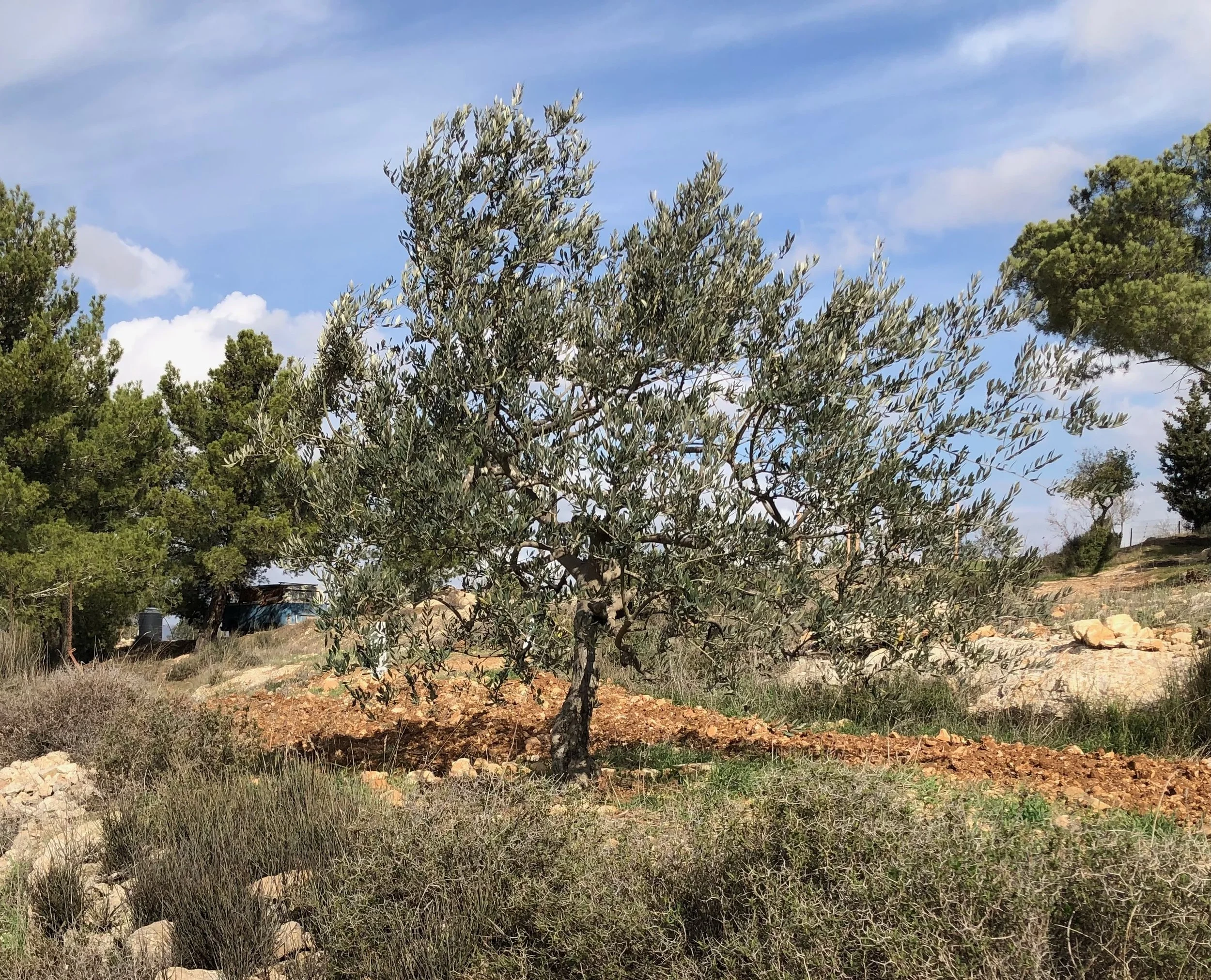
An olive tree on Tent of Nations Farm, near Bethlehem on the West Bank. The Nassar family has been resisting the take-over of their farm by Israel for the last 35 years. Photo by Sylvia Keesmaat.