
Genocide, Refugees, and Creation’s Praise: 1st Sunday of Christmas Year A
Rev. Emily E Ewing
While it is irresponsible to skip this week’s Gospel, holding it in conversation with the other readings for the day proves tricky. Isaiah and Psalm 148 are filled with praise for God, Hebrews casts Jesus as the high priest and sacrifice in his perfection, and the Gospel casts Jesus as a first century Moses, complete with genocidal acts by a powerhungry ruler. And that’s just the biblical take! Creation’s praise of God calls us out of our human-centric approach to life, even as Isaiah and Matthew call us toward the most vulnerable and the communities and peoples God loves. Today, world leaders talk about “peace”, but bullets and bombs still fly and people still starve. Where is the Good News? Maybe that’s not the task for today. Maybe it is enough that God is still with us and we do not face the horrors alone.
Commentary
-
God is present in the communities of God’s people
Verse 7
God’s love is abundant.
Verse 9
God redeems (pays the debt of/rescues) God’s people; God’s presence saves.
-
A psalm of praise from all Creation to God.
Verse 1
High places praise God.
Verse 3
Sun, moon, and stars praise God.
Verse 4
Sky and clouds praise God.
Verse 5
God commands creation.
Verse 6
Good boundaries!!
Verse 7
Earth, sea and its creatures praise God.
Verse 8
All weathers praise God.
Verse 9
Landscape and trees praise God.
Verse 10
Creatures of land and air praise God.
Verse 11
Rulers and subjects praise God.
Verse 12
All ages and genders praise God.
-
Jesus joins humanity in suffering, even as our sanctifier and high priest.
Verse 10
God as Creator of all and Jesus framed as a martyr (perfection from suffering).
Verse 14
All are made of the same stuff; Jesus destroys the power that death holds over humanity
Verses 15
Free from fearing death.
Verse 17
Jesus’ perfection from the beginning of the passage now points towards that of the high priest who sacrifices on Yom Kippur and the unblemished animal sacrifice itself.
-
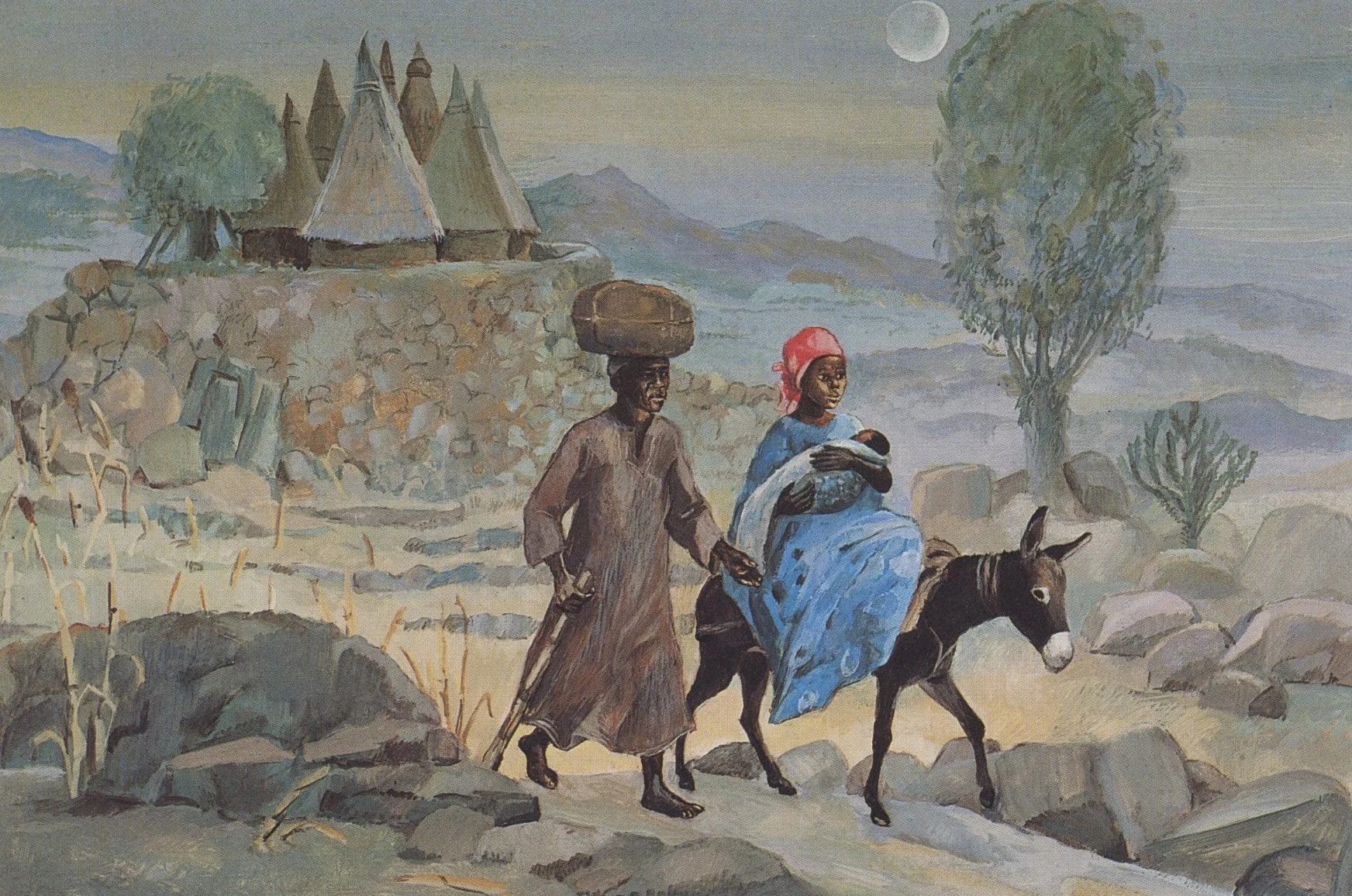
Casting Jesus in Moses’ role, he and his family flee the wrath of Herod, exacted on the infants and toddlers of Bethlehem.
Verse 13
Another of Joseph’s dreams, this time as warning leading the holy family to become refugees.
Verse 15
From Egypt traveling lands well-travelled.
Verse 16
Genocide and violence, aimed at humans, yet always impacting the whole of creation.
Verse 18
Lament over genocide.
Verse 22
Power and the ease with which rulers can abuse it, cause fear and change plans.
Teaching and Preaching Suggestions
Journey to Pilgrimage
The journey that Mary, Joseph, and Jesus take is long, with the current geopolitical climate making it even longer. There is currently, according to Google Maps, no way to walk from Bethlehem to Egypt, but the walk from Bethlehem to Cairo is 716 km, 161 hours, long because it cannot go through the Gaza Strip, but instead must go along the eastern border of what is now the country of Israel. The journey back and north to Nazareth adds 828 km and 186 hours to the total trip, making it a total of 1544 km and 347 hours. All this because travel in and out of the Gaza Strip and along Route 40 is being controlled and blocked by Israel.
When compared to the long traveled Camino de Santiago, this route would be a different kind of pilgrimage, traveling through the lands that Jesus’ family travelled. While this most clearly connects with the Gospel reading, the praise for God’s saving presence in Isaiah and Psalm 148’s praise of God by all of Creation would certainly resonate for all who would travel this pilgrim’s journey. It would also spark new questions. Would Israel commit genocide in a place of sacred pilgrimmage? Would they be able to keep journalists out? Would people from North America have a better sense and better connection to Palestinians when crossing through Israeli checkpoints for the pilgrimage? How does describing the journeys, roadblocks, and hazards today help connect powerhungry despots of the past to the present?
Creation’s Praise
Psalm 148 dives deep into all of Creation’s praise of God. Using the Hebrew poetry technique of a merism at various points (fire and hail in v. 8; men and women, old and young in v. 12) to encompass the full diversity of creation, the psalm fits well within the Christmas season, yet strikes a jarring chord when it comes to the Gospel. Both Isaiah and Psalm 148 praise God for God’s presence while the Gospel and Hebrews unsettle with suffering, sacrifice, and genocide in the murder of a community’s children. But what are humans to Creation? For so long Creation has gifted humanity, as Robin Wall Kimmerer points out in her book Braiding Sweetgrass, with life and sustenance and outside of First Nations and Native peoples, humanity has largely taken advantage of Creation. What does it look like to lean into Creation’s praise of God? How does that inform human understandings of violence, oppression, and genocide?
Refugees
Mary, Joseph, and Jesus, following a dream, flee for their lives. They escape what would have surely been death. While Matthew uses this story to position Jesus as a new kind of Moses, from the murder of babies to the flight to Egypt, the story also takes on new meaning in a world where those with the most power are growing in their warmongering, kidnapping, and genocide. The people of Gaza and Sudan, Latine immigrants and transgender people in the united states, boats from Venezuela and people of Ukraine all face danger and death. And the reality is that climate change is further creating climate refugees, particularly for Pacific Islanders and Native people in and near the Arctic Circle, and even internal climate refugees as people are forced to leave their homes due to climate disasters.
How are countries responding? Some open their borders and refugee processes to more people, others restrict refugees and asylum seekers. None have thrown wide their gates. While Canada is a far cry from the united states, they still don’t extend immigration rights to disabled people, who are so often left behind during a climate disaster. What would a world where Creation was the guide look like? How would sun, moon, and shining stars divide up the land and waters? How would weather? Animals? Plants? They have divided it, not with borders and military might, but with diversity and resources that grow where they are needed and nurtured. God’s presence is not far off, but as Isaiah claims, God’s presence saves. And God’s presence is with those suffering, displaced, and marginalized, seeking safety.
Sources and Resources
For more on the understandings of perfection, from Hebrew, check out the article “Perfection through Suffering” in The Jewish Annotated New Testament, p. 408, as well as notes on the Hebrews text itself.
For more information on refugees on a global level, check out the UNHCR: https://www.unhcr.org/about-unhcr/who-we-protect/refugees
UNHCR also has information specific to climate refugees, but Climate Refugees is also a great place to learn: https://www.climate-refugees.org
Learn more about Palestine from Palestinians: https://www.travelpalestine.ps/en
For more on the history of Palestine, check out The Hundred Years’ War on Palestine by Rashid Khalidi.
To dig into Matthew and anti-Judaism, check out “Matthew and Anti-Judaism” in Currents in Theology and Mission by Jewish New Testament Scholar Amy-Jill Levine: https://lstc.edu/wp-content/uploads/2023/02/Amy-Jill-Levine-Matthew-and-Anti-Judaism-Copy.pdf
For more on the climate impact of war, genocide, and militarism, check out this article from 2023: https://climatedefenseproject.org/a-note-about-genocide-and-climate-injustice/
Contributor Bio
Rev. Emily E. Ewing (they/them) is a Lutheran (ELCA) pastor serving in Baltimore, Maryland working on their MFA in Community Arts from the Maryland Institute College of Arts (MICA). They combine creativity, spirituality, nerdiness, and the call to justice in many ways. Pastor Emily cohosts the Horror Nerds At Church podcast. They consult with communities of faith for anti-oppression trainings, Doodle Care spiritual practices, creative community projects, and whatever the Spirit calls them to.
Image Description
Flight into Egypt from the JESUS MAFA series shows a dark-skinned couple in Cameroonian attire walking away from a village with a bundle on the head and walking stick in the hand of the one on the left. The one on the right carries a baby, wears a red headscarf, and rides on a donkey. The moon is visible in the sky.
JESUS MAFA. Flight into Egypt, from Art in the Christian Tradition, a project of the Vanderbilt Divinity Library, Nashville, TN. https://diglib.library.vanderbilt.edu/act-imagelink.pl?RC=48313 [retrieved December 19, 2025]. Original source: http://www.librairie-emmanuel.fr (contact page: https://www.librairie-emmanuel.fr/contact).