
The Vulnerable in God’s Economy: 17th Sunday After Pentecost (A)
Laurel Dykstra
The Season of Creation theme is Living Waters yet the Exodus passage is set in a wilderness landscape where water is scarce. Having come out of the well-watered and well-provisioned slavery in Goshen, through the Sea of Reeds, and into the wilderness, the Hebrews’ complaints and God’s response offer an opportunity to reflect on the wilderness prophet Miriam and her association with water, while the story of manna and quail points to God’s divine economy of abundance. The psalm emphasizes the agency of more than human actors (Cloud, Fire, Water) in this liberation story. In the Gospel, the Matthew kingdom parables invite engagement with the unjust realities of workers who labour to produce food on land owned by others. In a time of human-caused drought and food scarcity in a global economy, these scriptures read us as we read them.r it is, the way you tell your story online can make all the difference.
Commentary
-
There are a few textual points worth making but I’ll stick mostly to the funny ones.
The passage begins with complaints against Moses and Aaron (verse 2), yet it is God who hears and responds, a gentle/generous contrast to the Hebrews call and God’s response under slavery (Exodus 2:23-25). The exaggerated drama of the complaint “if only we had died…” is heightened in the parallel passage in Numbers 21:5 “there is no food and no water, and we detest this miserable food.”
In the arid wilderness the promised food is associated with water: rain (verse 4) and dew (verses 13 and 14)
In verse 15 the Hebrews ask of the mystery food man-ha, “what is it?” and the answer comes in the form of a word-play in verse 31: manna, the name of the stuff is “what is it.” Manna is described in down-to-earth, plant-based descriptors “like white coriander seed” “like wafers made with honey.” And in Numbers 11:7 “like resin,” which Dong Hyeon Jeong calls vegetal wisdom. One modern explanation is that manna might be honeydew, a sugary secretion of sap-eating insects.
The repetition of morning and evening (verses 8, 12, 13) resonates with the creation narrative and with Jesus’ prayer for daily bread.
-
Psalm 105 is a psalm of praise and thanksgiving, which recounts God’s saving acts in the history of God’s people. Verses 23-45 encapsulate the Exodus and in verses 28-25elements of the more-than-human world are employed by or conspire with the divine against Egypt, then in verses 39-41 cloud, fire, quail, manna, water are the agents of salvation in contrast with the gold and silver of verse 37 which serve no purpose in the wilderness.
The language of salvation/liberation through creation is very beautiful: a cloud spread out for covering, gushing water like a river in a dry place.
Yet in verse 44 the description of liberation from enslavement turns to conquest and despoilment.
-
Like the other gospels, Matthew (Matthaios) describes the life of the disciples (mathetes), but it also makes use of the word matheteutheis, which means one who has learned, been taught, or lives out certain teachings. In Matthew, discipleship means doing the word.
There are between 16 and 20 parables in Matthew, depending on the definition The parable of the vineyard workers is unique to Matthew and typically emphasizes work and money, and authority, and judgment for the failure to act with love and compassion. Unlike true parables, which are provoking stories that juxtapose realities and invite engagement, this is more of an allegory, a fixed moral tale where each character or object corresponds to an idea or person in the world.
In the matthean kingdom parables, God’s reign or divine economy is often described in terms of action “a householder who went out.”
Householder may be a better translation than landowner
The vineyard is a recurring image for Israel, land and people.Verse 13 -the address friend should alert the hearer/reader to be suspicious, other instances in Matthew are not used sincerely (22:12, 26:50)
Teaching and Preaching Ideas
Miriam
As we consider the presence, absence, and value of water we might focus on Miriam, consistently associated with water: as a young girl she saves the savior Moses at the Nile, her victory song at the Reed Sea is one of the oldest parts of scripture, and so revered is she, that in a parallel version of today’s passage, her death is like the absence of water (Numbers 20: 1b-2a).
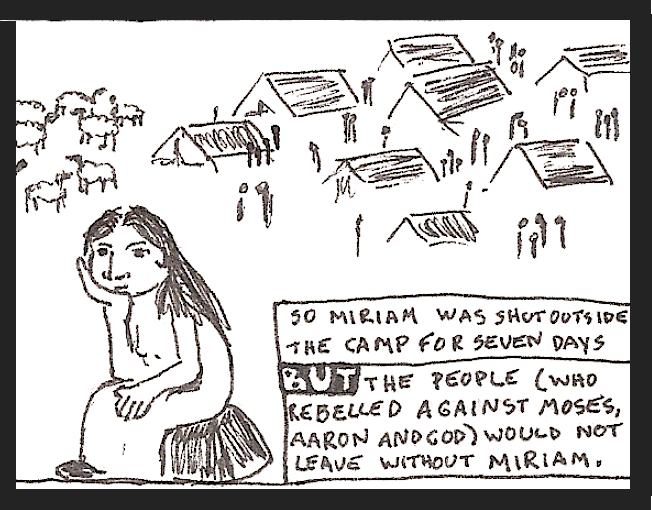
Miriam is not uncontroversial: she defies Moses in a conflict where both anti-African racism and sexism are at play, and although in scripture her status parallels Moses and Arron and she is described as both priest and prophet is largely neglected in the lectionary.
Miriam’s association with water connects with the realities of women and children in the clean water crisis. Globally women and children, mostly girls, carry water hauling heavy loads over many hours. Infants and young children die disproportionately from diseases in unclean water. There is a huge gender gap in water governance, where women lack decision-making power with regard to water use. However, women are also at the forefront of water protection movements: Anishinaabe Water Walkers carrying water in sacred ceremony around lakes and rivers, Lakota women declared “Mni Wiconi, Water is Life” defending the Missouri from the Dakota Access Pipeline, women in Guatemala and India lead opposition to mega-dam projects, protecting ancestral lands, water sources and traditional livelihoods. Miriam’s last recorded words connect powerfully to women’s water struggles, “Has God not spoken through us as well?” (Numbers 12:2).
Manna, What is it?
Another homiletic approach is to consider the lessons of manna framed around the scriptural word play “what is it?” as a recurring question.
Manna, what is it? A wilderness school that gets Egypt out of the people? The Hebrews, reliant in the wilderness on herd animals, may have eaten sugary honeydew, excreted by aphids feeding on tamarisks, and on migratory quail, easy prey exhausted after their evening landing.
Manna, what is it? A lesson in God’s economy of abundance? Manna appeared daily in sufficient quantity for everyone to have enough. People had to work to gather it, it didn’t appear in their plates or in their mouths. If you tried to hoard it, it would rot, grow maggots and smell foul. Abundance is not about having more than you need, but trusting that there will be enough if we share.
Manna, what is it? A Climate Crisis parable for the Global North? Many Black, Indigenous, POC, and disabled communities have shared in manna-like economies of mutual aid, solidarity and small-scale resistance to cascading apocalypses of colonialism, racism, ableism for centuries. For the privilege-insulated among us, who are only lately awakened to the consequences of capitalism driven climate crisis, perhaps the miracle of manna is not a magic fix, that God makes bread out of nothing, but that reality that the feared and despised places are a source of nourishment if we share and don’t take more than we need.
Love in Action
In Dostoevsky’s The Brothers Karamazov, the elder Father Zosima exhorts a wealthy woman to “active love” as a remedy for her doubts. “Strive to love your neighbor actively and indefatigably. In as far as you advance in love you will grow surer of the reality of God and of the immortality of your soul.” When she confesses her sentimental dreams of a life of service to the poor and her fear of their ingratitude, Zosima—while remaining kind—delivers a scathing critique of responding to poverty with charity, which is chiefly about controlling and defining the one who is in need. He concludes by saying, “I am sorry I can say nothing more consoling to you, for love in action is a harsh and dreadful thing compared with love in dreams.”
In Matthew, as Jesus and his companions approach Jerusalem, the parables lean more toward this harsh and dreadful love. They ask what love means in practical terms. How do we resolve conflicts in community? How do we love one another in a world of complex economic and social relationships? How do we deal with authority and power? How do we honor our families? The realities of debtors’ prison, day labor, prostitution: This is not the love of dreams.
There are compelling readings of the parable of the vineyard laborers, like Cynthia Bourgeault’s which interpret the householder as a gracious and inclusive God, and others like Ched Myers’ which focus on the social reality of exploitative landowners. Whichever interpretation you choose I encourage you to focus on the realities of vulnerable day labourers, agricultural workers and people who are undocumented.
Folks who work for the “decent” day-labor place in my neighborhood work all day for minimum wage. After they have paid for water, lunch, transportation, gloves, earplugs, and check-cashing, they have about two thirds of what they earned—enough for dinner, a bed at a hostel, breakfast, and maybe $10 left over. Workers who wait on the corners where contractors and carpenters know to find them, “idle in the marketplace,” earn less and are mistreated more. How can churches love in action be real and meaningful for these most vulnerable of workers?
Sources and Resources
Write the Canadian Government calling for action to ensure Indigenous peoples’ right to clean drinking water.
https://canadians.org/fn-water/
Water Wonder Box -a multi age curriculum for exploring the theme of water in scripture
https://www.salalandcedar.com/resources/2024-10-bbcnbky3fn1dh1fo7l13n2dtz7v98q
Come All You Green -a water focused baptismal prayer
https://www.salalandcedar.com/resources/come-all-you-green-baptism
Embracing the Divine Exchange: Laborers in the Vineyard, Cynthia Bourgeault at Center for Contemplation and Action https://cac.org/daily-meditations/the-laborers-in-the-vineyard/
Ched Myers on the Parable of the Workers in the Vineyard https://www.youtube.com/watch?v=Kik_sha9P4U
Ched Myers, A Fool’s Economics, Radical Discipleship
https://radicaldiscipleship.net/2016/07/28/a-fools-economics/
Ched Myers, Healing Affluenza and Resisting Plutocracy: Luke's Jesus and Sabbath Economics, Fortress Press, 2025.
Wendell Berry, Two Economies
http://www.worldwisdom.com/public/viewpdf/default.aspx?article-title=Two_Economies_by_Wendell_Berry.pdf
Robin Wall Kimmerer, Abundance and Reciprocity in the Natural World, Scribner, 2024.
Sheryl Johnson, Serving Money Serving God: Aligning Radical Justice, Christian Practice, and Church Life, Fortress Press, 2023.
Dean Spade, Mutual Aid: Building Solidarity During this Crisis (and the Next), Verso Press, 2020 https://www.deanspade.net/mutual-aid-building-solidarity-during-this-crisis-and-the-next/
Contributor Bio
Laurel Dykstra is the founding priest of Salal + Cedar Watershed Discipleship Community, a church that worships outdoors and seeks to help Christians in the lower Fraser watershed grow their skills for Climate Justice. They are also vicar of St. George’s, Fort Langley a progressive church in an historic building. Laurel’s latest book on interspecies loneliness, Wildlife Congregations is a finalist in the Roderick Haig-Brown Regional Prize of the BC/Yukon Book Prizes.
Image description
A simple cartoon-style drawing. In the foreground on the left a person with long hair and a long robe sits on a rock, with their chin cradled in their hand. In the background is a flock of sheep on the left and a group of tents and people on the right. In the lower right-hand corner a boxed caption reads: So Miriam was shut outside the camp for seven days, but the people (who rebelled against Moses, Aaron and God) would not leave without Miriam.