3rd Sunday after Pentecost: A gift from the Hawk’s Rock Wamanwawa people
Andrea Tsugawa
A couple of months ago, I had the chance to sit with an Elder. A Reverend of the Ganosono (Gah‑nuh’-sun‑noh) of the Turtle Clan, Cayuga Nation of the Six Nations Haudenosaunee (Hoh’-den‑noh‑show’-nee) Confederacy at Grand River Territory. He looked at me and said, “So you are Quechua, right?” It was the first time we had ever met.
He began telling me how, years ago, he traveled to Jerusalem and met Pastor Rómulo Sauñe Quicaña, the advocate and translator of the Chuya Qellqa Bible, the Quechua Bible. The same Bible I later found, the one that changed my entire way of relating to Scripture.
The Elder told me the intention behind Rómulo’s work: how he wanted to create this Bible for his people, for us, the Quechua, so that we could receive the Word in our own language, within our own boundaries, and with our own songs. He shared how Rómulo lost his life defending this cause during the period of terrorism that targeted not only evangelical churches but also Indigenous peoples.
I received his words knowing there was something more in the work I do, something, something entrusted, whispering from our Lands to our spirits.
This is a gift from Rómulo and from our Wamanqaqa territory, the Hawk 's Rock people, to all who may resonate with it. Here, I’m just the messenger.
Commentary
-
Quechua: 9:35 Jesusmi purirqa llapallam llaqtakunapi hinaspa llaqtachakunapipas huñunakunanku wasikunapi Diospa munaychakusqanmanta yachachistin, allin noticiakunata willakustin chaynataq tukuy onqoqkunata hinaspa nanayniyoqkunata sanoyachistin. 36 Runakunata qawaykuspanmi llakipayarikurqa wischusqa, cheqesqa hinaspa mana michiqniyoq ovejakuna hina kasqankumanta. 37 Chaymi discipulonkunata nirqa: —Achkallañam kachkan cosechanapaqqa, cosechaqkunam ichaqa aslla. 38 Chaynaqa mañakuychikyá chakrayoqta cosechaqkunata kachananpaq.
10:1Chaymantam Jesus qayarqa chunka iskaynintin discipulonkunata hinaspam atiyta qorqa demoniokunata qarqonankupaq chaynataq imaymana rikchaq onqoyniyoqkunatapas hinaspa nanayniyoqkunatapas allinyachinankupaq. 2 Chay chunka iskaynintin apostolkunaqa kaykunam: punta qayasqan Simon, paypa huknin sutinmi Pedro, wawqen Andres, Zebedeopa churin Jacobowan Juan, 3 Felipe, Bartolome, Tomas, impuesto cobraq Mateo, Alfeopa churin Jacobo, Tadeo, 4 cananista partidomanta kaq Simon hinaspa Jesus traicionaq Judas Iscariote. Willakamunankupaq discipulonkunata Jesus kachasqanmanta 5 Kay chunka iskayniyoq discipulonkunatam Jesus kacharqa kaynata kamachispan: —Amam rinkichikchu mana judio runakunapa llaqtanmanqa, amataqmi yaykunkichikchu Samaria runakunapa llaqtanmanpas. 6 Puntataqa riychik chinkasqa ovejakuna hina Israelpa miraynin runakunamanyá. 7 Rispayá willakamuychik: “Diospa munaychakunanmi hichparamunña” nispa. 8 Onqoqkunatayá allinyachimuychik, wañuqkunatayá kawsarichimuychik, leprawan onqoqkunatayá allinyachimuychik, qarqomuychiktaqyá demoniokunatapas. Qamkunaqa mana imallawanmi chaskirqankichik kay atiyta, mana imallapaqtaqya qamkunapas qomuychik.English: 9:35 Jesus walked through all the villages and communities, teaching in their gathering places and sharing the good life‑giving the message of God’s love. He healed the sick and brought relief to those who were suffering. 36 When he looked at the people, his heart was deeply moved, for they were tired, burdened, and without guidance, like sheep without a shepherd. 37 Then he said to his disciples: “The harvest is abundant, but the workers are few. 38 Ask the owner of the fields to send more workers for the harvest.”
10:1 After this, Jesus called his twelve disciples and entrusted them with strength and authority to drive out harmful spirits and to heal every kind of sickness and pain. 2 These are the twelve: Simon, called Peter; his brother Andrew; James and John, sons of Zebedee; 3 Philip; Bartholomew; Thomas; Matthew the tax collector; James son of Alphaeus; Thaddaeus; 4 Simon the Canaanite; and Judas Iscariot, who later betrayed him. 5 Jesus sent these twelve with the following instructions: “Do not go to the lands of those outside our people, nor enter the Samaritan communities. 6 Go first to the communities of Israel who are like lost sheep.7 Announce this message: ‘God’s loving presence has drawn near’ 8 Heal the sick, bring life back to those who have died, cleanse those with leprosy, and free those trapped by harmful spirits.
You received this gift without paying; in the same way, share it freely, asking nothing in return.”
Commentary:
35 For the Quechua people, the allin noticiakuna or allin willakuy carries not only the idea of “good news,” but also the sense of well‑being, harmony, community, and creation. It is a manifestation of allin kawsay or sumaq kawsay, the principle of good living. What Jesus brings is not merely information but a message that restores balance within the human and cosmic order.
36 When this passage refers to those who are exhausted, it invokes a sacred Quechua principle rooted in labour and will: llankay, the dignity of work. The way these people were laboring and exercising their will was leaving them in pain and imbalance. Jesus does not feel simple pity; he feels a communal responsibility to restore the sacredness of their work.
In the Andean worldview, suffering is never an individual experience. It is shared by the community, and healing is likewise communal.
37–38 When we understand harvesting from a Quechua perspective, reciprocity (ayni) and communal work (minka) cannot be separated from its meaning. Thus, when Jesus points out the abundant work and the few workers, he is highlighting a break in the balance of communal labour. The sacred agricultural cycle requires harmony, and Jesus is calling for its restoration.
10:1 Jesus gives power to the disciples through atiyta qorwa — a transmission of living force. Passing on strength in this context is not merely granting authority; it is a flow of spiritual energy, a relational empowerment rather than a hierarchical one.
2–4 When Jesus names his disciples, he does so as a community, an ayllu, not as isolated individuals. He recognizes each by name and affirms their relational identity. In doing this, Jesus reminds us that there are no solitary followers, only a collective of believers bound together.
5 In this verse, the instruction “do not go” establishes a boundary. In the Andean worldview, boundaries are grounded in love — an ethical relational compass that guides accountability and responsibility. The boundaries Jesus sets are not expressions of rejection or fear, but are rooted in the ethos of love and relational care.
6 Here, the sheep are not seen as sinners or merely lost individuals. To be chinkasqa is to be disconnected from community and from the Sacred Order, lacking guidance from elders and becoming socially and spiritually disoriented. “Being lost” is not an individual condition but a communal rupture.
7–8 “Diospa munaychakunanmi hichparamunña”. “God’s loving presence has drawn near.”
Munay is love, affection, and care, but love is understood as presence, not mere proximity. It is relational. The love God has for us and the love we return to God are reciprocal, forming a shared bond. This reveals that spiritual power is not owned but shared within our communities and with the Divine.
Teaching and preaching ideas
The Gospel as Restoration of Balance
When we inspire ourselves with the Allin Willakuy and become vehicles for the “good news,” this understanding allows us to see our role as active advocates for the restoration of harmony, well‑being, and communal flourishing.
Learning the good news, the gospel, becomes a way of discovering how to reconcile with our ayllus (communities). An ayllu is not merely a gathering of human beings; it is a network of all relationships that sustain our existence.
This worldview connects us to gratitude and reciprocity with the plant world, the animal world, and even the material things that allow us to live. Our glasses that help us see, our beds that hold us as we rest — all become reminders of the web of relationships that sustain us.
To live in this awareness is to practice ayni, a constant posture of gratitude, reciprocity, and recognition that life is shared. It is a reminder that we are always being held, supported, and nourished by the world around us.
In this sense, Jesus does not bring a message of escape, guilt, or shame, but a pathway to re‑balance life as humans. He invites us to see the gospel as a source of healing relationships: with community, with creation, with the Sacred, and also with ourselves. Through these teachings, Jesus calls us to preach the Kingdom as sumaq kawsay: God’s project of restoring right relationship and teaching us how to sustain good living.
In a world where people feel fragmented, isolated, and exhausted, where our ways of working and exercising will lead us toward devastation, the perspective of my ancestors offers a vision of wholeness. It reminds us that we must rely on one another, that we need each other to restore harmony, and that healing is always a communal journey.
Healing our labour
The verse 36 of this text speaks loudly to our current society’s ways of work. Work has lost its sacredness, leading not only to physical exhaustion but also to spiritual depletion.
Ancestrally, we had three sacred work systems: ayni (reciprocity), mita (communal service), and minga (collective labour). Work required relationships, accountability, and responsibility beyond individual purposes. It was rooted in well‑being, dignity, and shared purpose.
Jesus, through this text, sees our bodies tired and our dignity wounded. Even when many may not be able to see or name this themselves. Jesus aims to show us that our notions of work also need healing. He calls us back to work that is communal, dignified, and sacred, inviting us to ask: Is what I am doing sustaining life? Healing? Advocating for balance?
The calling that Jesus offers through the gospel and particularly through this passage is a calling to restore purpose, agency, and communal belonging. In a world that has mastered “technique” but also burnout, exploitation, and extraction, Jesus calls us to dignify our labour and to heal the ways we share our gifts on Mother Earth.
Healing needs relationship
Despite the many ways we often imagine healing as an individual journey, this passage ignites a different fire. Jesus shows us here that healing needs relationships. It cannot happen in isolation because life itself cannot happen in isolation.
When Jesus sees the “lost sheep,” through the spirit of these comments, he sees beings who have lost their way because isolation has diminished their sense of self and belonging. To be chinkasqa is to be outside the Great Network of Beings, outside the web of love, reciprocity, and belonging that sustains life.
This spirit challenges the common advice about healing: that it should be silent, private, hidden; that we should not burden others with our wounds or failures. But Jesus shows us two things, that yes, healing requires relationship, but also boundaries, boundaries rooted in love and Love is an ethical capacity that shapes our communal relationships. It teaches us accountability, responsibility, and the courage to name what sustains life and balance and what harms it.
Our healing becomes a pathway to heal our communities, because healing is never only about the self. It is about re‑entering the relationships that make life possible.
Jesus calls us to re‑enter the web of relationships that sustain Creation. Through this lens, a person cannot be healed in isolation, not apart from community, Land, ancestors, elders or purpose. Healing requires love, belonging, reciprocity, and shared responsibility.
Jesus’ compassion in this text is not directed at solitary suffering but at a collective wound, and his response is a call to communal restoration. To be healed is to be brought back into the right relationship — with others, with creation, with the Sacred, and with oneself.
Author Bio
Andrea Tsugawa (she/her) was born and raised in Peru in a Japanese–Chanka mestizo family, and she carries with her a deep sense of cultural roots and resilience. Guided by gratitude for the Land, she hopes to always advocate for its care and protection—especially for this beautiful territory she now calls home. She is currently pursuing theological studies, seeking to weave faith, heritage, and compassion into her work and calling.
Image Description
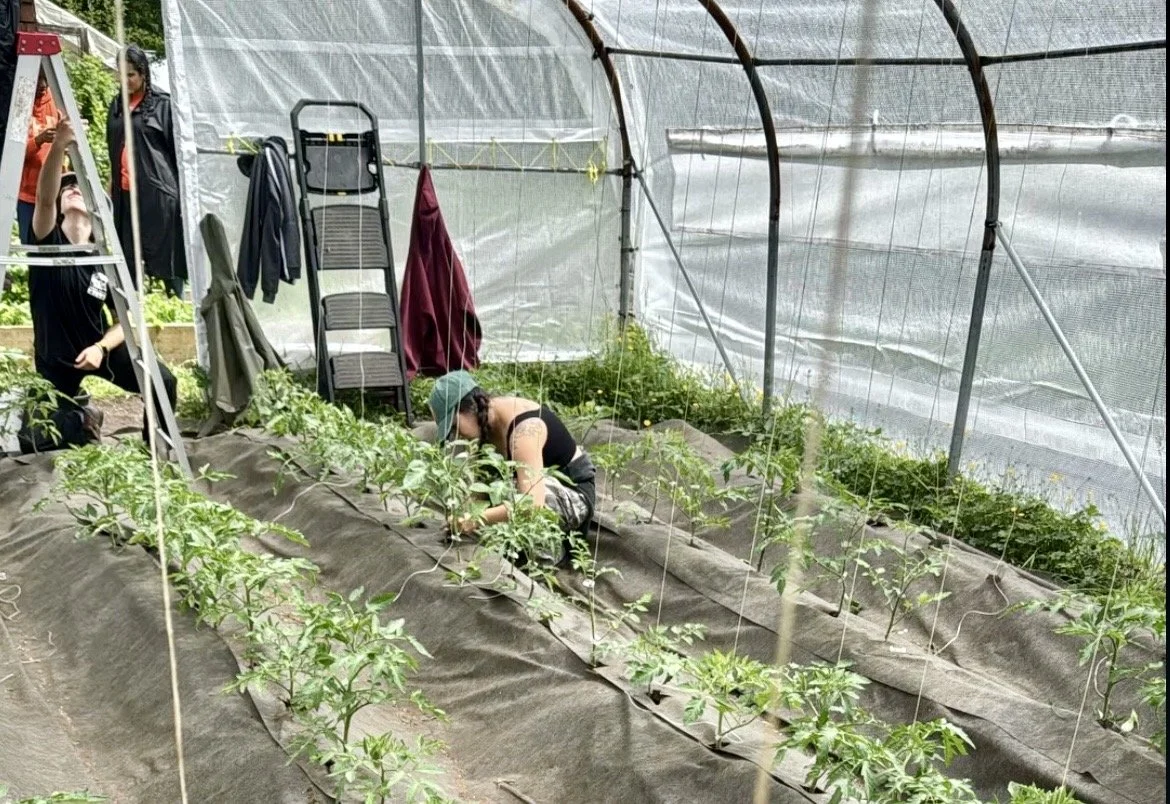
Image shows a slightly obscured figure, crouched to the ground and working with plants in a pop-up style greenhouse covered in plastic sheeting. Some additional figures are outside the green house door, doing additional work.