
Reading Scripture with the Land: A Buddhist's Reflections
1. Introduction
1.1 Context
Meditating under trees is something I do often, yet not often enough. As a practicing Buddhist, I’m inspired by the teachings of the Buddha, whose ground-breaking experiences all took place beneath trees over 2,500 years ago. Sitting under a tree is a very simple thing to do, and yet not entirely straightforward. This reflective piece explores the riches that may be uncovered in doing so, and how spiritual practice on the land can connect us to ancient and timeless wisdom, right here and now.
One of my monthly sits takes place under a tall cedar with the Prayer Circle Action Group, near the Tsleil-Waututh Nation’s (TWN) Watch House on Burnaby Mountain. Also known as Kwekwecnewtxw (a place to watch from), the structure was built to symbolize TWN’s resistance to the Trans Mountain pipeline expansion. The Prayer Circle has been meeting here on the 2nd Saturday of every month (10:30-12:00) since 2018. It was initiated by my friend, Ruth, as an interfaith response to the pipeline being forced through unconsenting communities, terminating at tidewater opposite the TWN reserve. Originally called Earth Witness, some founding principles of the monthly meeting include sitting in silence, expressing inspiration when called to do so, listening deeply, and building community around a difficult issue. To ensure our solidarity is effective, we maintain a direct line of communication with our host Nation. The tall cedar is a central landmark of the meeting.
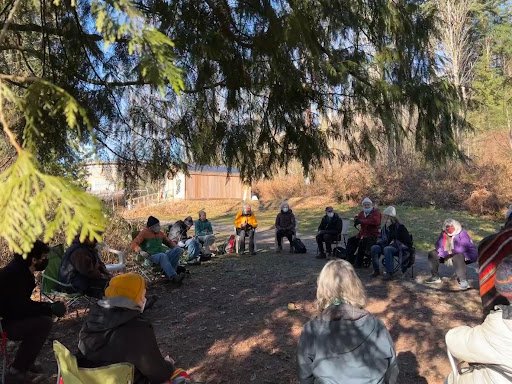
The Prayer Circle meets under the tall cedar near the Watch House on the 2nd Saturday of every month.
Credit: Vulpes virya
This reflective piece is part of a greater project, “Reading Scripture with the Land: A Year of Exploration and Partnerships.” The interfaith Prayer Circle is one of several groups across the province involved in the project, which was designed to deepen scriptural and watershed literacy in ways that impact spiritual practice. The project summary describes the purpose as such:
Because we experience increasing urgency of the climate crisis and a lack of integrated response in the church, we hope to implement a project of nature-based outdoor study to increase ecological and scriptural literacy in participants and their communities, and increase preaching that is rooted in scripture and bioregion.
This piece is a personal reflection, which has benefited from conversations with friends from various spiritual traditions. Special thanks to those who helped clarify my explorations from the vast Buddhist canon, notably Tim Bartoo and Ruth Walmsley (both Quaker), Laurel Dykstra (Anglican), Amala, Akuppa and Shantinayaka (all Buddhist). All errors, misunderstanding, and false views are mine alone. Scriptural sources are given at the end.
1.2 Foundation: Ethics, Universal Friendliness, and Wisdom
Trees and water hold important places in the heart and spirit of the tradition known as Buddhism. Compared to other religions or philosophies, the Buddha’s Dharma (Teachings) have some distinctive approaches with regard to non-human forms of life. To clarify the attitude towards trees and water, the foundations underpinning the Buddhist world-view are outlined before diving into the theme.
Ethics are central to this tradition because they refine one’s awareness of the law of karma (actions have consequences) with relation to words, actions, and thoughts. As a framework to imitate the Buddha, who naturally lives in harmony with the way things are (free from stories, hatred, or greed), ethics help us lead to a happy, more skillful life. They help us do more good, and less damage.
The first ethical precept – non-harm – is unequivocal and fundamental. On the one hand, all forms of existence – whether animal, plant, water, rock, or mythical beings – are to be treated with the same quality of respect, care, and dignity, as are all humans. By emulating the Buddha in practicing the opposite of harm – universal friendliness – we reduce drama and suffering in the world around us, and experience a more peaceful, contented life. Ethics guide us on how to be kind to ourselves and to others.
On the other hand, the wisdom behind the aspiration of universal friendliness and ethical conduct activates the understanding that all forms of existence are equally subject to the same laws and processes. While we are all unique, we are also the same. Contemplating my solidarity with all beings (including water and rocks) is part of the path to insight. Like everything else, I am equally subject to impermanence, and dependent on conditions at each moment. The thing called “me” or “I” is an insubstantial flow of processes, no different from those affecting trees, water, or rocks.
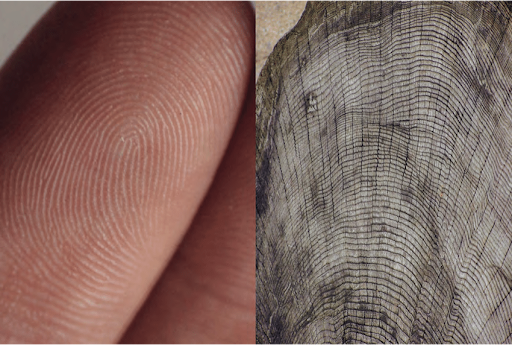
Fingerprints and tree rings.
Source: Aesthetic practices in the climate crisis: Intervening in consensual frameworks of the sensible through images - Scientific Figure on ResearchGate. [accessed 2 Aug 2025]
2. Trees in Buddhism
The insight that transformed Siddhartha Gotama into the Buddha (“enlightened one”) is captured in the Bodhi Sutta. Bodhi translates to "awakening" in Sanskrit, signifying the moment of awakening from the sleep of ignorance and delusion. Bodhi is not an intellectual concept but a profound, life-altering experience that changes one's perception of reality. In this case, the Buddha came to understand the profound, yet empty, inter-connectedness of all phenomena – conditioned co-production – with a meta-physical vision of beings forever coming and going, in cyclic re-births, powered by the energy of craving and ignorance. (Karma and re-birth aside, the teaching of conditioned co-production can be perceived by anyone who pays attention.)
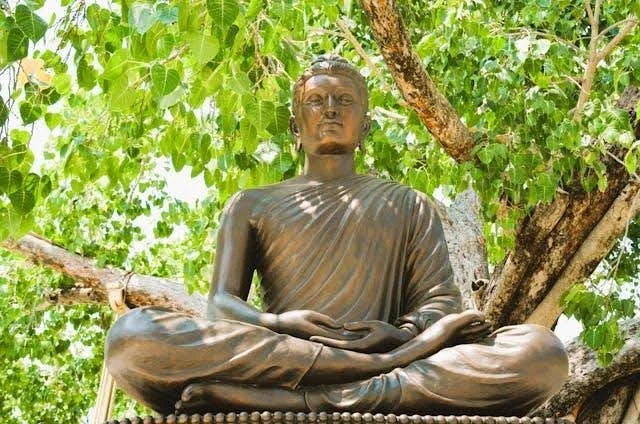
Bronze Buddha Sculpture Under Bodhi Tree.
Credit: Pexels Elizara 32554453
Bodhi Sutta: The Bodhi Tree
Thus have I heard. At one time the Lord was staying at Uruvela, beside the river Nerañjara at the foot of the Bodhi Tree, having just realized full enlightenment. At that time the Lord sat cross-legged for seven days experiencing the bliss of liberation. Then, at the end of those seven days, the Lord emerged from that concentration and gave well-reasoned attention during the first watch of the night to dependent arising in forward order, thus:
This being, that is;
from the arising of this, that arises;
this not being, that is not;
from the cessation of this, that ceases.
That is:
with ignorance as condition, volitional activities come to be;
with volitional activities as condition, consciousness comes to be;
with consciousness as condition, name-and-form comes to be;
with name-and-form as condition, the sixfold base comes to be;
with the sixfold base as condition, contact comes to be;
with contact as condition, feeling comes to be;
with feeling as condition, craving comes to be;
with craving as condition, grasping comes to be;
with grasping as condition, being comes to be;
with being as condition, birth comes to be;
with birth as condition, aging-and-death, sorrow, lamentation, pain, grief, and despair come to be.
This is the origin of this whole mass of suffering.
Then, on realizing its significance, the Lord uttered on that occasion this inspired utterance:
When things become manifest To the ardent meditating brahman, All his doubts then vanish since he understands Each thing along with its cause.
Translated from the Pali by John D. Ireland © 1998
The Bodhi tree served as the context of the Buddha’s break-through, together with the Earth. These elements play significant roles in the story, as active characters or presences. This is fascinating in and of itself, because most stories from 2,500 years ago treat the natural world and its wild inhabitants as something to be feared, at best, or as dull backdrop.
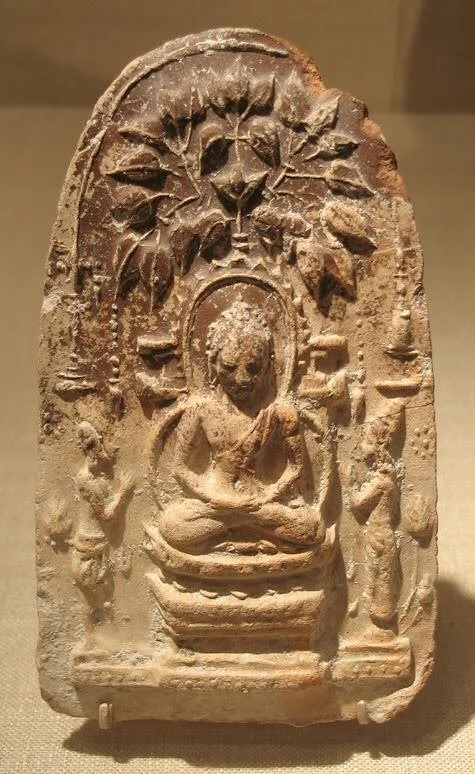
Buddha Seated under the Bodhi Tree
7th–9th century, Thailand
Source: The Met
Siddhartha’s breakthrough to becoming a Buddha is a story of heroism. However, unlike the archetypal masculine, he symbolizes a gentle and sensitive truth-seeker, who was not too proud to ask for help. Although in solitude, his victory was not achieved alone. After re-counting the story, I’ll share how I apply this to my life on a regular basis.
2.1 Scripture: Courage, Intent, and Humility under the Bodhi Tree
After six years of severe fasting and self-mortification, Siddhartha realized this path was not leading to true understanding. Abandoning the extremes of asceticism and indulgence, he realized a Middle Way, a balanced approach between indulgence and self-denial, between eternalism and nihilism. Leaving his community of fellow truth seekers, he sought out an amenable place in which to focus his efforts in solitude. His quest: to establish the source of suffering associated with life, and how to escape the cyclic patterns that lock people into lifetimes of unsatisfactoriness, or suffering.
He sought complete solitude to pursue his quest undisturbed. One day, he found a lovely spot near the town of Uruvela, by the bank of a river. Here he prepared a seat of straw beneath an asvattha tree (later called the Bodhi Tree) and sat down cross-legged, making a firm resolution that he would not rise from that seat until he had won his goal. (Bikku Bodhi, 2006).
He sat for 7 days under the bodhi tree, deep in meditation. While it may have appeared peaceful on the outside, he was locked in a raging battle with the mind-demon, Maara, who questioned his legitimacy and assailed him with endless provocations, including armies with infinite artillery, terrifying monsters, and seductive temptresses. Maara’s undermining torment was based upon the question that may be familiar to some of us: “What right do you have to be here, doing this? What makes you so special that you think you deserve happiness?”
Maara was a familiar figure to Siddhartha, and may be familiar to us, as well. A constant shape-shifter, Maara is a specialist of destabilizing our best intentions and aspirations. In the Padhaana Sutta in the Sutta-nipaata (vv. 425 ff.) of the Khuddaka Nikaaya, the Buddha recognizes the voice as Maara, and rebukes him as Pamattabandhu (the Friend of Heedlessness), Paapimaa (the Evil One), and Ka.nha (the Black One). He identifies Maara’s army :
"Your first squadron is Sense-Desires,
Your second is called Boredom, then
Hunger and Thirst compose the third,
And Craving is the fourth in rank,
The fifth is Sloth and Torpor
While Cowardice lines up as sixth,
Uncertainty is seventh, the eighth
Is Malice paired with Obstinacy;
Gain, Honor and Renown, besides,
And ill-won Notoriety,
Self-praise and Denigrating Others:
These are your squadrons, Namuci.”
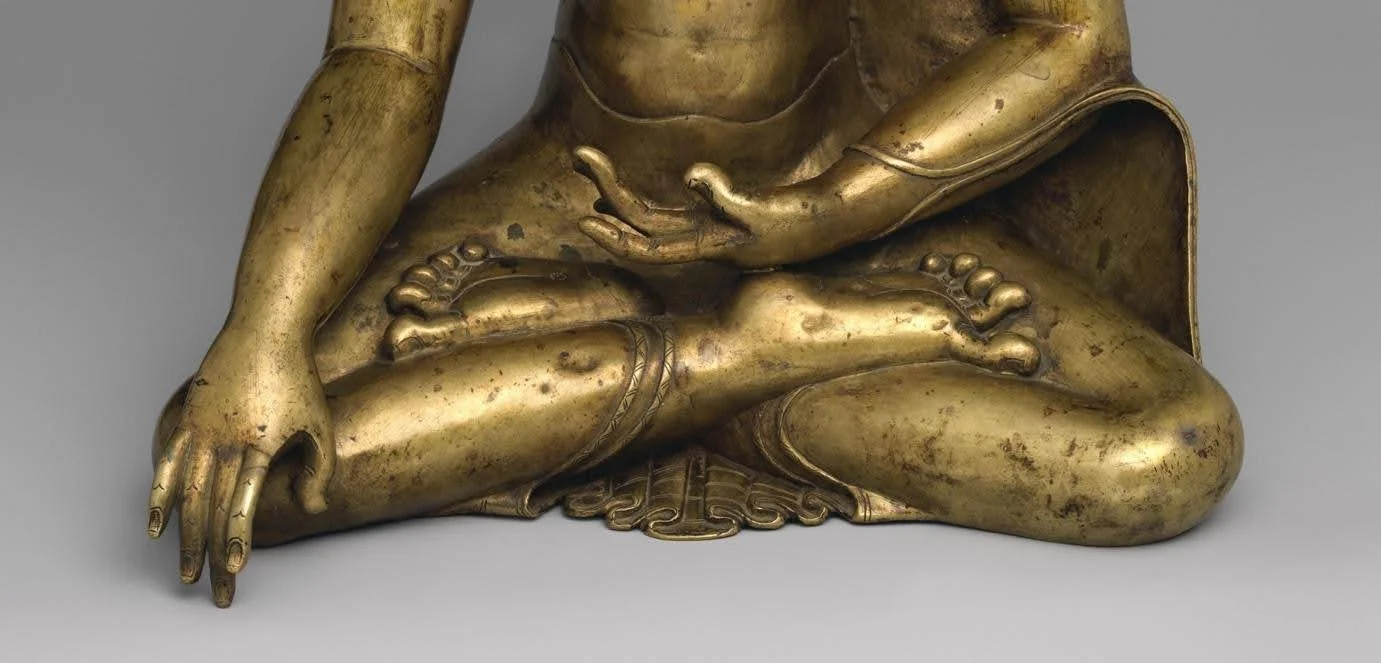
By the time the Siddhartha sat under the tree, Maara had summoned all his forces into full-scale assault. The Buddha-to-be managed the attack decently well – e.g., transforming the rain of arrows and flaming spears into flowers. After several days, though, in a moment of confident intuition and humility, he reached out his right hand and touched the Earth. With this gesture, known as the "Earth Witness" gesture (Bhūmisparśa Mudra), the Buddha called on the Earth to witness his efforts and dispel Maara’s forces.
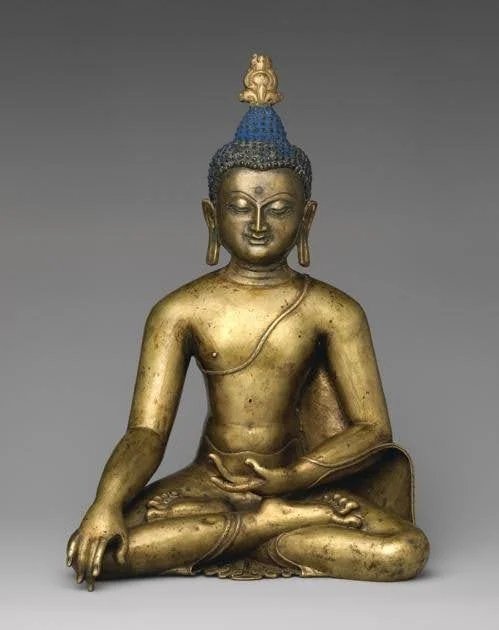
With his right hand lowered, the Buddha gestured to the Earth Goddess at the moment prior to his enlightenment, demonstrating steadfast resistance to all the temptations of desire.
Source: The Met
The Earth Goddess responded, affirming Siddhartha’s right to be there, on the throne of Enlightenment, and confirmed he had accumulated merit over countless lives that made him worthy of happiness, and of Enlightenment. With that, the demon Maara vanished, and Siddhartha realized ultimate truth, beyond all dualities and relative concepts, and beyond the cycle of birth and death, as he had sought. In attaining Enlightenment, he became a Buddha, awakened from the sleep of ignorance with a profound understanding of reality. In the Pali Canon and Mahayana texts, the Buddha often referred to himself as “Tathagata”, which means “thus-gone" (tathā-gata), as an enlightened being who exists in a state of "suchness" or "thusness" (tathata).
There are several key reasons for the Earth’s role as witness here.
Impartial Observer: The Earth was present for every act of virtue, sacrifice, and merit the Buddha accumulated throughout his long journey of rebirths. No god, human, or being possessed this continuous awareness, making the Earth the only fully qualified witness
Symbol of Validity: By calling the Earth to witness, the Buddha affirms his spiritual achievement is not only personal but also rooted in the cosmic and moral order. The Earth’s validation signifies that Enlightenment is not apart from the world but is in harmony with it
Victory Over Maara: The act invalidated Maara’s challenge by demonstrating that the Buddha’s right to awaken was established through a long, witnessed history of moral conduct and self-restraint, not an unproven claim.
Meaning in Practice: On a symbolic level, the gesture reminds practitioners that real spiritual achievement requires both personal effort and a harmonious relationship with the world; the path to awakening is grounded in everyday reality, not abstract detachment.
After the Enlightenment experience, the Buddha gazed at the Bodhi tree with affection, gratitude and reverence for 7 days. He then spent time under a banyan tree, which brought clarity to his efforts of articulating what would become his Dharma.
2.2 Reflection: Touch the earth (you belong here!)
“Buddhism is for heroic spirits intended" - Ratnagunasamcayagatha
The story of the Buddha touching the Earth, and calling on the Earth for help, can serve as inspiration as well as practical guidance. Even with such distance in time and place, I have found this story to serve as a healing balm for some of anxieties and discomforts I experience on a daily basis. Whether in dispelling unhelpful, negative inner voices, or seeing the world and my place in it in a healthier way, my life is richer when I apply the lessons from this story.
For one, the demon, Maara, is a force to be recognized and reckoned with. Maara preys on my awareness that I’m an uninvited guest on unceded Coast Salish territory, and that my life is one of privilege quite unlike those of my Indigenous brothers and sisters. (Certainly, my life has difficulties and challenges, but an order of magnitude less than what First Nations experience). How can I be a “good settler” when I’m embedded in a colonial system that rewards me with comfort, yet is responsible for generations of continued trauma by violent supremacy, fraud, deceit, and desecration? What is an authentic means by which to reverse the evils of colonialism, as a settler? It seems paradoxical, if not impossible, to clear away this heritage.
To any Buddhist, the cue of paradox implies a teaching. Paradox is an invitation/ opportunity to see through dualism. The Middle Path presents the option and challenge of dwelling within paradox. We can simultaneously dwell in bliss and suffering. Existing within paradox helps us reconcile dichotomies and duality.
This has helped me to recognize Maara’s squadrons, as described above, and realizing I have a choice. I can shut down into dull alienation and apathy, or I can muster my courage and engage in the radical transformation and ego-destruction required to be a true force for good in the world. Yes, to attain enlightenment.
Maara aside, sitting in meditation and touching the earth also helps me to allow, and to be. A simple, sacred presence, here and now. Touching the earth helps me cut through the neurosis of colonial guilt, and be more fully present. It connects me with everyone and everything. There is no need to be anything other than how/ what I am right now, nor is there anything to appropriate. I can relinquish the guilt and accept that my ancestors are indigenous to other lands, and I am here. This is where I can contribute to the healing of self and the world. This is where I can try to be a force for good. This is where I can work to dissolve the rigidity of the ego project and cut through the stories with direct experience.
3. Water in Buddhism
Water is sacred. Water is life.
Along with the Prayer Circle Action Group, I’ve been fortunate to participate in several water ceremonies on Coast Salish territory. The first four were under the spiritual leadership of our dear friend, Judy Wilson, and her wonderful family of matriarchs, notably Minnie Kenoras, Joanne Buffalo and others from Secwepemc territory. In the last two years, the TWN has been hosting an annual water ceremony, with an inter-faith emphasis. It’s an honour to participate in ceremony in this way, and a beautiful means of establishing common ground with other faith traditions. The ceremony invites different faith communities to paddle together and protect the water, and to evoke the spirit of “one heart, one mind, one prayer”.

Charlene Aleck and Amy George offer prayers to open the Tsleil-Waututh Nation Sacred Trust’s Water Ceremony.
Credit: Vulpes virya
3.1 Scripture: Water element
Water in Buddhism is a versatile symbol of purity, clarity, compassion, and change, serving as a daily reminder of the spiritual qualities sought on the Buddhist path. The Six Element Contemplation, which is rooted in canonical suttas, is a powerful meditative tool for understanding non-self, developing equanimity, and recognizing the interconnectedness of all life. As above, I’ll re-count some scripture and then reflect on how the selected teachings have enriched my life.
The Six Element Contemplation
The “Six Element Practice” is a profound meditation found in early Buddhist texts. It is mentioned in the Mahāhatthipadopama Sutta (MN 28), Mahārāhulovāda Sutta (MN 62), Satipaṭṭhāna Sutta (MN 10), as well as commentaries such as the Visuddhimagga, but most notably in the Dhātuvibhaṅga Sutta (MN 140):
"There are these six elements: the earth element, the water element, the fire element, the air element, the space element, the consciousness element... One should see each as not-self, not-mine, not-what-I-am."
The practice involves contemplating each of those elements, both internally and externally, and recognizing that what is "mine" is simply borrowed for the time being, and is otherwise in a process of continual cycling. One contemplates:
This is not me,
This is not mine,
This is not myself.
The water element (āpo-dhātu) specifically refers to liquidity and cohesion—everything in and around us that is moist, fluid, or cohesive. In the body, this includes blood, saliva, and other bodily fluids. Externally, it includes all forms of water. The goal of the reflection is to dissolve the boundaries of self. Practical benefits of the practice include:
Breaking Attachment and Self-Identity: By seeing the elements as impersonal, practitioners loosen their identification with the body and mind, reducing egocentricity and nurturing a sense of freedom
Interconnectedness and Interdependence: The practice unveils how every part of us is intimately connected with the world, cultivating empathy and a sense of belonging
Acceptance of Impermanence: Contemplating the ceaseless flow and exchange of elements helps practitioners accept change, and let go of fear and clinging
Equanimity and Calm: Meditating in this way develops deep tranquility and equanimity, recentering practitioners in an ever-changing world
Penetrative Insight (Vipassanā): The Buddha praised this practice for developing insight into the nature of reality, leading towards the realization of non-self (anattā) and liberation
3.2 Reflection: I am water
“Water surrounds the lotus flower, but does not wet its petals.” – The Buddha
Water supports my practice in varying degrees of profundity, including existential emptiness, meditation practice, and beauty in everyday life.
As one of the six elements, water reminds me that I am an insubstantial flow of processes. Not only am I constantly changing, but one day I will die and the elements I’ve been borrowing will return to the great cycle of coming and going. It’s not if, but when. Contemplating the inevitability of my own mortality is liberating, as I’m no longer running from my shadow, nor do I need to cling to things I can’t control. I don’t need to be afraid of the inevitable. Instead, I’m acutely aware and grateful for my blessings. Sensing the emptiness within and around me, I feel more connected to the Earth and all beings.
More practically, I’ve always been a swimmer and absolutely love being in the water. There are various ways in which I apply the Dharma to swimming. On the one hand, the beauty, dynamism and uniqueness of every moment is easy to perceive and realize when in the water. Moving through water with goggles, I enjoy watching the aquatic world, the bubbles that come off my fingers, any beams of light that shine through. Receptivity to beauty is an important part of the spiritual life, and also a key element of happiness. On the other hand, mindfulness of breathing while swimming is an excellent meditation practice. Counting to ten with the breath is not as easy as it sounds, neither on the cushion nor under water. After a swimming session, I experience the spaciousness of meditation, with the added bonus of feeling good in my body.

Spot the human. Water is found in every cell, tissue, and organ.
Credit: Bethany Kunert.
4. Dedication of Merit
Core to Buddhist practice is that of relinquishment, not holding tight to the material, emotional, or even spiritual progress we have made. Instead, we “dedicate the merit,” offering whatever we may have gained to benefit others. I therefore conclude this reflective piece with a “Dedication of Merit” developed by the EcoSattva community, as a prayer that any goodness generated here be extended out into the world.
May all places be held sacred.
May all beings be cherished.
May all injustices of oppression and devaluation
be fully righted, remedied and healed.
May all who are captured by hatred be freed to the love that is our birth right.
May all who are bound by fear discover the safety of understanding.
May all who are weighed down by grief be given over to the joy of being.
May all who are lost in delusion find a home on the path of wisdom.
May all wounds to forests, rivers, deserts, oceans,
all wounds to Mother Earth be lovingly restored to bountiful health.
May all beings everywhere delight in whale song, birdsong and blue sky.
May all beings abide in peace and well-being, awaken and be free.
May Mother Earth witness my intention – to practice for the benefit of all beings. May I overcome the self-limiting voices of Maara, and see through the delusion of a separate self.
5. Scriptural sources
“Make your mind like the earth, which receives all things steadily.” The Buddha
Having emerged in the Bronze Age, the historical Buddha’s teachings were passed down orally for at least three centuries. The scriptures referred to here are drawn from various sources, including the Pāli Nikāyas, which contain the discourses (suttas) of the Buddha. From that collection, this piece refers to the Aṅguttara, Dīgha, Majjhima, and Saṃyutta Nikāyas. Other significant sources include the Udāna, literally “utterances” of the Buddha. Some well-known stories have no written attribution, and are known from artwork dating between 1,000-1,500 years ago. These are considered legends, rather than scripture, but still hold significance. Citations are given where appropriate and possible.
6. Biography:
Vulpes virya practices and teaches at the Vancouver Buddhist Centre. Their pseudonym evokes their power animal, Fox (Vulpes) and their commitment to virya (Sanskrit for "energy in pursuit of the good"). Vulpes joined the effort to stop the Trans Mountain pipeline expansion (TMX) in 2020 as a tree-sitter, and as a member of the Prayer Circle Direct Action group.
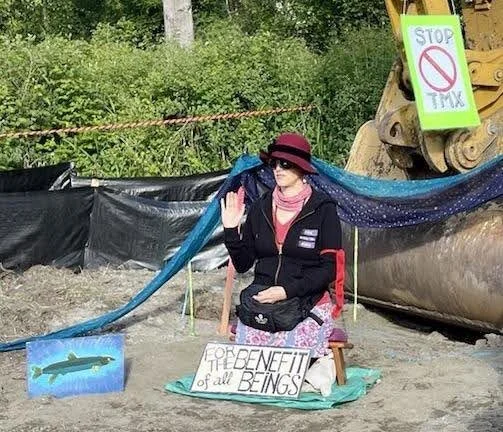
At an action to protect the Brunette River, the author used the Abhaya mudra to abate anxiety, dispel fear, and evoke benevolence, while daring to contemplate infallible success.
Credit: Donna Clark