
Wild Love of a Wild God: Holy Trinity Sunday Year C
Rev. Caleb Crainer
For people concerned about the environment, imagining the world beyond a human-centered perspective becomes an important aspect of our spirituality. We are grounded in our interconnectivity with all of creation. But many people have difficulty making the shift away from their own concerns. The frameworks of interconnection are few and far between, instead we default to narratives that reinforce the idea that the creation of the world is ultimately about humans and human prosperity. When we put humans at the center of everything (anthropocentrism) then every other aspect of reality is only important as they can contribute to the well being of humans. The result: greed, unrestrained capitalism, and the accumulation of authoritarian power.
Human centered theology is ultimately self-destructive, because all living things, including humans, thrive according to the condition of our environments. Our interconnections are real. Our perceived zero-sum competition is not. Trinitarian Christianity can challenge anthropocentrism by centering an interconnected divinity. God’s love is not formulaic and boring, it is wild and unruly. It disrupts us in the best ways. Is God’s wild love only for humans? Is there room for an unexpected divine creation where humans aren’t the be-all and end-all? How can religious leaders help shift attitudes away from self-destructive greed? How does a theology of three-in-one help us? Let’s get into it.
Commentary:
-
In the Bible, Wisdom is frequently personified in a similar way to when we say “Mother Nature.” The character of Wisdom (“Chokmah” in Hebrew, “Sophia” in Greek) could be considered a proper noun and read as a divine feminine attribute of God or even as God’s companion or offspring. Is she a part of the trinity? Certainly! But not necessarily as an additional “person.”
To appreciate the Book of Proverbs we first need to recall that the book is poetic, meaning that sentences are structured to produce meaning beyond the words themselves. In Ancient Hebrew poetry, ideas rhyme. For example, in the first verse we see “Wisdom calling” and “Understanding raising her voice.” Both "Wisdom" and “Understanding” are synonyms that use different verbs to suggest an auditory event. The opening verses (1-4) introduce Wisdom and direct her call to all that live, specifically towards humans. The omitted verses (5-21) in the chapter reinforce Wisdom’s authority to deliver truth and her aversion to any distortions or manipulations. Wisdom tells it like it is. The rest of the lectionary passage (22-31) is a retelling of the Genesis creation story from her perspective as another entity that was present from the very beginning.
In the Genesis story the first thing created was the separation between light and darkness. This creation was not out of nothing, but from a formless chaos best likened to waters. By reading the character of Wisdom into the story, the author is associating the light of day with the light of truth. Wisdom, in this case, facilitates the rest of creation. Notice that Wisdom does not claim to be present before the creation of “day,” but is heralded as God’s “daily delight.” This suggests an even stronger association with Wisdom, daytime, and the truth fully illuminated.
While this passage includes overtly ecological themes, the intent of the author is not necessarily to convey a natural harmony, but rather to reinforce the position of Wisdom as God’s most important creation. This text is not centered on human experience, instead it is Wisdom-centric.
One thing that I find compelling about this passage is the idea that Wisdom exists outside of human brains. Wisdom is an external entity that celebrates the world and enjoys humanity. Climate Justice work often tends to position accumulated human knowledge at the forefront of debates. While well-intentioned, this can often have the opposite of the intended effect because knowledge is not readily transferred to others. Humans need convincing. Statistics do not connect as well as stories. Fortunately, Wisdom’s bluntness is refreshing and unassailable. We can tap into that as the recipients of Wisdom's call to attend to God’s creation. Again, our interconnections are real. Humans can cause harm to one another on an interpersonal scale, of course they can cause harm to the planet on a large scale.
-
On the surface, the ecological imagery of Psalm 8 presents many differing avenues for preaching. The song is composed of two parts framed by the repetition in verses 1 and 9. The first part (v. 2-4) situates humanity in a cosmic context and wonders why God would care about mere humans. Verse 5 is the center of the poem, the nut inside the shell. Here we see that humans are nearly divine and conferred with attributes like honor and glory usually reserved for God. Verses 6-8 proceed from this anthropological statement to elevate humans as the controllers of the world. The hierarchy of power is clear: God is on top, then humans, and everything else is below. It is fair to ask if humanity is part of the trinity in this psalm?
Ecologically minded preachers may long for a more egalitarian worldview in which humans exist alongside animals as cocreators of our world. Instead the Psalm centers around the high status of human beings in a cosmic order. The immense devastation that human-caused climate change has brought to the planet actually reinforces the Psalm’s content. Humans really do have a tremendous amount of power to control God’s creation. Sometimes we refer to this as “stewardship.” Indeed, this Psalm assumes that part of being near-divinity would entail care for God’s creation. The reality is that human “control” has obliterated God’s creation. What does it mean that humans set ourselves in superior positions to other lifeforms on this planet?
I am curious about the imagery in verse 2. I doubt that babies are chanting psalms, so I wonder what are the glorifying sounds that infants and children make? Who are God’s enemies? Who are the foe and avenger that God intends to silence? The Psalm does not provide answers. Perhaps these are recognizable exhortations that an ancient audience would’ve understood. Perhaps these are metaphors of vulnerability and persecution in a Psalm that speaks directly to human agency to control the world. We want to defend ourselves and shore up resources in case trouble happens. But prudence easily gives way to greed that creates the very scarcity we wanted to avoid.
It is important to me that the Psalmist reminds us that we are not God. While we do exercise control of certain things, it is God who controls the paths of celestial objects. Human power pales in comparison. When preaching on this psalm from an ecological perspective it may be important to contrast human destructive ability with human creative stewardship. It is possible for humans to ensure a future for God’s creation, but we cannot remain unreflective about the responsibilities that God has entrusted to us in our position. If we have the capacity for honor and glory, we also have the capacity for shame and guilt. Which are we earning as a species? Psalm 8 invites us to consider how we will protect vulnerable aspects of creation or how we will be complicit in their destruction.
-
Paul is writing to the Roman community of believers as they struggle to find hope amidst ongoing imperial oppression. At this point, Paul’s faith in Christ has not developed into a separate religious movement, but is still very much anchored in first-century Judaism. For generations, Paul’s words in this letter have been decontextualized and theologized to the point that many modern Christians see Paul as more Lutheran than Jewish. He was not. Paul is speaking about hope to a Jewish community that is suffering.
“Justified” has come into a highly technical meaning in protestant theology, but the term in Greek is about satisfying justice or receiving a fair judgement. It is common to translate the greek word “pisteos” as “faith” but a more accurate translation is not about intellectual ascent, but about community connection that can be built. I find that “trust” fits much better. Similarly, “peace” in a Jewish context would not just mean cessation of violence, but being made whole. “Grace” in a jewish context is not the term of protestant theology, but rather the expression of favorable status. “Hope” refers to the expectation for the future. “Glory” is not an image of heavenly opulence but rather the kind of weighty presence when someone considered honorable enters a room. A more contextualized translation of verse 1 and 2 might be: “We achieve justice by trust, we have completeness with God through our Lord Jesus Christ, through whom we have obtained access to this favor in which we stand; and we boast in our expectation of sharing in the honor of God.” Contextually, this sentence refers to the ways in which an oppressed Jewish community can survive together, secure in the favor of God, even if they are persecuted by the empire.
It is important to note that Paul is not making a theological statement to Christian seminarians in Europe, he is writing to suffering Jewish people barely surviving under Roman imperialism. In that situation their ability to perform holy rituals and observe God’s laws may have been threatened and Paul wants to assure them that their standing with God is not dependent upon whether they can fulfill religious obligations, but that they can be assured of God’s presence bringing them to completeness.
Paul goes on in verses 3-5 to talk about how God transforms suffering into hope. Instead of seeing their suffering as a sign of God’s dissatisfaction or God’s abandonment, Paul claims that suffering can produce endurance (if it doesn’t kill you), that endurance can produce evidence (“character” is a weird translation), and that evidence can produce hope. Perhaps the boldest claim Paul makes is that hope does not disappoint us. I think everyone has been disappointed by hope for a future that doesn’t happen. Paul’s claim is that the hope of the Roman Jewish community is that the Holy Spirit has poured God’s love directly into their hearts where no oppressor can take it away.
Doing ecological justice work can seem hopeless. The mechanisms of empire continue to rage on despite our most sincere efforts. Progress is always too slow and the ease of thoughtlessness is ever-tempting. Wouldn’t it be simpler if we didn’t care? It probably would be easier for us, but at the expense of the health and well-being of others. Future generations are trusting us to persevere. We can do it. The love of God has been poured directly into our hearts.
-
This reading comes in the middle of Jesus’ final discourse with his disciples minutes before his betrayal and execution. He knows the end is coming and he is trying to leave his disciples with the courage to carry on sharing God’s good news without his physical leadership. He wants to assure them of his care and connection to them and that whatever happens, he is secure in God’s solidarity with them. He has given them the commandment to love one another (John 13:34), he has promised the coming presence of the Holy Spirit (John 14: 16) aka The Advocate, aka The Spirit of Truth, and Jesus has foretold their impending persecution (John 16:2). Jesus is explicit that his goal is for his followers to love one another, to remain connected, and that he would send them help in the form of truth.
This section of John 16 mirrors Jesus’ advice in Matthew 10:19 where he says, ‘don’t worry about what you’re going to say, you’ll be given the words when you need them.’ In John, Jesus conveys that he has more to tell the disciples than they have the capacity to hold while they are grieving, anxious, and fearful. Jesus assures them that the Spirit of Truth will come to relay whatever he hears. He will tell it like it is. This sounds similar to the character of Wisdom from the proverbs reading. It’s this truth and the public exposure of corruption and violence that will propel the ministry onward.
What Jesus doesn’t say is also significant. Jesus does not tell his followers to avenge his death. Jesus does not tell them that he has communicated the entirety of his wisdom and that it has been faithfully recorded. He does not tell people that it will be easy. Jesus knows that the coming months and years will be tortuous for them and he chooses to leave them with the interconnections, the love, that will sustain them.
In environmental justice work, a substantial hurdle is knowing how to engage people who are hostile to climate science. In her book “Saving Us: A Climate Scientist’s Case for Hope and Healing in a Divided World,” Dr. Katharine Hayhoe talks about going to speak to polarized audiences about climate change. Her strategy is simple: find something they care about and connect it to climate change. I can report that her strategy works. Even the most ardent climate denier enjoys something. Maybe they like fishing. Awesome! Do you want that river to be clean with dead fish or clear with fully grown fish to catch? Dr. Hayhoe facilitates easy entry into ecological conversations by speaking directly to people’s self-interest. It’s a useful community organizing technique, and thankfully one where you don’t need to memorize all of the facts and numbers.
She doesn’t leave the conversations there, instead, she finds ways to speak to the interconnections of our lives. In doing so, she’s not fighting against people’s default human-centered worldviews, she’s using the things people love to connect with them. In the fishing example, she could have launched into statistics about water pollution and the lack of spawning areas for various species. Instead, she would continue the conversation in the terms her conversation partner is comfortable with. She might ask questions like, “Who should protect the river?” She wants people to understand that they are connected to, and maybe active in, the environmental movement because of the things they already care about. This challenges the default narrative of separation between humans and nature and instead reveals the truth that all of creation is interconnected.
The good news is that God’s love is not restricted, but flows through every aspect of our lives. The Holy Spirit continues to be with us in every important conversation where we invite people to reflect on the ways they have been told that their happiness is paramount even if the rest of the biosphere suffers.
These interconnected texts have a special resonance for Trinity Sunday because they are sites where divinity is experienced in multiple, overlapping, and wild ways. God is always connecting with us unexpectedly, through the foundational elements of the cosmos, through the liberating action of Christ, and through the ongoing truth-telling of the Holy Spirit. God is always de-centralizing our own narratives of self-importance so that we can see how we are wildly interconnected through love.
Sermon Ideas:
How do Humans relate to the rest of the world? Who is in charge? How does God give humanity responsibility through interconnection? How are we doing with that? The good news is that the love of God is not dependent on our capacity to get it right every time. Instead, God’s love connects us in many ways into the well being of the world and each other.
What is the role of truth-telling in ecological justice? How do we prepare for conversations where we might face hostility? We can’t prepare for what to say, but trust that God’s truth will illuminate how our well-being is bound up with the well-being of our planet.
How does unregulated capitalism (and empire) distort the good news of God’s gift of interconnection? How can the model of the trinity help us remain focused on nurturing the bonds between us instead of our own greed? We must meet people where they are at, in the default narratives they have been told. Paul talks about God’s love even for those who are suffering. The Holy Spirit/Wisdom/Advocate is leading us to truth, but it’s not the idolatry that worships ourselves, but a truth of love that can change the world.
Resources:
Katherine Hayhoe's "Saving Us: A Climate Scientist's Case for Hope and Healing in a Divided World."
Contributor Bio:

Rev. Caleb Crainer is an out-gay pastor at St. Andrew’s Lutheran Church in Los Angeles, California where his interfaith work as part of the Los Angeles Faith and Ecology Network has helped him to prioritize interconnection over division. Pastor Caleb is grateful that the Lutheran tradition prioritizes God’s grace, so we don’t have to have all of the answers. That being said, he is currently pursuing a PhD in Contextual Theologies from Claremont School of Theology.
Image Desrciption: Pastor Caleb Crainer, a white male with red hair and glasses, wearing a light green clergy shirt, smiling in front of a trellis of bougainvillea.
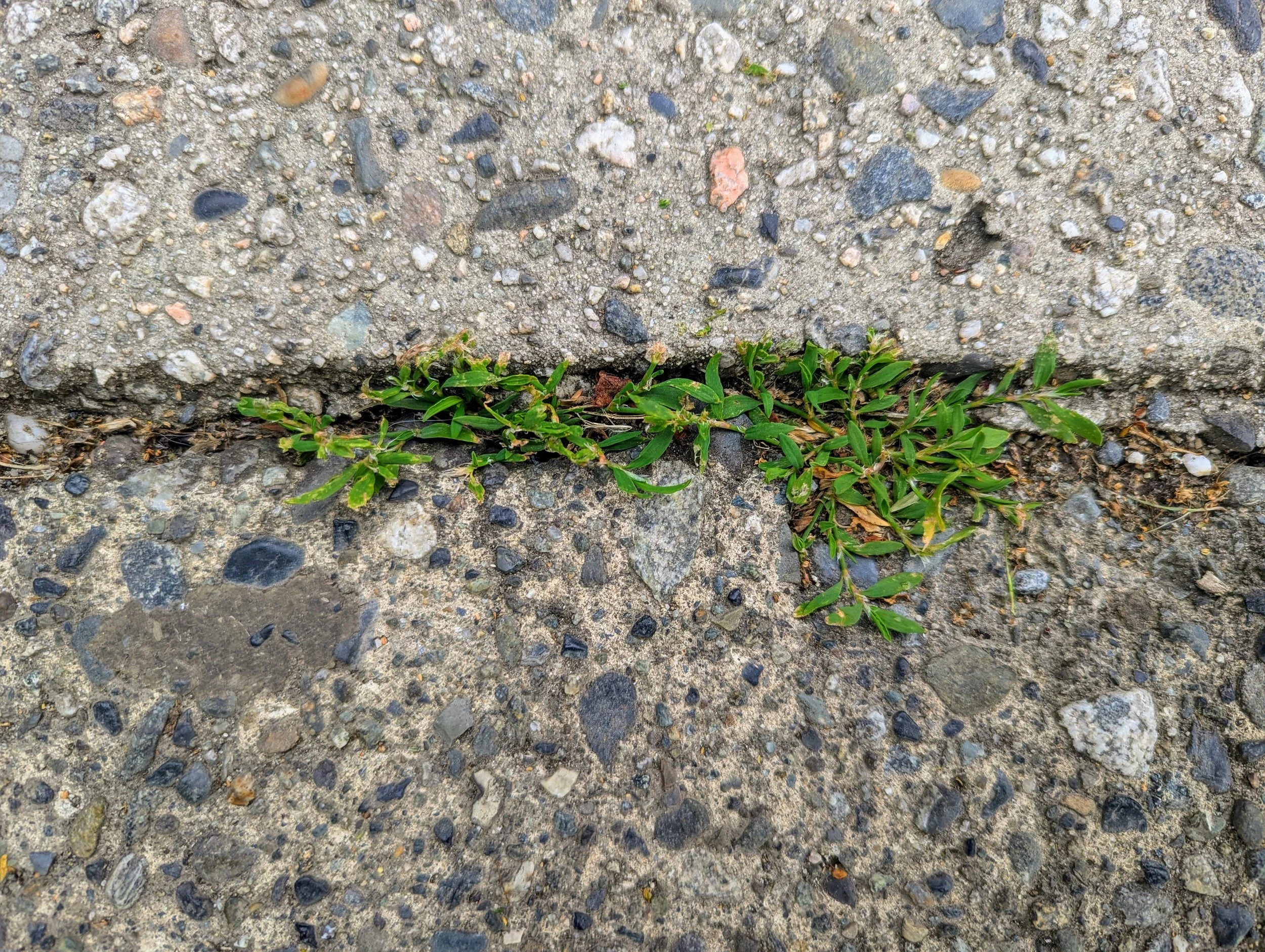
Image Description (Primary Image): a top-down view of a sidewalk is shown. The sidewalk is made of many small stones in the concrete. In the crack of the sidewalk, bright green plant life grows.