Ascension Year C: Cosmology, Kings, and Catastrophe
Rev. Emily E Ewing
While this week’s Ascension readings are not as tied to the earth as usual, they certainly lift the discourse on cosmologies and how they impact our own perspectives and biases. From cosmological models to maps with the south on top, our perspectives are influenced every day and Ascension provides space to wonder creatively about who is really on top. The readings also play a lot with kingly imagery and understandings of power that provide a bold witness against many of the abuses of power we experience today. And, as is always present when reading texts set in a land beset by violence and genocide, this Sunday, especially, our contexts call for care and attention to the pain and violence continuing in Palestine.
Commentary
-
The book of Acts begins with an account of Jesus’ ascension.
Verse 2
Many ancient cosmologies, or models of the universe, in the Middle East located heaven as “up” or “above” and places connected to death or hell as “down” or “below”.
Verse 3
Throughout Acts, Jesus is identified as the one who suffered, connecting him to all who suffer in this world at human hands.
Verse 4
As many throughout the Anglican Church observe Jerusalem and the Holy Land Sunday, the connections between Jerusalem, mentioned here as the place for the apostles to stay and wait, and the one today that is part of violence and occupation, broiled in centuries of conflict, calls our attention.
Verse 6
The apostles are still stuck on human power, rulership, and empire.
Verse 8
Called to be witnesses “to the ends of the earth”, the question is: what kind of witnesses?
Verse 9
Evoking the movie Nope, Jesus ascends by means of cloud abduction.
Verse 10
Evoking the Genesis 28 account of Jacob’s ladder, the apostles gaze up toward heaven and where God “should” be only to be surprised by the divine presence right beside them.
-
Psalm 47 sings praise for God’s ascent and power.
Verse 2
“Most High”, or El Shaddai in the Hebrew, can mean Big Breasted One, Tall Mountains, or Most High, queering the reading of God as the Big Breasted One, a great king over all the earth.
Verse 3
The affiliation humans claim for God’s military might and power over others.
Verse 7-8
Again divine kingship over not only all nations, but all the earth
Verse 9
What are the shields of the earth? How does the earth protect itself?
-
A psalm of praise, extolling God as king.
Verse 1
God’s rule is connected to the world’s everlasting nature
Verse 3
Flooding as a major fear and motif in the ancient world. The power of water and floods even praises God.
Verse 4
As destructive and awe-inspiring as water can be, God is even more majestic.
-
In gratitude for the faith of those in Ephesus, the author proclaims Christ’s power in the highest places.
Verse 16
A continual posture of gratitude, evoking Robin Wall Kimmerer’s relational gratitude with earth, a posture common in Indigenous cultures, in Braiding Sweetgrass.
Verse 17
Prayer for a spirit of wisdom and revelation, both of which draw humans closer to the more than human world
Verse 18
Of the many ways people perceive and hope, the heart’s sight rather than eyesight is lifted up.
Verse 19
Emphasis on God’s power for human believers.
Verse 21-22
The divine is up and above while all else is under God’s feet.
-
The gospel of Luke ends with an account of Jesus’ ascension
Verse 44
Jesus’s words reinforce his interpretation of scripture to the disciples.
Verse 46
The Messiah is again clearly linked with suffering, death, and resurrection
Verse 47
The breadth of Jesus’ mission encompasses all nations, yet begins, as with Acts, in Jerusalem.
Verse 48
The disciples are witnesses of Jesus as the Messiah and what that means for everyone.
Verse 50
Place continues to have meaning as Bethany, on the Mount of Olives, is held as the place for the Messiah to appear.
Verse 51
Again Jesus’ journey to heaven is an ascension up into the atmosphere.
Teaching and Preaching Suggestions
Ancient Cosmologies
In many ancient Middle Eastern cosmologies, the cosmos was much smaller and human-centered than we have since come to understand it. While many Middle Eastern cosmologies understood both earth and heaven to be circular, many of the layered and more complex cosmologies developed with greater study of the night sky and scientific discoveries. Many ancient peoples also believed in levels to the cosmos, such as Zuni and Mayan understandings of the lower realm below earth’s surface, the middle realm, where humans and many creatures live, and the upper realm of sky and all that is up.
Additionally, while humans have been valuing what is up or on top over what is lower or on the bottom, that has impacted our valuing of the world as a whole. The dominant way of talking and using directional language in North America places the North as “up” and South as “down”, from maps to verbal descriptors. This results in subconscious reinforcement that the northern hemisphere is more important than the southern, both within countries and in the world where the majority of land and people are in the southern hemisphere. Digging into the diversity of cosmologies and depictions of the world as a way of understanding a God who becomes human and then goes back “up” to heaven would provide a new insight into the well-known Ascension Day scripture.
Monarchs and Power
The readings this week have an abundance of kingly and royal imagery. Acts reminds us of the 40 days after the resurrection during which Jesus spoke about the “kingdom of God”. Psalm 47 and Psalm 93 both praise God as king. Psalm 47 even praises God for subduing “peoples under us and nations under our feet” while Psalm 93 talks of YHWH’s robes and throne in its kingly depiction. Ephesians extols Christ’s ascension to “the heavenly places, far above all rule and authority and power and dominion,” a reminder of what earthly power can and cannot do. In Luke Jesus promises the disciples that they will be “clothed with power from on high” before his ascension.
While monarchies have largely gone out of style, rulers with inordinate power over others still abound. The contrast between the opulence and abuse of authoritarian leaders, the obscenely wealthy, and others who use their money and influence to abuse and oppress and a divine king who becomes a human baby, grows, eats, suffers, and dies with us is rich for preachers in this particular time. Examples of abuse abound: the devastation of the environment because of those who launch rockets into space for fun, seek to circumvent human creativity through AI that consumes unimaginable energy, and the power grabs of land, trade, and wealth from those who do so because no one can or will stop them. The love and care of a divine ruler is found in our faith. Leadership that cares, forgives, and encourages aligns easily with God’s monarchy. And for those wishing to challenge or play with the pairing of God as king, Psalm 47’s reference to YHWH as “the Most High” evokes the height of mountains, which frequently were used to describe large breasts. And so the Big Breasted One “is awesome, a great king over all the earth.” The queerness of God sneaks in throughout scripture.
Jerusalem and the Holy Land Sunday
In solidarity with the Diocese of Jerusalem, this Sunday is also the observance of Jerusalem and the Holy Land Sunday for the Anglican Church in Canada. The connections are explicit for those preaching this day: Jesus tells the apostles to remain in Jerusalem in Acts until the “the promise of the Father” and Luke and Acts’ visions are discipleship spreading throughout the whole world “beginning from Jerusalem.” The ways power comes to play in the readings, as named above, also provide a powerful word for the ongoing genocide and violence in Palestine. The devastation of the genocide on the people and land of Palestine cannot be quantified: the ongoing destruction of ancestral olive trees and homelands; the environment degradation of the chemicals and destruction of war, bombs, and bullets; and the lives of humans, animals, and plants, wiped out all call out for care, attention, and resistance to violence.
Sources and Resources
For more on ancient cosmologies, check out the Nerds At Church podcast’s episode from their fourth season: https://podcasters.spotify.com/pod/show/nerdsatchurch/episodes/Season-4-Episode-01-Cosmology-e2e503j
This is a great “West Wing” look at the importance and value of depictions of the world: https://youtu.be/vVX-PrBRtTY?feature=shared
For nerdy takes on Ascension Day, check out Nerds At Church’s Ascension Day specials: what happens to a body as it ascends through the atmosphere, the aerodynamics involved in the Ascension, and the chances of a UAP (also known as UFOs) like the one in Nope being the real source of Jesus’ Ascension.
Dig into humanity with Rev. Elle Dowd and Ascension embodiment: https://elledowd.com/2015/12/04/heaven-and-earth-ascension/
More resources for those observing Jerusalem and the Holy Land Sunday: https://www.anglican.ca/gr/provinces/jerusalem/sunday/
Contributor Bio
Rev. Emily E. Ewing (they/them) is a Lutheran (ELCA) pastor serving in Baltimore, Maryland and getting ready for Art School. They combine creativity, spirituality, nerdiness, and the call to justice in many ways. Pastor Emily cohosts and coproduces the Nerds At Church podcast as well as cohosts the Horror Nerds At Church podcast. They consult with communities of faith for anti-oppression trainings, Doodle Prayer spiritual practices, and whatever the Spirit calls them to.
Image Description
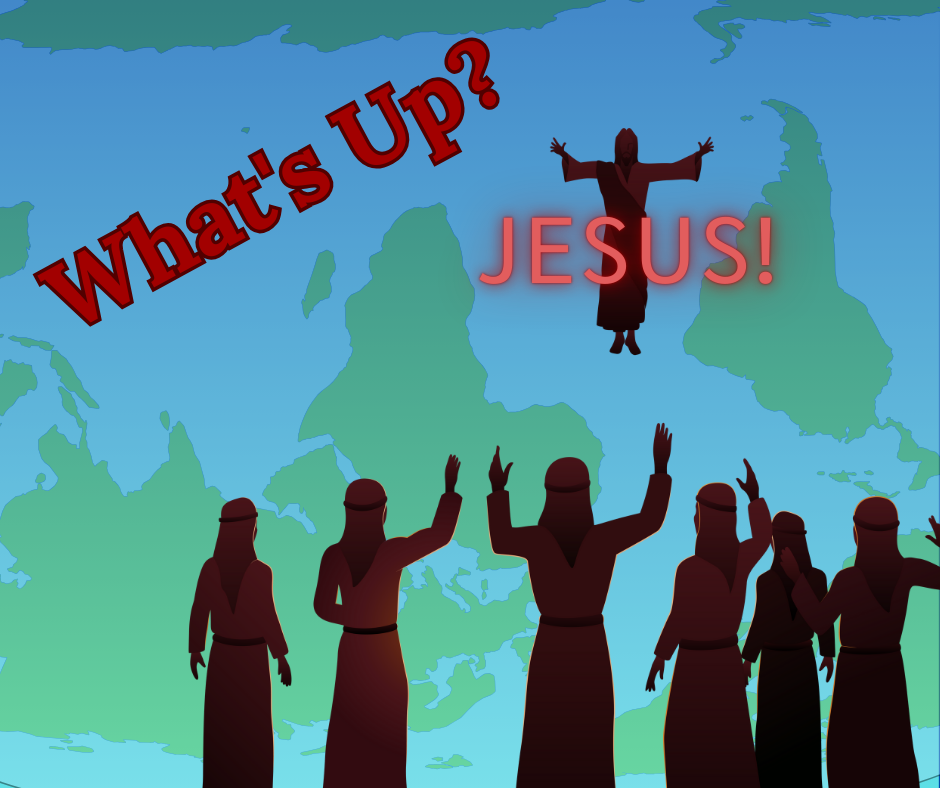
A blue and green map of the earth with the south on top provides a background for the silhouettes of six people looking toward a seventh whose arms are spread and who is above them and looking upward. On the left is the question “What’s Up?” and superimposed on the one who is above the others is “JESUS!”