
Becoming radically entangled with the flow of Creation: Sixth Sunday after Epiphany, year ‘C’

Wes Howard-Brook and Sue Ferguson Johnson
Our texts From Jeremiah and the Psalms this week invite humans to compare their relationship with God to a streamside tree. This ancient image may well sound “new” to readers expecting a comparison to God or to a “holy person” of note. But our Israelite ancestors were not bound by the Platonic assumptions that tend to shape Western thought and action, dichotomizing what the Bible joins: heaven (sky+) and earth.
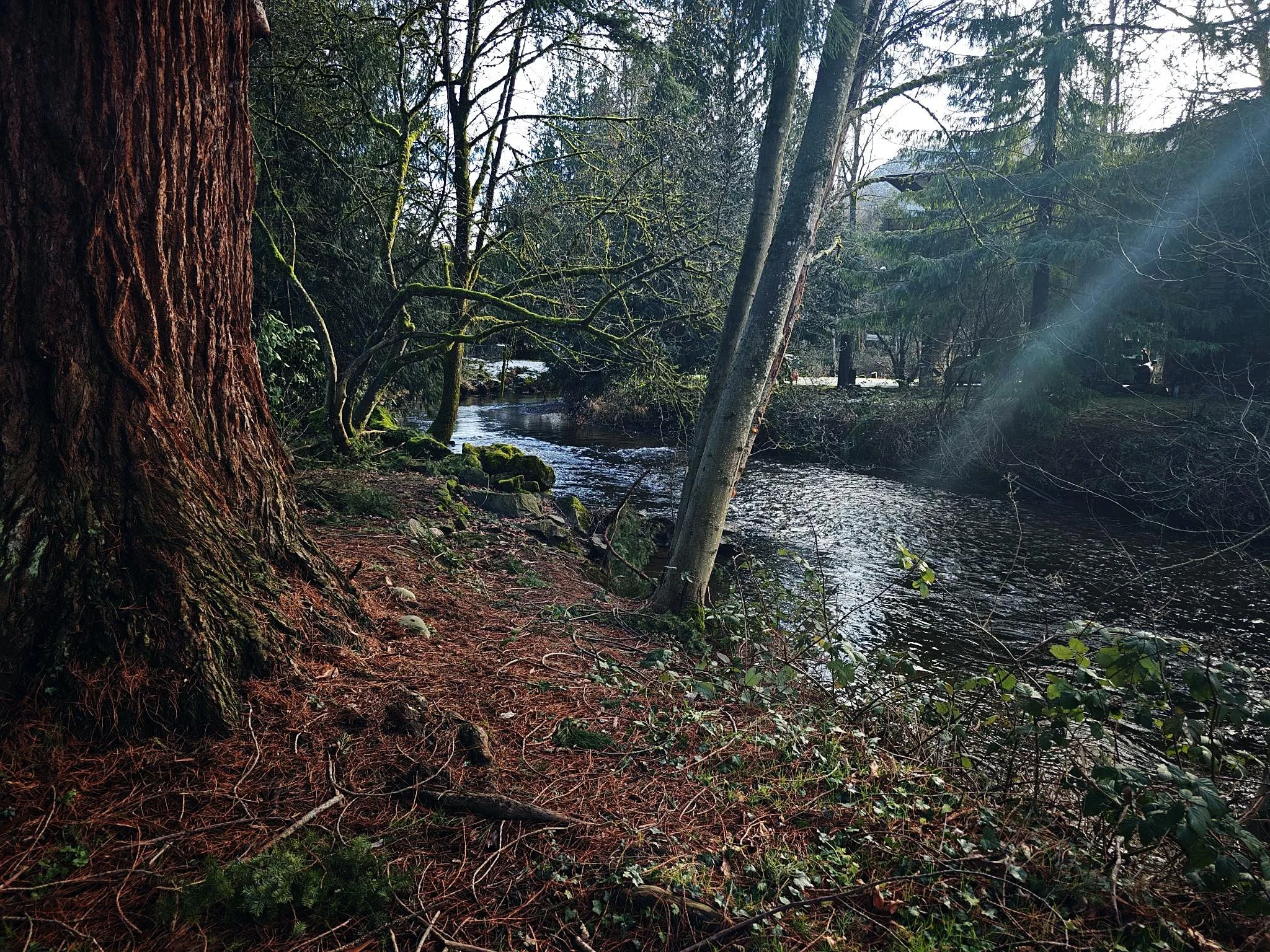
There is a paradox in this picture: the stability of the tree is determined by underground hydraulics in constant motion. It is a steady, assured motion, providing needed nourishment to all who dare “send out their roots (hence, “radical”) by the stream” (Jer 17.8).
It might seem at first that this theme is far from the message of Paul in 1 Corinthians 15 or Jesus in Luke 6. But to those with eyes to see and ears to hear, we can discern both voices singing in harmony with the prophet and poet of yore. Just a few verses down from the lectionary passage, Paul turns to an analogy to “explain” resurrection: it is like a seed planted in the soil (15.37-38)! We can be sure Paul already had that image in mind when he penned the portion we focus on this week: the reality of life beyond this one, named as “first fruits.” The transformation from seed to fruit cannot take place with that watery connection!
Again with Jesus in Luke’s Sermon on the Level Place. Jesus summarizes the contrast between those whose heart makes room for the Word and those whose hearts are more tightly bound: the former are like trees that bear good fruit (6.43-44)!
As we move toward digging into the dirt of the details of our texts, may we thirst deeply for the water/Spirit from which all Life flows (John 3.5-6).
Commentary
-
It’s always risky trying to interpret texts from the prophets out of their cultural and narrative contexts. Here, Jeremiah is in the midst of condemning the leaders of Judah for “idolatry” which manifests itself in acquiring “unjust wealth” (Jer 17.1-4, 11). In other words, the worship of the “gods of empire” threatens the security of God’s people in the land of promise and will lead to their exile (17.3-4). Our passage is found within this context.
vv. 5-6: Jeremiah shapes our passage in antithetical parallelism: first the “curse” and then the “blessing” (cf. Deuteronomy 30). The “cursed”—a biblical term meaning “unfertile”—are those whose trust is in human leaders rather than YHWH. Jeremiah does not attribute actual power to the idols; they are a mere mask for human will and authority. People who rely on such leaders will be like a “shrub in the desert” (Hebrew, `ar`ar `aravah). The word translated “shrub,” `ar`ar, is only one other time in the Hebrew Bible, at Psalm 102.17, where NRSV renders it “stripped.” It suggests a paltry plant struggling to survive in the “parched places (Hebrew, chareriym, only here in the Hebrew Bible) of the wilderness.” The leading lexicon gives the meaning of the word here as “lava field,” i.e., an utterly lifeless place.
vv. 7-8: In contrast to the cursed, the blessed who trust in YHWH are “like a tree planted by water, sending out its roots by the stream.” Note the image of movement-amid-stability: the tree stands still while its roots do their dance with the underground flow. The prophet calls his hearers to embrace this image as the fruitful, non-anxious life of those whose trust is in the only One who can bring shalom to creation.
vv. 9-10: The section concludes with a divine reflection: YHWH knows all too well that the human heart is “deceptive” (Hebrew, `aqov, as “Jacob”) and “in poor health” (‘anush, again at 17.16). The NRSV translation is extremely misleading in rendering these words as “devious” and “perverse.” The issue is that we cannot trust our own “heart” to lead us rightly apart from our life-giving link with the One Who Is. YHWH’s diagnosis is not a moral judgment (“perverse”) but a doctor’s observation: the people are sick and need healing! This interpretation is confirmed by the response of the voice (Jeremiah?) in 17.14: “Heal me, O YHWH, and I shall be healed; save me, and I shall be saved; for you are my praise.”
The passage concludes with YHWH’s self-proclamation as the one who “searches” (Hebrew, choqir, not “tests” as NRSV) the “hearts” and “kidneys” according to “the fruit of their doing.” In Jeremiah’s experience here, YHWH is not seeking to judge or condemn the people, but to heal and restore them.
-
This short poem presides over the Psalter as an introduction and invitation: to delight in YHWH’s torah. Like the Jeremiah passage, it uses antithetical parallelism to make its point, but reverses the order, starting with the “happy” or “fortunate” (Hebrew, ‘ashre) and ending with the “wicked” (Hebrew, rasha`). The word for “happy” is 26 times in the Psalms of 44 times in the Hebrew Bible. It runs as a refrain throughout. The Septuagint renders it with makarios, the “beatitude” word used in Luke’s passage for today (Luke 6.20-22; 15 times in Luke). The message is virtually identical to that of Jeremiah: don’t listen to the wicked, but to YHWH!
vv. 1-3: we hear the same image used here as in Jeremiah of the tree planted by the stream, but without Jeremiah’s “roots.” The translation of Hebrew torah as “law” should be abandoned, evoking as it does the anachronistic “law vs. gospel” debate of the Reformation and beyond. Rather, torah is “instruction”: the way of the Creator revealed to the creation as the path to happiness and fruitfulness. It is something to “delight” (Hebrew, chefets) in. We can picture a person with a torah scroll—or simply the Story contained within—sitting by the riverbank, feeling God in the flow of water and air and Life itself.
vv. 4-6: In contrast are “the wicked.” Unlike Jeremiah, the psalmist here does not point toward divine healing, but to exclusion. Those who would lead people away from the Creator cannot be part of the same community as those seeking to hear and respond joyously to the sacred Word.
Finally, the NRSV concludes the psalm by saying “YHWH watches over” (Hebrew, yd`) the “way of the righteous” (Hebrew, derek tsaddiq) which is better translated “knows the way of the just.” It is not God-as-supervisor, but God-as-intimate-companion on the Way.
-
Paul also participates in the parallelism of Jeremiah and the Psalmist, but on a bigger narrative canvas. His letter to the struggling community in Corinth is framed by the death and resurrection of Jesus. The ignorance and evils of the leaders whose response to Jesus was imperial violence is contrasted with the promise of the greatest possible reward to the faithful: the gift of transformed Life without end.
We know that Corinth was a city in intense competition with its neighbors for prestige and power. It was populated by “new money” who sought—as such people do across the ages and places—to convert their wealth into increased status in the eyes of the locals and of the Roman overlords. Paul wielded the cross as a weapon against such people in the fledgling congregation: the cross reveals the “foolishness” of those “who are perishing” (1 Cor 1.18) but is “the power of God” (1.18) and the “wisdom of God” (1.21). The way of empire leads to death.
In the sharpest possible contrast, 1 Corinthians 15 grapples with the world-shattering event that set Paul on his path. But how to “explain” resurrection? Our passage responds to some in the community who deny even the possibility of such an event.
vv. 12-15: Working with the forms of Greco-Roman rhetoric, Paul proceeds with a series of “if” (Greek, ei, used six times in our passage and 64 times in the letter) statements. He alternates from the general (“if there is no resurrection of the dead”) to the specific (“if Christ has not been raised)”. The “therefore” of this first set of “ifs” is that “our message” (Greek, kērugma) is “empty” (Greek, kenos) if there is no resurrection. Kērugma recalls Paul earlier in the letter (1.21; 2.4) where he spoke of the cross as noted above. The “message” of the cross is foolishness to those outside Christ, and is found to be “empty” if Jesus wasn’t raised. Even worse, it would condemn Paul as a “false witness” (Greek, pseudomartures; cf. Matthew 26.60, only other use in the New Testament), a harsh charge indeed given the Ten Commandments (Exodus 20.16; Deut 5.20).
vv. 16-20: Unfortunately, unlike our Jeremiah and Psalm passages, our Pauline piece ends just as the apostle shifts from the counterfactual to the real: “Now, Christ has been raised from the dead!” (15.20). But before he gets to the shift, our passage continues on the theme of the futility of Paul’s ministry and his hearers’ faith if it is not so.
What does any of this have to do with the rest of creation? We have to go beyond our text to Paul’s wider work for an answer. It is in his letter to the Romans that Paul connects the death and resurrection of Jesus to the larger context:
For the creation waits with eager longing for the revealing of the children of God; for the creation was subjected to futility, not of its own will but by the will of the one who subjected it, in hope that the creation itself will be set free from its bondage to decay and will obtain the freedom of the glory of the children of God. We know that the whole creation has been groaning in labor pains until now; and not only the creation, but we ourselves, who have the first fruits of the Spirit, groan inwardly while we wait for adoption, the redemption of our bodies. (Romans 8.19-23)
Paul certainly has this larger picture in mind in our current passage. He knows that the possibility of resurrection implies a seismic shift in the very nature of earthly life: it does not end with death, but, like a seed planted in the soil that is transformed into tree (1 Cor 15.37-38), so a human “planted” in the tomb comes out with a “glorious” “heavenly body” (15.40). The raising of Jesus begins the process of revealing the “new heavens and new earth” so long envisioned as the life-giving alternative to the imperial, demonic captivity to which creation has become subject (Isa 65.17; 66.12; 2 Peter 3.13; Rev 21.1).
-
Only Luke has Jesus teaching “on the level” (Greek topou pedinos, only here in the New Testament). It is clearly a callback to Isaiah 40.3-4 (as heard in Luke 3.4-5), YHWH’s insistent call to the exiles to “come out” and return to the land:
A voice cries out: "In the wilderness prepare the way of YHWH, make straight in the desert a highway for our God. Every valley shall be lifted up, and every mountain and hill be made low; the uneven ground shall become level, and the rough places a plain.”
The topography itself will change to allow God’s people to go home! In this context, Jesus presents “beatitudes” (Greek, makarioi, as in Psalm 1.1) and “woes”, making a paired contrast just as the prophet and psalmist did.
vv. 17-19: Luke sets up Jesus’ message by describing the place and the people gathered there: they have come from all around, including the far north of Tyre and Sidon—anachronistically recalling prophetic denunciations of those cites under Phoenician imperial rule for their arrogance and greed (e.g., Joel 3.4; Isa 23; Ezek 36). In other words, Luke suggests that people crushed by empire are now seeking hope in the message of Jesus. But they are also there seeking healing of “diseases”(Greek, nosōn, a word used for “empire disease,” e.g., Exodus 15.26; Deut 7.15). That is, both the spiritual “dis-ease” that becomes part of us under imperial propaganda and the physical diseases that arise when people are crammed into urban spaces with poor sanitation. Further, Jesus offers release from “unclean spirits,” i.e., those spirits that would align people with Rome.
vv. 20-24: He begins by “lifting his eyes” (Greek, eparas tous ophthalmous) to see his disciples. It is not an abstract teaching to “whomever,” but a Word addressed to the actual people Jesus sees and who are seeking to touch him and tap into his divine power (6.19). The familiar message inverts the imperial word: the “blessed” or “fertile” are those who are poor, hungry, mourning, hated and excluded!
Implicit here—but more explicit elsewhere in Luke (e.g., 13.6-9)—as that people are hungry and weeping because of the distortions in creation wrought by Rome: the destructive overfarming; the ruthless mining; the general indifference to life other than the lives of the imperial elite.
vv. 25-26: Jesus then turns from blessings to woes. “Woe” (Greek, ouai; Hebrew, ‘oy) is a common term expressing prophetic condemnation of those whose actions generate deep injustices that threaten to shatter the society into pieces (Isaiah 5.8-23; Amos 5.16; Ezek 7.26). Here, Jesus points it at the rich and the “full”. They are denounced for their lack of consideration of how they have become so wealthy and comfortable: by ignoring the needs of their neighbors (cf. 16.19-31).
While beyond the scope of our immediate passage, Luke’s Sermon on the Level ends as Jeremiah and Psalm 1 do: with a contrast between the “good tree” which “bears good fruit” and the fruitless “thorns” and “bramble bush” (Greek, batou). There is a subtle but key “twist” in the story here for those listening closely: the word for “bramble bush” is the same word the Septuagint” uses for the “burning bush” where Moses met YHWH (Exodus 3.2-4; only Deut 33.16; Job 31.40 elsewhere in LXX)! It is a biblical joke of sorts: the symbol of the intimate encounter out on the earth between Moses and the One Who Is becomes an expression here of the fruitlessness of life apart from God. Plainly, Luke’s Jesus is not condemning Moses. It is, rather, an ironic example of the need for discernment: such “bushes” aren’t for “fruit” but for encounter. Rather than seeking to force the plant to produce for human benefit, Jesus suggests, one must come to see that creation is good in itself for revealing God’s holy presence permeating all that is.
Teaching and preaching ideas
How might you “translate” the image of “tree by the stream” to fit your own environmental context? What natural features where you live might substitute for the “tree by the stream” image? The blooming desert? Mountains bursting into bud as the snow melts? A quiet pond bearing birds and bugs in tranquil harmony? What would re-earth you in your own dwelling place?
As we grow in claiming our God-created, intimate relationship with Earth and her creatures, we are invited to re-vise—i.e., to see with new eyes/vision—our relationship with all that is, including our everyday, household “stuff.” Consider the path to your kitchen (or any other room) of common things, such as bananas (https://whatbanana.com/are-banana-farms-sustainable/) or coffee (https://www.downtoearth.org.in/climate-change/coffee-here-s-the-carbon-cost-of-your-daily-cup-and-how-to-make-it-climate-friendly-74912). What sustainable alternatives might be found instead?
How does the reality of resurrection empower your discipleship? What might tapping into that transformation now (see Phil 3.10-11) look like in your community’s relationship with the sky and soil? How might this holy power enable us to respond with creativity and faithfulness to the violence and hatefulness in our world today?
Sources
Radical Bible: https://www.youtube.com/@radicalbible. Wes’ word-by-word commentary on Luke (and other texts) in YouTube form.
“Come Out, My People!:” God’s Call Out of Empire In the Bible and Beyond: pp. 410-411 have a section on Greek nosos as “empire disease.”
“We Shall Not be Moved: https://www.youtube.com/watch?v=duvoETGVvYU. The video shows people singing at the March on Washington, August 28, 1963, including the lyrics, “like a tree planted by the water, we shall not be moved.”
“How urbanization affects the epidemiology of emerging infectious diseases,” from the National Library of Medicine,https://pmc.ncbi.nlm.nih.gov/articles/PMC4481042/.
Contributor Bios
Wes Howard-Brook and Sue Ferguson Johnson share the ministry, Abide in Me (John 15), seeking to interweave the mystical and prophetic, the personal and the political, the human and the nonhuman in the name of Jesus https://www.abideinme.net/ . Wes and Sue have been teaching and writing on the Bible for nearly 40 years. Sue is a spiritual director for individuals and groups. Wes, after 20 years teaching at Seattle University, retired in 2021 to create the “Radical Bible” YouTube channel, a free, word-by-word, video commentary on the Bible (https://www.youtube.com/@radicalbible). They dwell in the Issaquah Creek Watershed, traditional and unceded land of the Issaquah Band of the Snoqualmie people. They are blessed to have three of their five adult children and three of their four grandchildren in the same watershed.
Image Descriptions
Both images in this post are provided by Wes Howard-Book. They both show trees by Issaquah Creek. Wes would like to note that this is his “Murphy Place,” in honor of St. Murphy Davis, whose book, “Goodness and Mercy,” he read sitting at that spot.