
Twelfth Sunday after Pentecost [Proper 19]
Creator, from the depth and breadth of creation, we thank you.
The Very Rev. Ken Gray
In different ways each of today’s lections share a common theme. God’s gift to and through all creation is simply love. Love is quickly followed by truth and gratitude. I now start and conclude all my preaching with a simple text:
Creator, from the depth and breadth of creation, we thank you.
Give it a try.
Commentary
-
Some might say that the nastiest conflicts are found within family units. Especially where wealth and the inter-generational transfer of power are negotiated, the world’s business dynasties—Amazon’s Jeff Bezos, Tesla’s Elon Musk and Facebook’s Mark Zuckerberg, and the Rogers family in Canada and the Murdochs in Australia— all these make the television series Succession look tame. Yet these others like them hold the power many of us struggle with again and again. We cannot pray them away; they do not share our view of God and God’s world, admittedly imperfectly understood and embraced. We raise a voice of prophetic complaint, patiently, and resiliently.
Likewise in the ancient world, and in the generations that follow the reign of King David, power, violence, jealousy, and deceit all create conditions for enmity and even murder. In addition to the human cost of conflict, there is another casualty of violence often ignored. The land.
Found in 2 Samuel, the story of King David’s third son, Absolom, describes the scenes and places of violence in describing in detail their ecological settings. “The army went out into the field;” “The battle was fought in the forest;” “The battle spread over the face of all the country;” “The forest claimed more victims that day than the sword.”
So what was the threat from the forest? Possibly fire (as with much of North America presently) or flooding, or disease, or lack of food, or wild animals or something unknown. We can only speculate, but the focus is significant.
It is a fact that in all situations of war, the land loses, sometimes permanently. Location is everything. Israel and Judah were both proximate to the greater powers of the ancient Middle East. Indigenous peoples were manipulated by both the French and the English in 18th and 19th century North America. In later times Holland and Poland were pressed on all sides during the Second World War. In the present moment, the imprisonment of Gaza surrounded by Israel creates ceaseless possibilities and motivation for war and genocide—and the land suffers with the people. What will Ukraine, South Sudan, and Haiti look like in five years’ time? The people, the non-human creation, and the land itself?
Often the damage is permanent. The US Marshall Islands, Bikini Atoll and other locations in the South Pacific still harbour the after-effects of nuclear testing. Land mines remain an active threat in Angola, Cambodia, the Democratic Republic of the Congo, the Lao People’s Democratic Republic and Viet Nam. The disruption to water quantity and quality, soil erosion, loss of forest cover, habitat survival and mobility, all contribute to land degradation, which itself leads to social instability, poor health outcomes, economic sustainability, and the rise of conflict including potential military action.
Land, and access to land, is a fundamental prerequisite for justice. The distribution of land rights is central to all cultural traditions and jurisdictions. What Indigenous communities have known since time immemorial, is that land is gift and is not to be owned in the manner decided and inflicted by colonizers. Land is for the use of all of creation. Warfare frustrates love, for us humans and for all. Justice is love in action.
-
Amongst the many and varied scenes in the life of the prophet Elijah—his ascension, the competition with the prophets of Ba‘al on Mount Carmel, his encounter with God in a cave where he hears a “still, small voice,” and other powerful forces of and within nature, comes this unique and very personal glimpse of the famous prophet.
He is in turmoil, aware of the threat against his life from Queen Jezebel. He has just murdered the prophets of Ba’al. He is likely weighed down in heart and mind. He literally runs to safety in the wilderness where he hope no one will find him or threaten him. His ancestors fled to the desert once leaving Egypt under Moses’ leadership. Here he retreats alone, though God knows where he is and enquires after the state of his spirit. If he is an instrument of God, he is exhausted. With Jonah, Moses, and Job, he despairs, to the point of wishing for death’s release.
God comes to Elijah and offers comfort, food, and eventually hope. The wilderness is the one place where he can find what he needs; nature can be his teacher, a tutelage not unlike Indigenous vision quests. Nature remains steadfast, where human relationships, wars and murder cannot suffice. Comfort comes not from power over adversaries but through assurance of divine relationship through loving care.
[Possible trigger warning] Having experienced serious depression myself, I and others with similar mental health histories can relate to the tired, disconsolate prophet. Sometimes it’s hard to get up in the morning; it’s hard to feel good about oneself or confident in any kind of positive outcome.
For the activist in all of us who struggle against the principalities and powers of corporate economics, pipelines, violations of Indigenous rights and freedoms, corrupt political systems and the prevalence of greed seemingly everywhere, Elijah, one of the bible’s most famous prophets clearly demonstrates that there are consequences arising from activism. We all live risky lives, the only kind worth living. Such advocacy however is worth the risk, though self-care is essential.
-
A classic psalm of lament, Psalm 130 would be an ideal text for the troubled Elijah in 1 Kings 19 described above. In the language of Alcoholics Anonymous, he has bottomed out and can do nothing but call on the Lord (higher power) for strength and hope.
The Lord alone commands authority and administers forgiveness. So he waits, and waits, and waits. He waits for mercy and redemption. God alone can resolve the conflict, or inspire resilience, or create the conditions for reconciliation. God does these things in God’s time and in God’s way.
Such waiting is not easy; the life of faith requires discipline; and the discipline of a religious life stirs faith. Attributed to various authors and sources, the following quote does exhibit a ring of truth? I first heard it in the movie The Best Exotic Marigold Hotel. It encourages us all to be hopeful, and patient simultaneously. “Everything will be OK in the end. And if it’s not OK, it’s not the end.” Works for me.
-
Written in the name of Paul, though in a manner and style quite different from other genuine Pauline letters, today’s lection includes a long list of ethical encouragements, each deserving careful attention. Ephesians is best considered as some sort of “circular letter” that speaks beyond the needs and experience of a particular community, and to the early Church as a whole.
The preacher ought to avoid presenting the challenges as rules of law but as consequences or symptoms of knowing Christ and living the Christian life. We have here a list of priorities that can become good behaviors or best practices for daily living.
In terms of ecological images and language, any imitation of God rouses all the senses including, smell (fragrance); I am told the last sense to leave the human body as it nears death, is smell. As I have offered last rites to persons nearing death I sometimes use fragrant holy oil (lavender) as the best service I can offer. At all times, as our physical bodies move through the cycles of human life, as we discern the spiritual transformations as love grows in us, around us and through us. The consequence is that bitterness and wrath diminish.
“Be angry but do not sin.” Easier said than done for sure, but it can be done, gradually, as we learn new ways to be, speak, and act together, even amidst disagreement.
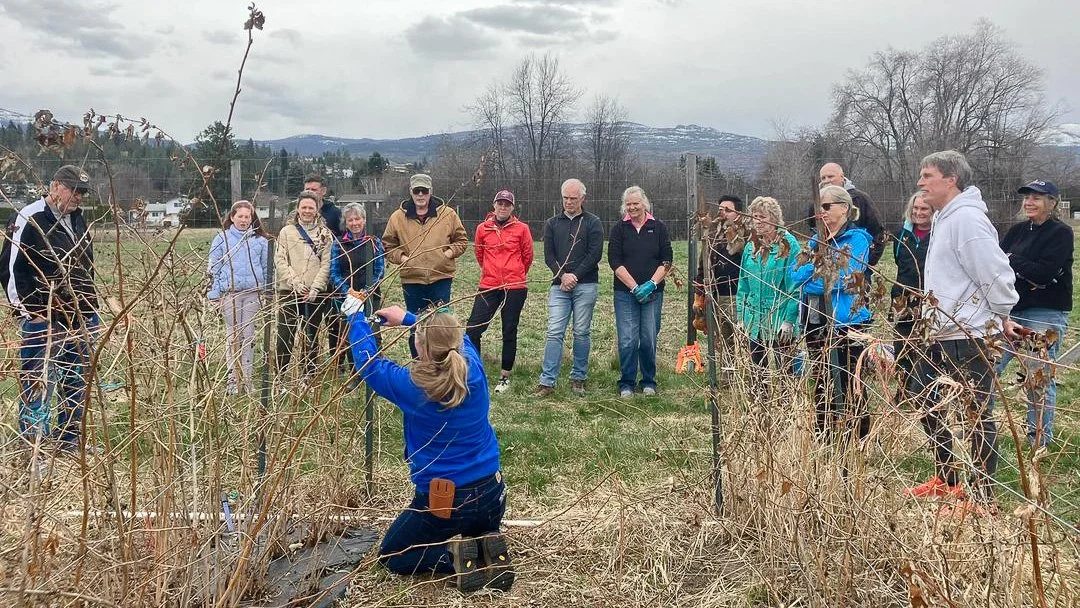
“Let no evil talk come out of your mouths, but only what is useful for building up.” How do we discover what is useful for building up? We can learn from the land. A group of Anglican Christians in Kelowna BC have established The Gift Farm Garden (see below). As an Anglican Parish they have allowed their food ministry outreach to teach them how to be a faith community together. Following the principles of regenerative farming they continue to take agricultural wisdom into their community life. How can the strategic planting of one crop benefit other nearby plantings; How does such care influence pest and weed management, fertilization, soil preservation and enrichment.
Healthy communities nurture love and replenish themselves daily and through all seasons. Especially for activists, for those called to challenge the principalities and powers (Eph 6:10-12), calling everyone and everything to truth and love, at all times and in all circumstances, speak the truth as we receive it; and live it is a daunting though worthwhile challenge and vocation. As farmers learn to depend and cope with the vicissitudes of weather, we as people of faith learn to depend on God, a way shown us by Jesus.
-
It is hard to imagine any more relevant and dynamic symbol for Christian reflection than bread. Today’s Gospel lection is the third of four detailed reflections from the 6th chapter of John’s gospel through which Jesus’ person, identity, vocation, and salvific role are celebrated though key symbols of the Christian faith.
The preacher must be strategic in rolling out, week after week, some of the richest material found in John’s Gospel if not the New Testament as a whole. Jesus is the prophet who feeds everyone from five barley loaves. He confounds natural law as he walks on the water and dismisses fear. The food he shares does not perish over time. He is the One sent from God, the new manna. Bread images find special focus and strength in today’s lection. "I am the bread of life. Whoever comes to me will never be hungry, and whoever believes in me will never be thirsty."
Bread is central to all cultures, traditions, and human histories. The grinding of grain is the oldest industry we know and practice (though not the oldest profession!). Through such a physical, tangible symbol, Jesus and the Gospellers narrate miracle stories and describe the way in which future communities (like ours today) can and will gather to remember these same stories, and their story-teller is made present to us now in and through nature.
I know an African bishop who refuses to say the Lord’s Prayer until everyone has access to enough daily bread. He is still waiting. His point however is well taken. To say that we seek “spiritual” bread only is unjust to those who suffer from famine, hunger, and disease. The daily bread of inspiration can and must evolve into specific justice-seeking acts of ecojustice, seeking awareness of food security, sustainable land use, access to land cared for by Indigenous communities prior to contact.
Preaching and Teaching Suggestions
Explore today’s title, “Creator, from the depth and breadth of creation, we thank you.”
Consider the land. What land do you visit, occupy, work, or enjoy? Talk about land acknowledgement. How is the land upon which you meet used, or abused?
Have some fun with the words “bread of heaven.” It’s often sung at Welsh rugby games. Have a singing competition. The irony of my musical suggestion is noted given comments on warfare above. Explore these ideological tensions. https://youtu.be/CgTvSAMp4Ec
Use the passage from FIRST KINGS 19:4-8 as a way to check in with listeners about their state of mind. If Henri Nouwen once described the “wounded healer” in the context of pastoral care, how do folks feel now about today’s witness to justice?
Schedule other music related to the theme of bread; I am the bread of life; eat this bread; as we gather round this table . . . and so forth.
References
Online lectionary resources used in relation to the notes above:
Notes on bread -- https://www.britannica.com/topic/bread
My blog celebrating the Kelowna good farm garden -- https://take-note.ca/2024/05/12/the-gift-farm-garden-grows-gives-and-teaches/
For more on Land, see “The Promise of Place: Shaping a Local Anglican Response to Global Realities” by Montreal theologian Jesse Zink. It is found in a new book edited by myself and Maylanne Maybee available from the publisher website https://wipfandstock.com/9781666779325/partnership-as-mission/ OR contact me, Ken Gray, at grayintheforest@shaw.ca for a discounted copy payable by e-transfer.
Author Bio
Recently retired from cathedral and parish ministry Ken Gray now lives in Summerland in the South Okanagan area of British Columbia. He is secretary to the Anglican Communion Environmental Network, a recently published author (see above), a blogger, musician, and photographer. He is a longtime friend and supporter of Salal and Cedar.
For Further Study
Eucharist symbol of Transformation
https://www.amazon.com/Eucharist-Transformation-William-R-Crockett/dp/0814660983
The late William Crockett (formerly of the Vancouver School of Theology) traces the evolution of Eucharistic traditions - traditions which reflect the cultural diversity characteristic of the regions in which they were produced - and compares them to our Eucharistic celebrations today, exploring as well the relationship between Eucharist and justice.
For an Indigenous perspective on what Tzeporah Berman calls “These Crazy Times” read We Survived the End of the World: Lessons from Native America on Apocalypse and Hopehttps://www.amazon.com/We-Survived-End-World-Apocalypse/dp/1506486673 by Choctaw elder Episcopal Bishop and theologian, Steven Charleston. Charleston speaks to all who sense apocalyptic dread rising around and within Pandemics and war, social turmoil and corrupt governments, natural disasters and environmental collapse--it's hard not to watch the signs of the times and feel afraid. But we can journey through that fear to find hope.
Image
Members of the Good Farm Garden in Kelowna BC learning pruning skills. Photo credit: Anne Privett