
Tenth Sunday After Pentecost Year B: Abusive Power and Abundant Provision
Rev. Emily E. Ewing
From military overwhelm and abusive power to the strength and abundance of God, this week’s readings have a lot to say about the world in which we live. King David’s abuse of power, both at waging a war he is not willing to risk his own life for and at raping Bathsheeba and having her husband assassinated, provide plenty of examples of Psalm 14’s proclamation that humanity has failed to live up to our best selves. While Ephesians’ emphasis is more focused on praising God, its imagery of rootedness and groundedness calls to mind vegetation that keeps hillsides from falling away and deserts from claiming more land. As John’s feeding of the multitude begins the Bread of Life series, the abundance of what is needed and the power of the sea draw us into the reality of God’s provision. God provides enough, yet it is hoarded by the few, whether it is a powerful king’s sexual exploits and brash military might or today’s world of unnecessary poverty and hunger.
Commentary
-
In 2 Samuel, the well-worn story of King David, sending others into battle while he stays behind, only to rape Bathsheeba, the wife of a loyal soldier, provides plenty of space for engagement. Verse 1
Today those deciding on wars are rarely, if ever, the ones risking their lives, but in David’s day, the expectation was that kings join soldiers for battle, so from the start this story veers from the expected as David is not with his troops.
Verse 4
David rapes Bathsheeba, one of many women in 2 Samuel whose voice is not heard. In terms of climate change and creation care, as Nobel Peace Prize winner Wangaari Mathaai frequently pointed out, women make all the difference in creation care. Erasing and hiding them harms not only women, but all of creation.
Verse 5
Though it receives only a brief mention in this passage, Bathsheeba’s pregnancy evokes questions of choice, reproductive justice, abortion access, and the impact of having children on the escalation of climate change.
Verse 7
The casualness of war conversation while David is not participating
Verse 15
Once again King David uses the military for his own purposes, this time to assassinate Uriah.
-
In Psalm 14, humanity’s worst is on display and the psalmist laments humanity’s evilness. This psalm, which is attributed to David calls David’s own self out from the 2 Samuel text. While this psalm does not explicitly connect to creation, the ways it calls out the harm of humans can easily be applied to humanity’s harm to creation.
Verse 1
The mention of abominable deeds and corruption usually connect with economics and wealth, which harm the environment rather than supporting care of all humans and the more than human world
Verse 2
The wise seek after God, and so they seek to care for the environment, just as God does.
Verse 3
All of humanity has gone astray, environmental harm being one of many possible examples.
Verse 5
Using military language, the psalmist recalls God’s presence with the righteous.
Verse 6
The BECOMING ONE is the refugee of the poor, protecting those most harmed from environmental degradation and racism.
Verse 7
The BECOMING ONE restores the fortunes of a people who feel abandoned, recalling the collective nature of God’s blessings and rescue.
-
In the letter to the Ephesians, the author praises God and extolls God’s majesty.
Verse 16
The author prays for the receivers of the letter to be strengthened internally with power through the Spirit, encouraging strength of commitment and values, care for creation.
Verse 17
The imagery of being rooted and grounded calls to mind the Civil Rights spiritual, “We Shall Not Be Moved,” with the lyrics “like a tree that’s planted by the water, we shall not be moved.”
Verse 20
While it is easy to feel overwhelmed and give up on climate justice, God can “accomplish abundantly far more,” so there is still hope for us to fight climate change.
-
As John’s Bread of Life series begins, the feeding of the multitude with the food of one child and Jesus’ walking on water in the midst of a storm draws into both a God of abundance and the power of God’s creation. The feeding of the multitude is one of very few stories that occurs in all four Gospels.
Verses 1-3
Nature provides the backdrop for Jesus’ ministry, from crossing “to the other side” of the Sea of Galilee/Tiberias and back again between Gentile and Jewish communities, breaking down the boundaries of nation-states.
Verse 4
Passover, celebrated as a reminder of liberation from slavery, relies on food and natural symbols as reminders.
Verses 5-7
The abundance of people presents a challenge to the disciples’ imagination and trust in being able to provide enough food.
Verse 9
One of my favorite songs for children, and a reminder of the power children have is “1 boy had 2 fish / and 5 loaves of bread. / He gave them to Jesus, / Everybody was fed!” The barley was also a safe food for Passover.
Verses 10-11
With 5000 people gathering to sit on the grassy mountainside, Jesus gives thanks and distributes the boy’s food.
Verses 12-13
When all are satisfied, they gather what remains “so that nothing may be lost”, making use of everything and trusting in God’s abundant provisions to provide 12 baskets of leftovers.
Verse 15
Exhibiting great wisdom, Jesus chooses mountain over monarchy.
Verse 16-17
The disciples sail in the dark to Capernaum without Jesus.
Verses 18-19
As the sea grows rough, the crew in the boat rows 3-4 miles before seeing Jesus walking on the water. As Adele Reinhartz points out, in walking on water, Jesus “demonstrates power over the natural world.”
Verse 20-21
Jesus reassures those in the boat and when they try to get Jesus into the boat with them, he avoids the smalltalk of the boat as they immediately reach land.
Teaching and Preaching Suggestions
Abusive Power in War
Both 2 Samuel and Psalm 14 lend themselves to a dive into the harm that humans cause. King David, who is frequently lifted up as a righteous king and is extolled as Jesus’ ancestor, here commits horrendous acts. In a culture where war was fought not just by the poor, but also by kings, David chooses instead to stay home. His willingness to risk and even take others’ lives without taking on any of the risk himself is familiar with the empires still dominating, warring over, and claiming other lands and peoples. It is as if Psalm 14, lamenting that “there is no one who does good” in verse 1b, was written not by, but about David. David really does eat up Uriah as if eating bread: talking with him, getting him drunk, and ultimately sending him off for a sabotaged attack so that David’s officers can put Uriah directly in the line of fire.
Today war is a much too fast approach to resolving conflict. Men in fancy buildings send particularly the poor to die for oil, money, and empire. This is not new, and towards the end of his life, Dr. King spoke out repeatedly against the Black and brown kids being sent to Vietnam to kill and be killed. The environmental devastation caused by war is also not new, though it has significantly increased with the increased deadliness and danger of weapons.
Preaching that takes seriously care of creation and climate justice demands an accounting for,
as Psalm 14 states, those who “are corrupt, they do abominable deeds”. The psalmist cries for people to be filled, as Ephesians echoes, “with all the fullness of God” rather than remain astray.
Abusive Power in Sexism
Similarly to a sermon addressing the abuse of power and human harm in relationship to war, 2 Samuel’s depiction of David while others are at war for him challenges any goodness we have attributed to him. 2 Samuel depicts King David not only embracing the safety and deadliness of sending others to war, but also embracing the power of kingship to compel others to his will. While Bathsheba purifies herself. David sees her and sends for her. After raping her and she returns to her home, only to discover that she is pregnant. David, who faces little to no direct accountability for his decisions and actions, continues to order others around so that they will clean up his mess. Calling Uriah back from the battlefield where David ought to have been, David attempts to get Uriah to have sex with his wife so that her pregnancy might be attributed to him. When this doesn’t work, David leaps to assassination and orders Joab to put Uriah as directly in the line of fire as possible.
Again the psalmist’s words echo as a rebuff to David’s actions, “Have they no knowledge, all the evildoers who eat up my people as they eat bread, and do not call upon the BECOMING ONE?” David, who is later called to account by the prophet Nathan, has eaten up Bathsheba and Uriah in different ways and will eventually reap the consequences.
God’s Abundant Provision
The first part of our Gospel reading depicts Jesus as a teacher of a few that inevitably grows with the large crowd enthralled with “the signs that he was doing for the sick.” Rather than turn them away or send them back early, as would be all too common today, Jesus tests his disciples, asking what should be done. Jesus knows that creation, which has opened up to welcome them all, first in journeys across the sea and then on the grassy mountain side and inevitably in food and hospitality. In Jesus’ day hospitality was an essential part of the culture, so turning away the large crowd would have raised serious concerns.
The question of “is there enough?” is asked almost constantly today. The answer, as Action Against Hunger states, is clearly “Yes!” while over three quarter of a billion people go hungry, humans produce more than enough food. The child in the Gospel embodies the author of Ephesians’ prayer that “according to the riches of his glory, he may grant that you may be strengthened in your inner being with power through his Spirit.” Grounding in loving generosity, this boy offers his five loaves of bread and two fish for the sake of the community gathered. Jesus amplifies his offering and before we know it, everyone has had all they could want and the leftovers, gathered so nothing goes to waste, fill 12 baskets. The number of tribes of Israel and of disciples becomes the tangible reminder that all may be filled with plenty remaining.
This feeding of the 5000 is a powerful message of communal responsibility and cooperation. We need each other. God has created a world in which we are interdependent. That is how climate justice works, that is how we end hunger and poverty. We recognize our interdependence and live into God’s abundance that provides enough.
Sources and Resources
Ken Stone, “1 and 2 Samuel”, Queer Bible Commentary
Gerald West, “1 and 2 Samuel”, Global Bible Commentary
Mavis Staples, “We Shall Not Be Moved,” https://youtu.be/Qf0vf6eV6JE?si=rHQw1epdf8ziRg5W
Adele Reinhartz, “Introduction and Annotations in John”, The Jewish Annotated New Testament
Action Against Hunger, “World Hunger Facts”, https://www.actionagainsthunger.org/the-hunger-crisis/world-hunger-facts/
Contributor Bio
Rev. Emily E. Ewing (they/them) is a Lutheran (ELCA) pastor serving in Baltimore, Maryland. They combine creativity, spirituality, nerdiness, and the call to justice in many ways. Pastor Emily cohosts and coproduces the Nerds At Church podcast as well as cohosts the Horror Nerds At Church podcast. They consult with communities of faith for anti-oppression trainings, Praying in Color spiritual practices, and whatever the Spirit calls them to.
Image Description
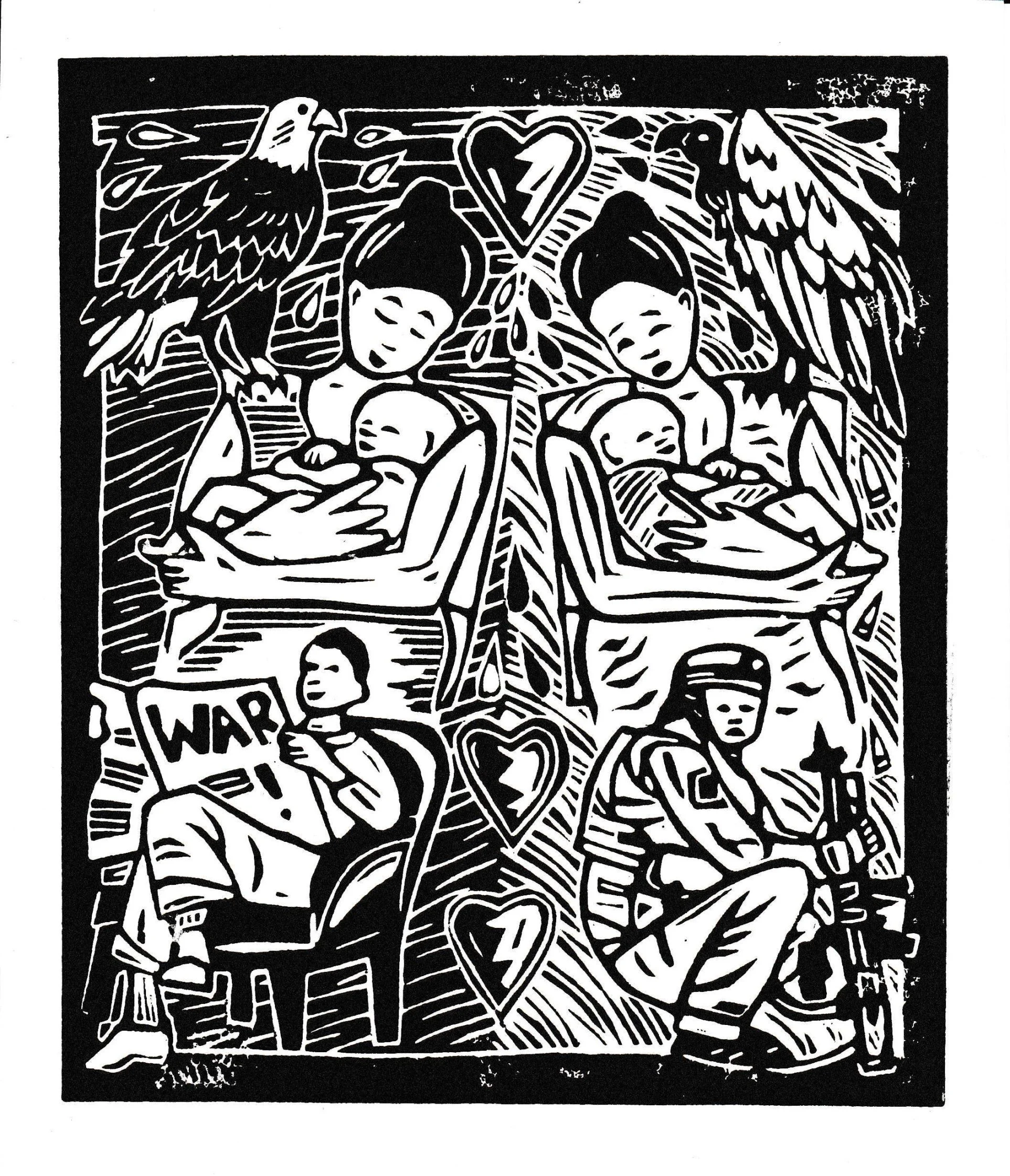
Lino cut by Sarah Fuller. A black and white linocut with contrasting images. On the top left against a dark background an eagle perches on the shoulder of a smiling person in a dress with hair up in a bun, holding an infant. On the bottom left a person with short hair sits in an arm chair reading a newspaper that says “War!” On the top right against a white background a vulture perches on the shoulder of a person with hair up in a bun holding an infant, their face is distressed. On the bottom right a soldier in fatigues crouches holding a machine gun. The two sides of the image are divided by three hearts, each heart is dark on the left side and light on the right. The heart at the top has drops coming out of it.