Seventh Sunday after Pentecost, Year B: Cultivating Beloved Community
Vic Welle
While limited in terms of ecological imagery, the readings offer an opportunity to reflect on issues important to movements for social change and cultivating beloved community. The readings offer insight into how leadership and authority is determined, the role of illness and disability, and which perspectives are centered in climate justice and related movements for liberation. Central questions for reflection include: What and who do we consider an authority, and what is the source of knowing? Who is included in community? Whose voices do we listen to, and whose do we devalue?
Commentary
-
Verse 1 “…we are your bone and flesh.” A declaration of kinship spoken to David. In presenting their case for the reasons why David should become their king, the tribes choose to lead with this visceral statement of body-based knowing. Reading through an ecofeminist lens, theologian Ivone Gebara notes that an ecofeminist epistemology is an affective one, a way of knowing that is related “to the senses, and to the emotions that respond to gut feelings.” This appeal to affective knowing, a knowing felt deep in the bones, is spoken about first, even before the tribes remind David of God’s direct message to him to be “the shepherd of my people Israel” (v. 2).
In contemporary somatic understanding, physical bodies are also understood to hold deep knowing. Susan Raffo, a bodyworker and author of Liberated to the Bone, writes of the ways bodies hold history, including histories of trauma and violence among kin. This calling to mind of “bone and flesh” connectedness may be an appeal to kinship ties, but it might also be a reminder of the bodies that will continue to be impacted by the ongoing political and military conflicts at play.
“All the tribes” (v. 1) “all the elders of Israel” (v. 3) – David is portrayed as one being convinced to lead, rather than one seizing power. He is collectively chosen by the elders (left unexamined, however, is how the elders are chosen!). As the story of David unfolds, we know that he will struggle with using his power in a responsible way. The pressures placed on a charismatic leader to fulfill all of the needs of the collective is a common pitfall of many movements for social change. “Movements that put all their eggs in one leader’s basket are vulnerable movements,” writes adrienne maree brown, reflecting on the lessons of the Black civil rights movement in the United States.
-
Verse 2. Paul’s recounting of a mystical experience (“caught up in the third heaven”) highlights a way of knowing that is deeply experiential and not based in intellect and logic. It defies easy categorization - “in the body or out of the body I do not know” – but nevertheless was deeply felt.
In their social science commentary on scripture Malina and Rohrbaugh note that “For most of the world, even today, a report of alternate states of awareness would be considered quite normal.” In our contemporary medicalized or scientific frameworks of meaning making, however, a person experiencing such an altered state is often deemed “mentally ill” or under the influence of a drug, regardless of what meaning the experience might hold for the person. What might be different in our congregations and movement spaces if these more difficult to understand experiences were more widely accepted as part of the multitude of valid ways humans can experience the world? What wisdom might be lost by dismissing such experiences?
v. 7 “a thorn…in the flesh” is another visceral body-based image found in this week’s readings. The text does not clarify what this thorn was for Paul. A frequent interpretation is that of illness or disability. Read from a disability justice perspective of wholeness, we can note that, while painful to live with, God does not see Paul as deficient or in need of curing.
Disability justice advocate Amy Kenny notes that “we regularly erase disability… Moses has a speech disorder, Elijah deals with depression and suicidal ideation, Timothy is chronically ill, Zacchaeus is likely a little person, Paul has the thorn in the flesh, the list goes on. And all of those disabilities aren’t cured or erased in Scripture, yet we erase them when we tell stories. And I think in turn, we erased the way that God is already at work in disability now.”
-
Verse 2. Continuing the theme of authority and knowing, we read of Jesus returning to find his home community questioning how he possibly knows what knows (“What is this wisdom that has been given to him?”). Perhaps there is also some fear about the impact his growing notoriety will have on his community: later in this chapter is the recounting of John the Baptist’s violent death. It is not a safe time to be a vocal prophet.
V. 6 “And he was amazed at their unbelief.” It’s worth pausing here to note the impact on Jesus after this rupture with his community. Ched Myers describes this moment as one in which Jesus is disowned, “stripped of status and robbed of clan identity.” In a collectivist society this kind of rejection could be deeply consequential.
v. 7 In the next verse Jesus shifts his attention to gathering the twelve (a queer reading of the text might note an element of seeking “chosen family” after a rejection by family of origin) and sending them in pairs to continue the work of teaching and healing.
v. 7 “and gave them authority over the unclean spirits,” v. 13 “they cast out many demons”
Malina and Rohrbaugh note that “Possessed persons were excluded from community. Freeing a person from demons, therefore, implied not only exorcizing the demon but restoring (them) to a meaningful place in the community as well.” Those seen as outcasts due to illness, disability, or some “otherness” are welcomed back into community through the healing ministry of the disciples. In contrast with the dry dust that is shaken off in protest of those who do not offer welcome (v. 11), the sick are anointed with oil (v.13).
Preaching and Teaching Ideas
Disability Justice
As noted in a previous lection, disabled bodies will be disproportionately impacted by climate crisis. Centering the perspectives of disabled people is essential. If preaching on themes of disability, be mindful to note that while Paul opts to make meaning of his “thorn” as “a messenger of Satan,” it’s important that this meaning is not one to impose on all disabled bodies. In the same way, it is also important to not impose an explanation of disability as “God’s will” for the person. Each disabled person deserves the autonomy to make meaning of their own experiences in light of their faith, community, and other intersecting identities they may hold.
Voices, Visions, and Altered States
David, Paul, and Jesus all had experiences of hearing the voice of God, seeing visions, or otherwise experiencing an altered state of some kind. In scripture these experiences often designate a person as having a significant role in their community. In contemporary times, many hold negative bias (conscious or unconscious) towards people who hear voices, see things others do not see, or who otherwise experience reality in a different way. These experiences of altered states can often result in involuntary psychiatric involvement, discrimination, and exclusion from community.
In response to these harms, peer support groups such as the Hearing Voices Network exist for those who experience voices, visions, or similar phenomena. Here, voice-hearers self organize to offer mutual support. The groups hold space for exploration of meaning, including the “relational, social, cultural, spiritual, historical and political” dimensions of these experiences. What can congregations and social change movements learn from these groups where empathy, open-minded curiosity, and mutuality are prioritized? (recommended viewing: Beyond Possible)
Anointing, Leadership, and Authority
Potential questions for further examination of these themes:
What does it say about leadership that both a king and people outcast due to illness are anointed with oil? (Paul also references “the power of Christ--the anointed one--dwelling in him as a result of his “weakness.”)
Does social change come from having the correct people in positions of power? Or might we be better served by disrupting leadership hierarchies?
Are those most deeply impacted by climate crisis the ones centered in decision making? Or are they considered unworthy due to lack of status? How does elitism show up in our congregations and movement spaces—are we guilty of dismissing the knowledge of working class laborers (carpenters) in favor of those with wealth, ministerial titles, or academic credentials?
Who are the prophets of today, who are the elders? Do they have the good of the whole community in mind when making decisions?
Sources and Resources
adrienne maree brown, Holding Change: The Way of Emergent Strategy Facilitation and Mediation, AK Press, 2021
Ivone Gebara, Longing for Running Water: Ecofeminism and Liberation, Fortress Press, 1999
Susan Raffo, Liberated to the Bone: Histories, Bodies, Futures, AK Press, 2022
Ched Myers, Binding the Strong Man: A Political Reading of Mark's Story of Jesus, Orbis Books, 1988
Bruce Malina, Richard Rohrbaugh, Social-Science Commentary on the Synoptic Gospels, Fortress Press, 2nd Ed, 2002
Amy Kenny, “My Body is Not a Prayer Request,” The Bible for Normal People podcast, episode 205, May 9, 2022 https://thebiblefornormalpeople.com/episode-205-amy-kenny-my-body-is-not-a-prayer-request/
“Beyond Possible: How the Hearing Voices Network Approach Transforms Lives,” https://youtu.be/Qk5juEgi1oY?si=NED7ft_P0g10-p96 accessed 23 June 2024
Hearing Voices Network values, https://www.hearing-voices.org/about-us/hvn-values/ accessed 22 June 2024
“10 Principles of Disability Justice” as articulated by Patty Berne and Sins Invalid, https://www.sinsinvalid.org/blog/10-principles-of-disability-justice accessed 22 June 2024
Holly Rockwell, “Wild and Unpredictable Incarnate Word” Radical Discipleship https://radicaldiscipleship.net/2018/07/05/wild-lectionary-wild-and-unpredictable-incarnate-word/
Ched Myers, “Strategies of a Subversive Movement” Radical Discipleship https://radicaldiscipleship.net/2018/07/08/strategies-of-a-subversive-movement/
Contributor Bio
Vic Welle is an activist, psychiatric survivor, and peer support trainer currently living near the Kinnickinnic River in Wisconsin. Vic’s work includes supporting community-based crisis alternatives and offering spiritual support to those alienated from faith communities due to sexuality, gender identity, or mental health discrimination.
Image
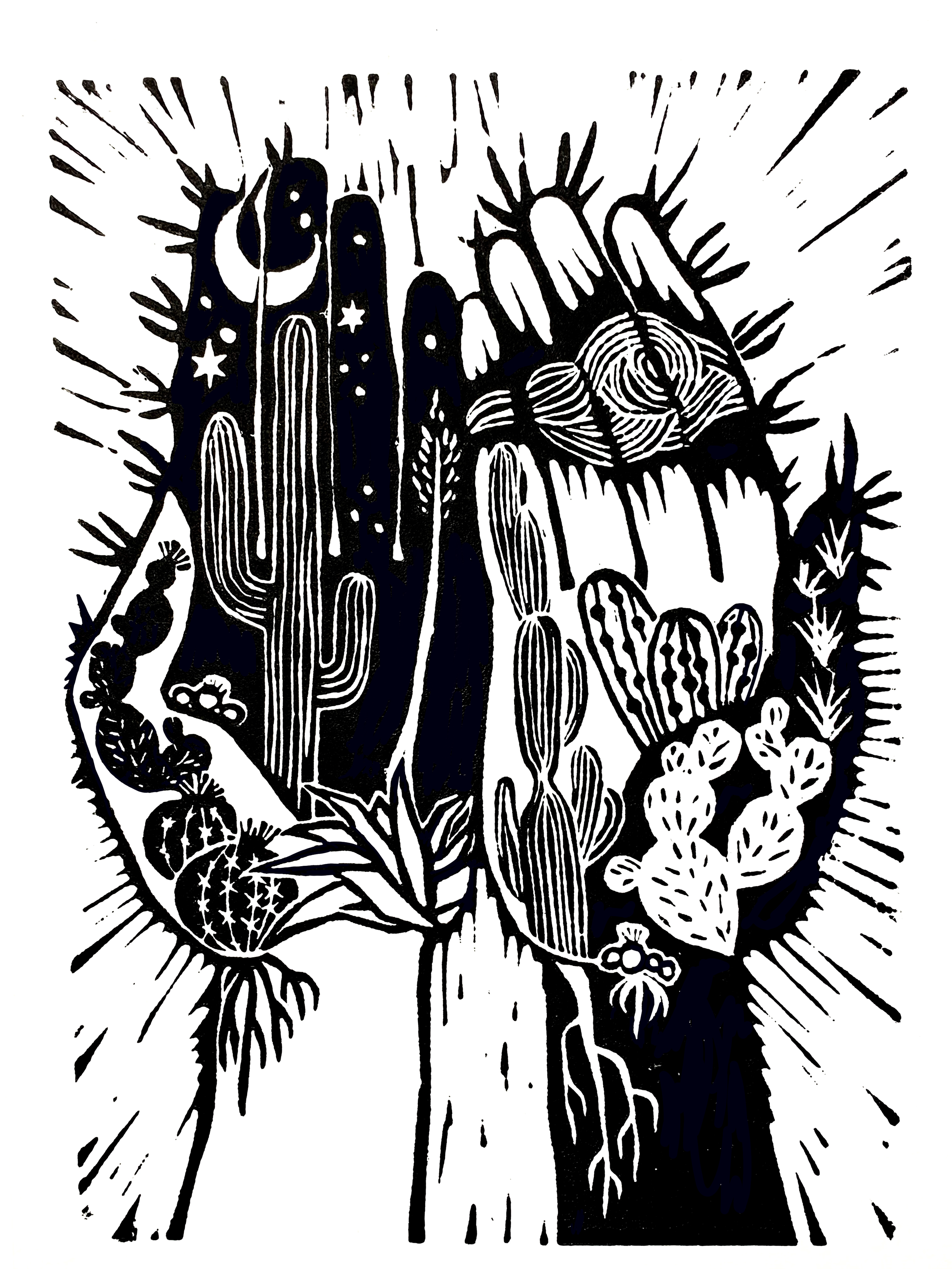
“Still We Reach for One Another” by Kate Morales, via justseeds.org
Image description: Two hands are held up next to each other in a black and white woodcut design. The hands are filled with images of desert plants such as cactus, agave, nopal, as well as a night scene with moon and stars.