
Second Sunday of Easter, year ‘B’: Burden of Proof
Featured contributor: The Rev. Helen Dunn
The Second Sunday of Easter is traditionally called “Low Sunday” to reflect a “somewhat less intense celebration.” The readings appointed for this Sunday, though, reflect anything but. In Acts, the people first called Christians are on the move: folks from different tribes and nations pool their money and possessions; the word that Jesus is risen is out; in a subversive act, land is sold—the earth freeing up financial resources to flatten systems of oppression where the rich get richer and the poor get poorer. In the psalm appointed for the day, a mountain shows itself to be teacher: instructing the human kin in what it means to dwell together in unity. Then, in a letter and a gospel from the Johannine community we see the earth assuming the burden of proof in the case for Jesus: where humans fail to believe, light and darkness and the whole of creation step up to the witness stand—showing Jesus to be who he said he was, beyond a reasonable doubt.
Commentary
-
v. 32 - “of one heart and soul” - allusions here to Genesis 11:1 and the Tower of Babel when “the whole earth was of one language and of one speech” (KJV).
“everything they owned was held in common” - an allusion to the covenant with Noah in Genesis 9:2, “Every moving thing that lives shall be food for you; and just as I gave you the green plants, I give you everything” (NRSV).
v. 33 - “great grace was upon them all” - the Greek word for grace is the same that appears when the angel Gabriel appears to Mary (Luke 1:30) and in John’s prologue when describing Jesus coming into the world (John 1:14). As well, it is used in the LXX Greek translation of the Hebrew story of Ruth, when she and her mother-in-law are facing starvation and are seeking the “grace” of their neighbour to ensure their survival (Ruth 2:2;10;13).
v. 34-35 - When the land is sold, the earth participates in the earliest gathering of support for the Jesus movement. The financial resources acquired from selling the land are distributed according to need—a key feature of land metaphors throughout the Bible (c.f. Mount Hermon in Psalm 133 of this week’s lectionary) and especially of Jesus’ land parables (Parable of the Mustard Seed; Parable of the Sower).
“Laid it at the apostles’ feet” - the apostles include “the whole group”. We ought to assume that Mary Magdalene, Mary the Mother of James, Joanna, Salome and others were among them (Mark 16:1; Luke 24:10).
-
v. 1 - The Inclusive Language Psalter from the Anglican Church of Canada translates the more commonly used “brethren” as “kindred.” Kindred refers to a vision for the dispersed tribes of the people of God coming together (links here to Acts 4:32— “the whole group . . . were of one heart and soul . . . everything they owned was held in common”). Kindred includes human kin and nature kin as will be described in verses 2 and 3.
vv. 2-3 - can be read as asyndeton, ‘twin’ or parallel verses illustrating “how good and pleasant it is, when kindred live together in unity!” The oil that is used to consecrate Aaron as priest in Leviticus 8 is likened to the dew that falls on the highest mountain peaks in Israel-occupied territory (Mount Hermon is said by some scholars to be a possible site of Jesus’ transfiguration). When the land below Mount Hermon is parched, the dew pools at the top of the mountain range and runs down the sides, giving water to the land below. Nature participates in what and whom God consecrates as much as—if not more than—humans do.
-
Today, most scholars conclude that the First Letter of John and the Gospel of John were written by different authors, though both from within the Johannine community. This means that while there is variance in grammar and style there are certain themes that show up in both scriptures. In this passage from 1 John 1:1-2:2, we see allusions to:
Thomas placing his finger in the resurrected Jesus’ side and touching his hands in John 20:27 (c.f. 1 John 1:1 - “We declare to you . . . what we have heard, what we have seen with our eyes, what we have looked at and touched with our hands”).- Themes of light and darkness throughout John’s gospel, especially in John’s prologue: “The light shines in the darkness, and the darkness did not overcome it” (c.f. 1 John 5:5-7).
Both the First Letter of John and the Gospel of John pull on language from the creation story in Genesis 1. For example, Genesis 1:1-3, “In the beginning when God created the heavens and the earth, the earth was a formless void and darkness covered the face of the deep, while a wind from God swept over the face of the waters. Then God said, ‘Let there be light’; and there was light.” The light and darkness parallels to the creation story show how the earth is very much informing the early testimonies of the Johannine community to “the life that was revealed” in Jesus.
-
v. 19 - “The Jews” refers to the religious leaders who had colluded with the Roman authorities to stamp out any opposition to the state. It does not refer to all Jews, or to the Jewish religion more broadly.
Given John’s creation references to “the beginning” in chapter 1 of this gospel, the “first day of the week” here in chapter 20 is almost certainly a reference to the first day of creation in Genesis 1. John’s Jesus comes into the world as the earth came into the world; John’s Jesus comes into being as the earth came into being. Which is to say, the earth is the pattern after which humanity is created and the pattern after which the Saviour of the World is begotten.
Note: just as “darkness covered the face of the deep” in Genesis 1, so also here it is evening and the disciples are gathered in a locked (darkened) room.
v. 22 - Jesus breathing on the disciples and saying to them, “Receive the Holy Spirit” is a reference to Genesis 1:2 - “a wind from God swept over the face of the waters.”
v. 23 - The power to forgive and retain sins is akin to the “dominion” (stewardship) of the earth humankind is given at Creation (Genesis 1:26ff).
v. 24 - Thomas is called “the Twin” in two other places in the Gospel of John: John 11:16, “Thomas, who was called the Twin, said to his fellow-disciples, ‘Let us also go, that we may die with him’”; and John 21:1-2, “After these things Jesus showed himself again to the disciples by the Sea of Tiberias; and he showed himself in this way. Gathered there together were Simon Peter, Thomas called the Twin, Nathanael of Cana in Galilee, the sons of Zebedee, and two others of his disciples.”
v. 25 - “We have seen the Lord” - reminiscent of the women at the tomb testifying to the (men) disciples after witnessing the resurrection, and the disciples not believing them (Luke 24:10-11). Or, more explicitly, to Mary Magdalene in John 20:18 who “went and announced to the disciples, ‘I have seen the Lord’; and she told them that he had said these things to her.”
v. 27 - Given the links to Genesis 1 in this story, one could read Thomas’ refusal to believe as Thomas not yet being able to see “that it was good” as God saw “that it was good” throughout the six days of creation. Thomas is invited to “put his hands to” Jesus as God put his [sic] hands to creation (Genesis 1:31, “God saw everything that he [sic] had made, and indeed, it was very good.”). When Thomas “believes”, he sees “that it was very good.”
v. 28 - Thomas repeats what Mary and the other women disciples have already testified to when they witnessed the resurrection.
v. 29 - The language of seeing and believing is related to the language of light and darkness in John’s gospel. Jesus’ words to Thomas here could be translated, “Blessed are those who have want for daylight and yet have come to believe.” There are allusions to Genesis 1:2, “the earth was a formless void and darkness covered the face of the deep.” Those who “want for daylight”, “those who have not seen” are those, perhaps, who chose to follow Jesus, the “word of life” (c.f. 1 John 1:1), without having survived persecution from the state to witness his resurrection.
vv. 30-31 - The “many other signs” Jesus did in the presence of his disciples is both a literal reference to Jesus’ works and an allusion to the “signs” mentioned in Genesis 1:14 - “And God said, ‘Let there be lights in the dome of the sky to separate the day from the night; and let them be for signs and for seasons and for days and years’”. The point is that there is as much evidence in the natural world for “Jesus . . . Messiah, the Son of God” as there are stars in the sky, and that the whole of creation takes part in this testimony.
Preaching and Teaching Ideas
Twinning
“Twin” is Thomas’ second name, as in Thomas the one who was called Twin. Second names (not to be confused with surnames) in the Bible generally refer to a reenactment or fulfilment of an ancestral story. Think twins, Jacob and Esau, or Jesus Christ—Jesus the one was called to fulfil the ancestral story of the Christ.
Who, then, is Thomas’ twin? What reenactment or fulfilment is shown in Thomas’ actions in this passage? How about Mary Magdalene, who, when she was called by name by Jesus in the garden, became the first among the apostles to witness the resurrected Jesus? How about Peter, who, when he was asked if he knew Jesus failed to acknowledge (recognize/see) him?
Rhetoric is defined as “the art of effective or persuasive speaking or writing, especially the use of figures of speech and other compositional techniques.” One such form of rhetoric is asyndeton, where related thoughts are put next to each other without conjunction, similar to the parallel (twin) structure of Hebrew poetry. If you were to preach Psalm 133 as asyndeton, how might humanity be copying or “twinning” with the earth in the psalmist’s description of unity? How can you encourage your congregation to look to the more-than-human world for patterns and examples of how to dwell in unity with one another and the earth?
Eco-preacher, the Rev. Dr. Leah Schade writes this of the twin themes of light and darkness in John’s gospel: “From a postcolonial perspective, we can imagine the tension between light and darkness in the Prologue (John 1:1-18) manifesting as a struggle between the death-dealing forces of empire and the life-affirming forces of God’s reign.” How do you see the “twin themes” of death-dealing forces of empire and the life-affirming forces of God’s reign at work in your own context?
Unity
When preaching from an eco-feminist lens, the Rev. Dr. Leah Schade encourages preachers to “engage creative actualization” telling stories from earth’s and women’s perspectives. How might the presence of the women apostles among the group gathered in Acts have informed the decision to hold all things in common? What does Mount Hermon in Psalm 133 have to say about unity? So often unity is preached as uniformity in belief and practice. In Psalm 133, unity seems to have more to do with an economic principle where wealth is shared out among those with greatest need—just as the dew that pools at the top of Mount Hermon is shared out amongst the parched land below. What are some practical ways you could invite your congregation to share their financial resources to resource the unity—the wellbeing—of the women and eco-systems in your context with the greatest need?
Burden of Proof
In the famous story of Doubting Thomas in this week’s gospel, preachers typically assume that the burden of proof is on the disciples—or on Jesus. In “Tools for Climate Preachers,” the Wild Lectionary blog invites preachers to consider “The Principle of Resistance: where Earth and its components not only suffer from human injustices but actively resist them in the struggle for justice.” In what way do you see the Earth stepping up to the witness stand in this week’s gospel and New Testament lesson, assuming the burden of proof in the case for Jesus? Start with the allusions in John’s gospel and the first letter of John to the creation story in Genesis 1 and see where it takes you.
Sources and Resources
Anglican Church of Canada, A Liturgical Psalter: The Psalter of The Book of Alternative Services Emended for Contemporary Liturgical Use (General Synod, 2016). Accessed online on 15 March 2024 at https://www.anglican.ca
Blue Letter Bible. Accessed online on 18 March 2024 at www.blueletterbible.org
Wes Howard-Brook, “Sixth Sunday in Lent, year ‘B’: Jews, Judeana and Ioudaioi in the New Testament, Resisting Christian anti-Judaism” in Wild Lectionary. Accessed online on 15 March 2024 at https://www.salalandcedar.com/wildlectionary
The Episcopal Church, “Low Sunday” in Glossary. Accessed online on 15 March 2024 at https://www.episcopalchurch.org
Leah D. Schade, “Repairing and Restoring Earth In Advent: Isaiah 61, John 1” in EcoPreacher. Accessed online on 15 March 2024 at https://www.patheos.com/blogs/ecopreacher/
“Tools for Climate Preachers” in Wild Lectionary. Accessed online on 15 March 2024 at https://www.salalandcedar.com/wildlectionary
R.T. France, Matthew: An Introduction and Commentary (IVP Academic, 2008).
Laurel Dykstra, “Thomas, Bodies, Touch and Violence” Radical Discipleship 2019
https://radicaldiscipleship.net/2019/04/25/wild-lectionary-thomas-bodies-touch-and-violence/
Dee Dee Risher, “Thomas” Radical Discipleship 2018 https://radicaldiscipleship.net/2018/05/21/thomas/
Sheryl Johnson, Serving Money Serving God: Aligning Radical Justice, Christian Practice, and Church Life, Fortress Press, 2023.
Author bio
Helen Dunn is a priest in the Anglican Diocese of New Westminster, serving as rector of St Clement’s in North Vancouver, BC located on the unceded and traditional territory of the Squamish and Tsleil-Waututh First Nations. Helen played a small part in the grand opening of Creekside Commons, a wheelchair-accessible outdoor meeting space that gathers human and more-than-human creatures alike. Creekside Commons gets its name from Acts 4:32: “Now the whole group of those who believed were of one heart and soul, and no one claimed private ownership of any possessions, but everything they owned was held in common.” “[H]eld in common” is understood to include rewilded gardens that encourage the flourishing of plant life native to the watershed as well as the care for and preservation of a salmon-bearing stream.
You can read more about Creekside Commons at https://www.stclementschurch.ca/news/creekside-commons-open-for-use
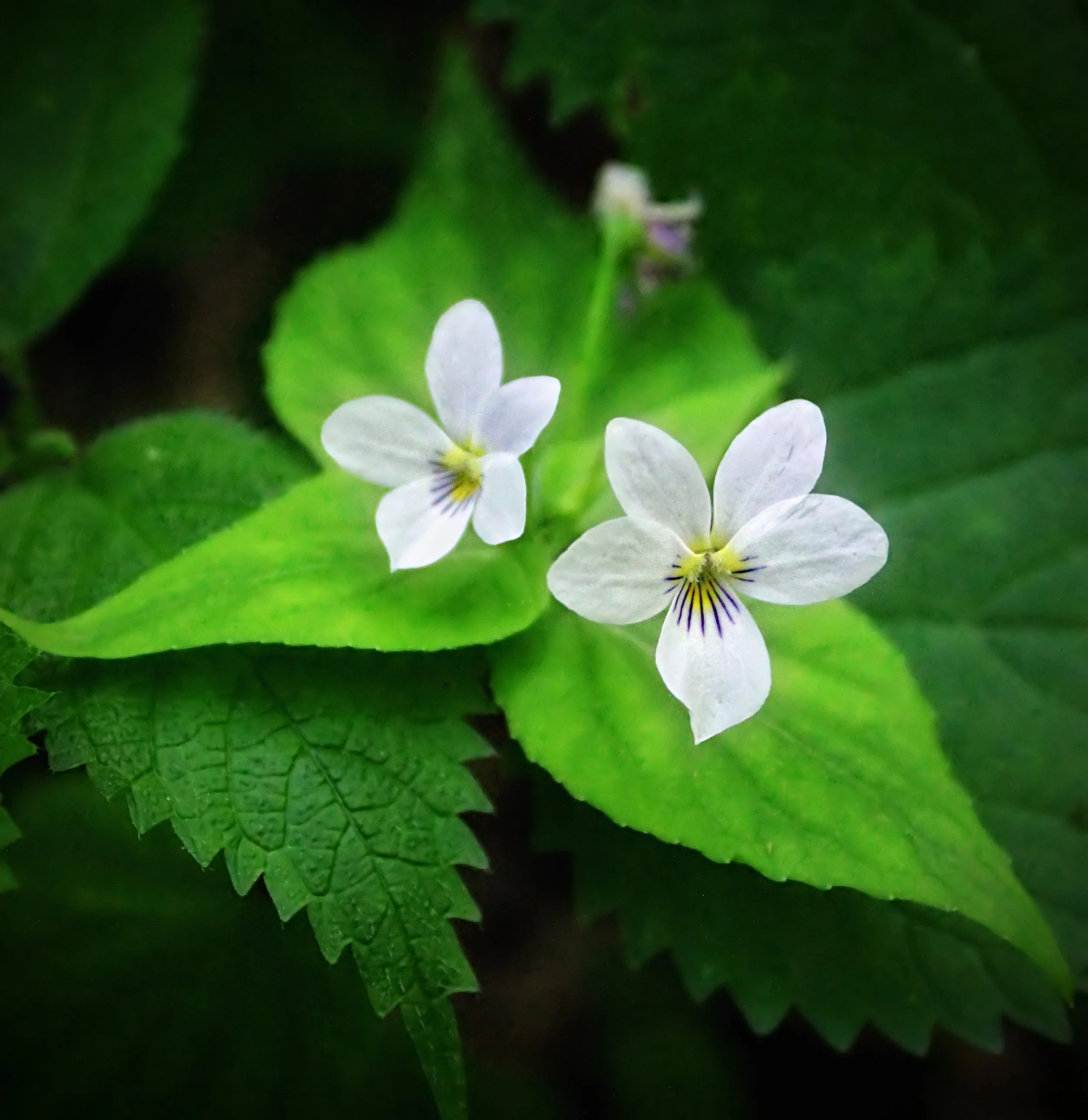
White Violets by Nicholas T licenced under Creative Commons 2.0