
Harvest Thanksgiving Year B
Rev Emily E Ewing
From the good of the earth and its harvest to our worries and relationship with the divine, this year’s Harvest Thanksgiving readings are rich with connections. Joel’s proclamation of joy first for the earth and then for the children of Zion reminds us of the centrality of the more than human parts of creation while also affirming, along with Psalm 126 and Matthew 6, God’s presence in providing and caring for humanity. 1 Timothy’s call to pray for rulers connects the importance of peace with God’s relationship to humanity. As many celebrate and give thanks for the harvest in worship this week and many throughout the world continue to suffer from the devastation of increasingly extreme weather, centering on God’s relationship with the land opens possibilities for accountability, repentance, and calls to action.
Commentary
-
As the second part of Joel begins, it shifts from the devastation of military invasion into the anticipation of comfort for the oppressed.
Verse 21
The prophet Joel calls the soil, quick to soak up the toxins of war and to nourish the whole creation, to rejoice.
Verse 22
From animals in the field to pastures and fruit trees, all receive God’s abundance.
Verse 23
Abundant rain, both early and late, sounds great, unless your community floods easily.
Verse 24
The abundant harvest of grain, wine, and oil provides what is necessary for God’s nourishment, even at the Holy Eucharist.
Verse 25
Swarms of locust and destructive bugs represent a military might devastating land and crops
Verse 26-27
The celebration of God’s presence through an abundant harvest calls into question why some today remain without enough food to eat.
-
A psalm of praise, the restoration of the people of Israel through God’s provision is like a dream, evoking farming and harvest imagery to shift from sorrow to joy.
Verse 4
The cool, thirst quenching water of the Negeb desert evokes how very precious God’s help is to the psalmist and their community.
Verse 5-6
The imagery of going out in sorrow to plant seeds, allowing the grief to die and be buried in the ground, provides the nourishment necessary for another life of joy and abundance.
-
Coming just before the author’s admonishment of women’s leadership, this 1 Timothy reading begs intentional and contextual reading. While this passage focuses on prayer for rulers and a reminder of God’s relationship with humanity, it is also written by psuedo-Paul, instructing a community, rather than describing one. 1 Timothy is much more concerned with power structures and gendered hierarchies than other epistles, which in this passage will provide for a life free of conflict or harm for believers.
Verse 2
The prayer for rulers in the hope of “a quiet and peaceable life” echoes with Joel’s “swarming locust” to remind us of the devastation of war in a time when the world feels dangerously near global destruction.
Verses 5-6
God’s relationship with humanity is one of liberation with “ransom” freeing the enslaved or paying to free a life from retribution.
-
In Matthew, Jesus continues the sermon on the mount, providing reassurance of God’s care and provision in the context of the values of the reign of heaven where wealth is measured through faithful living.
Verse 25, 27
Worrying does not add to life in quality or quantity.
Verse 26
Even the birds are cared for.
Verse 28-29
The lilies of the field, who do not work, rank higher in beauty than Solomon, one of the most famous kings of Israel.
Verse 30
God clothes even grass and so will of course clothe each person.
Verse 31
God nourishes and provides for humanity.
Verse 33
Prioritizing the reign of God and God’s righteousness allows the rest to fall into place.
Teaching and Preaching Suggestions
Humanity’s Capacity for Devastation
Both Joel and 1 Timothy hint at the capacity of humans to cause great devastation. Joel uses the imagery of locusts and grasshoppers to depict the damage of military powers, wiping out crops and lands. 1 Timothy’s prayer for rulers is a prayer for peace and freedom of faith, recognizing the harm that a ruler’s power can cause. As we’ve just passed the one year mark for the escalated conflict in the Middle East, the devastation of the land and peoples at the hands of rulers who cling to power begs for greater care. Genocide, war crimes, and displacement join with the destruction of ancient groves of olive trees, the construction of walls, and the separation of people who hold sacred the same land. Ukraine, the “Breadbasket of Europe”, struggles still to defend its land and people from Russian aggression, pushing back in what feels like a never-ending conflict.
Children and young adults today do not know a world without disaster, war, and danger. The world God calls humanity to is one where soil, the precious darkness that nourishes new life, is called to “be glad and rejoice, for the BECOMING ONE has done great things!” The devastation of war is not the only way. The call to end military violence is a call to peace and care for creation.
Abundance and Food Scarcity
Celebrating Harvest Thanksgiving with these readings is easy. The connections between Joel’s visions of abundance for everything from soil to animals to fruit trees and vines is reflected all around us as squash, apples, and other autumn produce abound at pop-up food stalls, in grocery stores, and at farmers’ markets. The rain and grain abound, and God says “You shall eat in plenty and be satisfied.” Jesus says the birds are fed, the lilies are clothed, you will be ok.
There is more than enough in the world of Joel and of Jesus, yet over 150 million more people are facing hunger now than five years ago. In a celebration and thanksgiving for the abundance of the earth, the call to end hunger, to feed everyone, cannot be skipped. The abundance that God calls for in Joel, the psalm, and in Matthew is one for the whole community, the whole world, not for a few elect to hoard. 1 Timothy’s prayer “for rulers and all who are in high positions” reminds us that we have power to influence and change the course of our governing bodies. We have the power to feed the hungry and call our leaders to as well.
The call to not worry, from Jesus to a crowd of people who have not had enough to eat and to share the way that they might like, rings true with the knowledge that Jesus also has wandered and eaten what was given in hospitality. It rings hollow, however, when proclaimed by those who have always had enough, who spend their excess on that which harms the earth rather than providing for those in need. Where is the hunger in your community? What is the need? How can you participate in God’s abundance for your community and the world?
The Power of Creation
God provides for all of creation, from birds and lilies to earth and earthlings. Creation responds to God, enjoying God’s abundance, seeking out nourishment. God rains on the earth that the plants and animals might grow. And as we have seen in recent weeks, the rain is not always good. Entire towns have been swept away in the devastation of Hurricane Helene, floods have devastated everywhere from Oman and Afghanistan to Uruguay, Argentina, and Germany. As climate change accelerates, weather becomes more extreme, causing extreme heat and dryness followed by torrential downpours, taking soil with it. For too many, rain prompts more terror than the joy evoked by the psalmist when referring to the watercourses in the Negeb desert.
The rain that allows the crops to grow needs balance as much as any of us do. As many begin the long, slow process of recovery, Harvest Thanksgiving is a perfect time to collect funds, food, and supplies for those who are devastated. Both Lutheran Disaster Response and Episcopal Relief and Development are providing resources, care, and recovery around the world and in specific response to Hurricane Helene’s devastation. Responding with gratitude by helping others is the call of our faith. In response to God’s abundant love for us, we love others. In response to devastation, we help. It’s how “those who sow in tears reap with shouts of joy.”
Sources and Resources
Michael Carden, “The Book of the Twelve Minor Prophets”, Queer Bible Commentary
Robert E. Goss and Deborah Krause, “1 and 2 Timothy, and Titus”, Queer Bible Commentary
Pablo R. Andiñach, “Joel”, Global Bible Commentary
Elsa Tamez, “1 Timothy”, Global Bible Commentary
Aaron M. Gale, “Introduction and Annotations in Matthew”, The Jewish Annotated New Testament
Action Against Hunger, “World Hunger Facts”, https://www.actionagainsthunger.org/the-hunger-crisis/world-hunger-facts/
Contributor Bio
Rev. Emily E. Ewing (they/them) is a Lutheran (ELCA) pastor serving in Baltimore, Maryland. They combine creativity, spirituality, nerdiness, and the call to justice in many ways. Pastor Emily cohosts and coproduces the Nerds At Church podcast as well as cohosts the Horror Nerds At Church podcast. They consult with communities of faith for anti-oppression trainings, Praying in Color spiritual practices, and whatever the Spirit calls them to.
Image Description
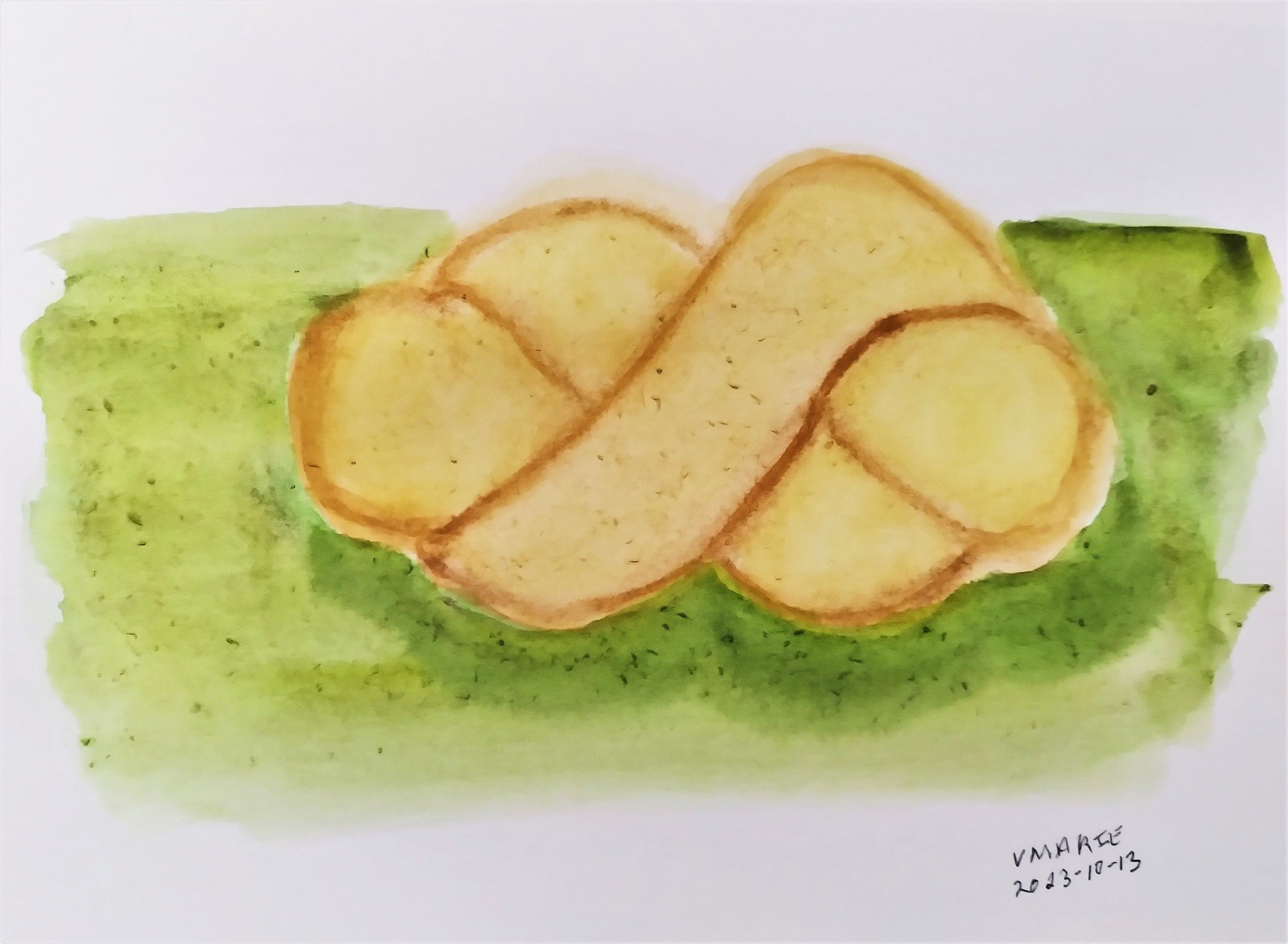
A watercolor painting on white paper depicts a speckled and braided loaf of challah bread sitting on a speckled green background. The bottom right corner reads V MARIE 2023-10-13